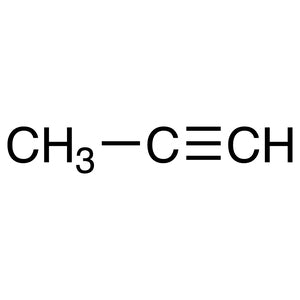
Propyne, with the CAS number 74-99-7, is an organic compound widely used in chemical reactions, particularly in conjugation chemistry and click chemistry. As a member of the alkyne family, it plays a crucial role in synthetic pathways that require alkynes for the formation of complex molecules or the modification of biological molecules. This product is available as a liquid solution dissolved in tetrahydrofuran (THF) at approximately 1 mol/L, making it highly convenient for use in laboratory settings. Its versatility allows it to be employed in various applications, including the synthesis of pharmaceutical compounds and biologically relevant molecules.
Propyne is valued for its chemical stability under controlled conditions and its reactivity in specific environments, such as high temperatures or exposure to UV light. The high concentration in THF eliminates the need for additional solvents, streamlining the reaction process. Its solubility in THF also ensures consistent performance across different experimental scales, from small-scale research to larger industrial applications. These properties make it a preferred choice for chemists working in both academic and research environments.
In Indonesian laboratories, propyne is a key reagent for researchers in pure chemistry, biochemistry, and pharmaceutical sciences. Its availability and ease of use make it an essential component in the development of new chemical compounds and in the study of molecular interactions. Many research institutions and universities in Indonesia rely on propyne for experiments that require precise chemical reactivity and controlled reaction conditions.
TCI brochures (PDF)
- Safely Handleable Volatile Solutions 2024-05-02 · p. 2
- DualSeal ― Airtight-Double-Cap Bottled Reagents 2024-08-13 · p. 4
- Click Chemistry 2026-09-08 · p. 10
Related TCI products
- TCI P3067 74-99-7 Propyne (ca 2% in Hexane, ca 03 mol/L)
- TCI P3066 74-99-7 Propyne (ca 2% in Toluene, ca 04 mol/L)
- TCI P3065 74-99-7 Propyne (ca 2% in Dichloromethane, ca 07 mol/L)
- TCI P2152 74-99-7 Propyne (ca 4% in N,N-Dimethylformamide, ca 10mol/L)
- TCI I0911 115-11-7 Isobutene (ca. 15% in Tetrahydrofuran)
- TCI V0127 593-60-2 Vinyl Bromide (ca. 12% in Tetrahydrofuran, ca. 1.0mol/L)
- Conjugation Chemistry: Propyne is ideal for conjugation reactions due to its ability to form stable intermediates, enhancing the efficiency of molecular linkage processes.
- Click Chemistry: The compound is widely used in click chemistry for its rapid and selective reaction with azides, enabling the synthesis of complex molecules with high yield.
- Pharmaceutical Synthesis: Its reactivity makes it a valuable reagent in the development of new drug compounds, particularly in the modification of functional groups.
- Bioconjugation Studies: Propyne is used in bioconjugation experiments to link biomolecules, facilitating the study of molecular interactions in biological systems.
- Organic Synthesis: Its versatility supports a wide range of organic reactions, making it a go-to reagent for synthetic chemists in both research and industrial settings.
| Brand | TCI |
|---|---|
| CAS number | 74-99-7 |
| Molecular formula | — |
| Purity | — |
| Category | Chemistry > Chemical Biology > Conjugation Chemistry/Click Chemistry |
| Pack sizes | — |
| Physical form | Liquid |
| Storage | Store in a cool, dark place away from heat and direct sunlight |
Propyne should be stored in a cool, dark place, away from heat and direct sunlight to maintain its chemical stability. It is recommended to use airtight containers made of materials that are chemically inert, such as glass or stainless steel, to prevent any unwanted reactions. Due to its reactivity under certain conditions, it is important to handle the compound with care, using appropriate personal protective equipment. In laboratory settings, it should be kept in a well-ventilated area to minimize exposure. Proper labeling and storage practices are essential to ensure safety and prevent accidental contamination. Always follow standard laboratory safety protocols when working with this compound.
—
Product Categories
Produk Terkait
-
Propyne(ca2%inHexane,ca03mol/L) TCI P3067
Regular price From Rp 1.087.800,00Regular price -
Propyne(ca2%inToluene,ca04mol/L) TCI P3066
Regular price From Rp 1.087.800,00Regular price -
Propyne(ca2%inDichloromethane,ca07mol/L) TCI P3065
Regular price From Rp 1.087.800,00Regular price -
Propyne(ca4%inN,N-Dimethylformamide,ca10mol/L) TCI P2152
Regular price From Rp 1.087.800,00Regular price -
Isobutene(ca.15%inTetrahydrofuran) TCI I0911
Regular price From Rp 903.000,00Regular price -
VinylBromide(ca.12%inTetrahydrofuran,ca.1.0mol/L) TCI V0127
Regular price Rp 2.545.200,00Regular price -
SulfurDioxide(ca8%inTetrahydrofuran,ca12mol/L) TCI U0147
Regular price From Rp 1.458.450,00Regular price -
Trifluoroiodomethane(ca.10%inTetrahydrofuran,ca.0.5mol/L) TCI T3957
Regular price From Rp 1.776.600,00Regular price