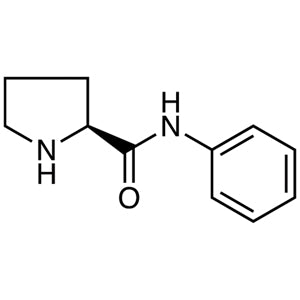
L-Prolinanilide from TCI is an amide derivative of the amino acid L-proline in which the carboxyl group has been converted into an anilide, an amide formed with aniline. This chiral compound belongs to the group of chiral catalysts, chiral ligands and chiral reagents used in asymmetric synthesis. In the laboratory, prolinamides like this one serve as organocatalysts in carbon–carbon bond-forming reactions such as the asymmetric aldol reaction. They are also used as starting materials for designing more advanced chiral catalysts and ligands.
Chemists choose this material because it combines the natural chiral centre of L-proline with an amide group that can form hydrogen bonds. The secondary amine in the pyrrolidine ring can form enamine intermediates with carbonyl compounds. At the same time, the amide N–H can help direct the incoming electrophile through hydrogen bonding, so the reaction can proceed stereoselectively. The anilide group can also be modified with substituents on the aromatic ring to tune the acidity of the N–H and the steric profile of the catalyst. This makes the compound a useful starting point for organocatalyst development studies.
In Indonesia, organic synthesis laboratories are the main users of this compound, especially research groups in organic chemistry, pharmaceutical chemistry and green chemistry. Organocatalysts based on L-proline do not need metals and work under relatively simple conditions, which makes them a good fit for university and institutional research on more sustainable synthetic methods. The compound also suits teaching and thesis projects that explore stereoselective reactions, catalyst design and the relationship between catalyst structure and the selectivity of asymmetric transformations.
Related TCI products
- TCI T3080 1089663-51-3 N-(2-Thiophenesulfonyl)-L-prolinamide
- TCI B3440 259212-61-8 trans-4-(tert-Butyldiphenylsilyloxy)-L-proline
- TCI A0945 64030-44-0 (S)-(+)-2-(Anilinomethyl)pyrrolidine
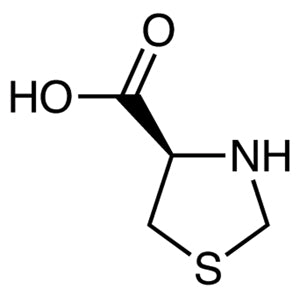
- TCI T0219 34592-47-7 L-Thioproline
- TCI P2083 62937-45-5 D-Prolinamide
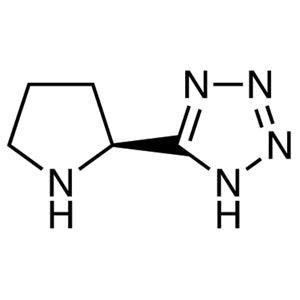
- TCI P1784 33878-70-5 (S)-5-(Pyrrolidin-2-yl)-1H-tetrazole
- Asymmetric aldol reactions: L-Prolinanilide can act as an organocatalyst. Its pyrrolidine amine forms enamine intermediates with carbonyl donors, and its amide N–H helps control the stereochemical outcome.
- Carbon–carbon bond formation studies: As a chiral prolinamide, it lets researchers study how enamine catalysis and hydrogen-bond direction work together to build new stereocentres selectively.
- Organocatalyst development: Substituents can be added to the anilide ring to adjust N–H acidity and steric bulk, so the compound is a practical scaffold for designing and comparing new catalysts.
- Chiral ligand and reagent design: The compound provides the natural chiral centre of L-proline together with a modifiable amide group, which makes it a convenient building block for more advanced chiral ligands and reagents.
- Green chemistry and metal-free synthesis research: As an amino-acid-derived organocatalyst, it supports studies of metal-free asymmetric methods, which suits sustainability-focused research groups in academic and pharmaceutical laboratories.
| Brand | TCI |
|---|---|
| CAS number | 64030-43-9 |
| Molecular formula | — |
| Purity | — |
| Category | Chemistry > Asymmetric Synthesis > Chiral Catalysts, Chiral Ligands, Chiral Reagents |
| Pack sizes | as listed by TCI for product P2430; see the product label and supplier documentation |
| Physical form | — |
| Storage | follow the storage conditions on the TCI label and Safety Data Sheet |
- Product code: P2430
Store L-Prolinanilide in its original, tightly closed container in a cool, dry and well-ventilated place, away from direct sunlight, heat sources and incompatible substances such as strong oxidising agents. Follow the specific storage temperature on the TCI label and Safety Data Sheet. Re-seal the container promptly after use to protect it from moisture and contamination. Handle the compound in a fume hood or well-ventilated area while wearing a lab coat, safety glasses and chemical-resistant gloves. Avoid creating dust, inhaling it, or letting it touch your skin or eyes. Clean up spills promptly, and dispose of waste according to local regulations and your institution's chemical waste procedures.
—
Product Categories
Produk Terkait
-
N-(2-Thiophenesulfonyl)-L-prolinamide TCI T3080
Regular price Rp 3.155.250,00Regular price -
trans-4-(tert-Butyldiphenylsilyloxy)-L-proline TCI B3440
Regular price From Rp 4.823.700,00Regular price -
(S)-(+)-2-(Anilinomethyl)pyrrolidine TCI A0945
Regular price From Rp 1.829.100,00Regular price -
L-Thioproline TCI T0219
Regular price From Rp 1.590.750,00Regular price -
D-Prolinamide TCI P2083
Regular price From Rp 1.087.800,00Regular price -
(S)-5-(Pyrrolidin-2-yl)-1H-tetrazole TCI P1784
Regular price From Rp 1.696.800,00Regular price -
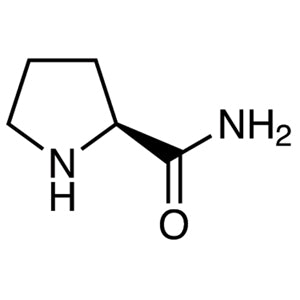
L-Prolinamide TCI P1382
Regular price From Rp 530.250,00Regular price -
(S)-(+)-1-(2-Pyrrolidinylmethyl)pyrrolidine TCI P1241
Regular price From Rp 2.279.550,00Regular price