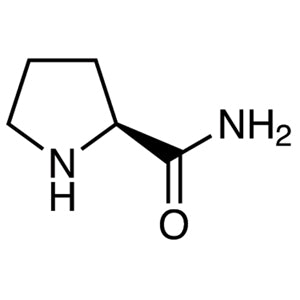
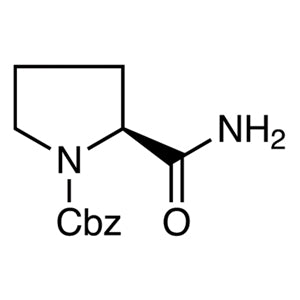
D-Prolinamide is a chemical compound widely used in asymmetric synthesis, particularly in the creation of molecules with specific chirality. This compound plays a critical role in laboratory settings where precise control over molecular structure is essential. It is commonly employed in organic chemistry and pharmacology to facilitate reactions that require the synthesis of complex, stereochemically defined compounds. Its utility spans across various research areas, making it an indispensable tool for scientists working on advanced chemical processes.
The stability of D-Prolinamide under certain conditions makes it a preferred choice for synthetic applications. Its ability to form bonds with a variety of functional groups enhances its versatility in different chemical reactions. This adaptability allows researchers to design and execute a wide range of synthetic pathways efficiently. Additionally, its chemical properties ensure minimal degradation during synthesis, maintaining the integrity of the final product. These characteristics contribute to its widespread use in both academic and industrial research environments.
In Indonesian laboratories, D-Prolinamide is a key component in the study of organic chemistry and asymmetric synthesis. It is frequently used in research related to drug development, bioactive compounds, and advanced materials. Its availability and reliability make it a preferred choice for researchers aiming to achieve high-quality results in complex chemical processes. The compound's role in both fundamental and applied research underscores its importance in the scientific community.
TCI brochures (PDF)
- Asymmetric Organocatalysts 2025-06-12 · p. 7
- Chiral Building Blocks 2025-04-14 · p. 2
- Asymmetric Synthesis: D-Prolinamide is ideal for creating chiral molecules due to its ability to influence stereochemical outcomes in reactions.
- Pharmaceutical Research: It supports the development of new drugs by enabling the synthesis of bioactive compounds with specific stereochemistry.
- Organic Chemistry Studies: Its versatility in forming bonds with functional groups makes it suitable for a wide range of synthetic reactions.
- Material Science: It is used in the synthesis of advanced organic materials that require precise molecular structures.
- Bioactive Compound Development: D-Prolinamide aids in the creation of compounds with specific biological activities, supporting drug discovery efforts.
| Brand | TCI |
|---|---|
| CAS number | 62937-45-5 |
| Molecular formula | — |
| Purity | — |
| Category | Chemistry > Asymmetric Synthesis > Chiral Building Blocks |
| Pack sizes | Available in various quantities as per supplier specifications |
| Physical form | Solid (as per standard product description) |
| Storage | Store in a cool, dry place away from moisture and direct sunlight |
D-Prolinamide should be stored in a cool, dry environment to maintain its chemical stability. It is recommended to keep the compound in a sealed container to prevent exposure to moisture and air. Suitable storage containers include glass or high-density polyethylene vessels that are resistant to chemical reactions. In laboratory settings, it is important to handle the compound with care, using appropriate personal protective equipment such as gloves and safety goggles. Avoid direct contact with skin and inhalation of vapors. Proper labeling of storage containers is essential for safe handling and to ensure that the compound remains accessible for research purposes. Regular inspection of storage conditions is advised to maintain the integrity of the material.
—
Product Categories
- Asymmetric SynthesisChiral Building BlocksChiral Heterocyclic Building Blocks
- Asymmetric SynthesisChiral Catalysts, Chiral Ligands, Chiral ReagentsProline-Based Organocatalysts [Asymmetric Synthesis]
- Building BlocksChiral Building BlocksChiral Heterocyclic Building Blocks
- Catalysis and Inorganic ChemistryOrganocatalysts [Catalysis]Asymmetric Organocatalysts
- Chemical BiologyPeptide ChemistryAmino Acid Derivatives [Peptide Chemistry]
- Pharmaceutical Development and Drug Discovery Research ReagentsPeptide ChemistryAmino Acid Derivatives [Peptide Chemistry]
Produk Terkait
-
L-Prolinamide TCI P1382
Regular price Rp 582.750,00Regular priceRp 423.150,00Sale price Rp 582.750,00 -
N-(2-Thiophenesulfonyl)-L-prolinamide TCI T3080
Regular price Rp 3.207.750,00Regular priceRp 2.258.550,00Sale price Rp 3.207.750,00 -
N-(tert-Butoxycarbonyl)-L-prolinamide TCI B3756
Regular price Rp 900.900,00Regular priceRp 645.750,00Sale price Rp 900.900,00 -
N-Carbobenzoxy-L-prolinamide TCI C3005
Regular price Rp 980.700,00Regular priceRp 701.400,00Sale price Rp 980.700,00 -
D-Proline TCI P0994
Regular price Rp 1.431.150,00Regular priceRp 1.016.400,00Sale price Rp 1.431.150,00 -
L-Proline TCI P0481
Regular price Rp 1.033.200,00Regular priceRp 738.150,00Sale price Rp 1.033.200,00 -
L-TryptophanamideHydrochloride TCI T2312
Regular price Rp 2.068.500,00Regular priceRp 1.461.600,00Sale price Rp 2.068.500,00 -
(S)-(-)-1-Methyl-2-(1-piperidinomethyl)pyrrolidine TCI M1183
Regular price Rp 3.763.200,00Regular priceRp 2.647.050,00Sale price Rp 3.763.200,00