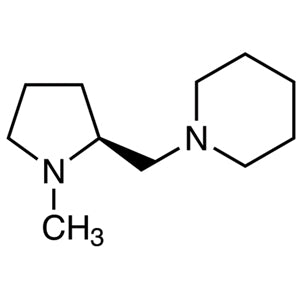
(S)-(-)-1-Methyl-2-(1-piperidinomethyl)pyrrolidine is a chiral diamine that combines an N-methylated pyrrolidine ring with a piperidinylmethyl group at the 2-position. This arrangement places two tertiary nitrogen atoms at precisely the right distance to function as a bidentate ligand — a molecule that binds a single metal center through two coordination points at once. In asymmetric synthesis laboratories, compounds of this type are used to bind and orient organometallic reagents so that attack on a prochiral substrate occurs predominantly on one face of the molecule, yielding a product enriched in a single enantiomer.
The characteristics that make this compound attractive are the combination of strong Lewis basicity from its two tertiary nitrogens with a rigid chiral framework. The pyrrolidine ring restricts conformational freedom, while the larger piperidine ring provides directed steric hindrance around the coordination center. Because both nitrogen atoms are tertiary, the compound carries no N–H protons that could interfere with organolithium or Grignard reagents, making it suitable for use under strongly basic conditions. The (S) configuration with negative optical rotation gives the material a clear stereochemical identity for reproducible work.
In Indonesian laboratories, this chiral building block is typically encountered in university and institutional research groups working on enantioselective methodology, in pharmaceutical development laboratories exploring routes to single-enantiomer intermediates, and in synthetic chemistry teaching programmes at the graduate level. It is normally handled in small quantities under inert atmosphere on a Schlenk line or in a glovebox, alongside anhydrous solvents and the organometallic reagents whose selectivity it is intended to control.
TCI brochures (PDF)
- Asymmetric Organocatalysts 2025-06-12 · p. 7
- Asymmetric Synthesis 2026-03-18 · p. 8
- Chiral Building Blocks 2025-04-14 · p. 3
Related TCI products
- TCI A0945 64030-44-0 (S)-(+)-2-(Anilinomethyl)pyrrolidine
- TCI P1241 51207-66-0 (S)-(+)-1-(2-Pyrrolidinylmethyl)pyrrolidine
- TCI M1169 84025-81-0 (R)-2-(Methoxymethyl)pyrrolidine
- TCI M1161 63126-47-6 (S)-2-(Methoxymethyl)pyrrolidine
- TCI B6611 848821-61-4 (2S)-2-[Bis[3,5-bis(trifluoromethyl)phenyl][(trimethylsilyl)oxy]methyl]pyrrolidine
- TCI P2083 62937-45-5 D-Prolinamide
- Enantioselective organolithium additions — the two tertiary nitrogens chelate the lithium center and create a chiral environment that biases addition to one face of a prochiral carbonyl substrate.
- Asymmetric Grignard reactions — the ligand coordinates the magnesium center without any N–H protons to quench the reagent, allowing facial selectivity to be imposed under strongly basic conditions.
- Chiral ligand screening studies — its rigid pyrrolidine backbone and defined (S) configuration make it a useful reference entry when comparing bidentate diamine ligands for a new transformation.
- Enantioselective deprotonation methodology — the compound can direct strong bases toward one of two enantiotopic protons, generating configurationally defined carbanion intermediates for further functionalisation.
- Chiral auxiliary and intermediate synthesis — as a building block bearing a defined stereocenter, it serves as a starting point for preparing more elaborate ligands and auxiliaries in research-scale routes.
| Brand | TCI |
|---|---|
| CAS number | 84466-85-3 |
| Molecular formula | — |
| Purity | — |
| Category | Chemistry > Asymmetric Synthesis > Chiral Building Blocks |
| Pack sizes | research-scale packs; available sizes confirmed at time of order |
| Physical form | — |
| Storage | store in a cool, dark place under inert gas, in a tightly sealed container |
- Catalogue number: M1183
Store the container tightly closed in a cool, dark place, preferably under an inert gas atmosphere such as nitrogen or argon, since tertiary amines of this type are sensitive to air and moisture. Keep the material in its original glass container with a chemically resistant closure, and avoid transferring it to containers whose seals have not been verified. Handle in a working fume hood using nitrile gloves, safety goggles, and a laboratory coat. Amines are corrosive and have a strong odour, so avoid inhalation and skin contact. Withdraw aliquots using dry syringes or cannula technique to limit atmospheric exposure, and keep the compound away from strong acids and oxidising agents. Consult the manufacturer's safety data sheet before first use.
—
Product Categories
- Asymmetric SynthesisChiral Building BlocksChiral Heterocyclic Building Blocks
- Asymmetric SynthesisChiral Catalysts, Chiral Ligands, Chiral ReagentsProline-Based Organocatalysts [Asymmetric Synthesis]
- Building BlocksChiral Building BlocksChiral Heterocyclic Building Blocks
- Catalysis and Inorganic ChemistryOrganocatalysts [Catalysis]Asymmetric Organocatalysts
Produk Terkait
-
(S)-(+)-2-(Anilinomethyl)pyrrolidine TCI A0945
Regular price Rp 1.881.600,00Regular priceRp 1.331.400,00Sale price Rp 1.881.600,00 -
(S)-(+)-1-(2-Pyrrolidinylmethyl)pyrrolidine TCI P1241
Regular price Rp 2.332.050,00Regular priceRp 1.646.400,00Sale price Rp 2.332.050,00 -
(R)-2-(Methoxymethyl)pyrrolidine TCI M1169
Regular price Rp 3.578.400,00Regular priceRp 2.517.900,00Sale price Rp 3.578.400,00 -
(S)-2-(Methoxymethyl)pyrrolidine TCI M1161
Regular price Rp 3.285.450,00Regular priceRp 2.313.150,00Sale price Rp 3.285.450,00 -
(2S)-2-[Bis[3,5-bis(trifluoromethyl)phenyl][(trimethylsilyl)oxy]methyl]pyrrolidine TCI B6611
Regular price Rp 7.182.000,00Regular priceRp 5.037.900,00Sale price Rp 7.182.000,00 -
D-Prolinamide TCI P2083
Regular price Rp 1.140.300,00Regular priceRp 812.700,00Sale price Rp 1.140.300,00 -
L-Prolinamide TCI P1382
Regular price Rp 582.750,00Regular priceRp 423.150,00Sale price Rp 582.750,00 -
(3R)-(+)-3-(Trifluoroacetamido)pyrrolidineHydrochloride TCI T1369
Regular price Rp 2.439.150,00Regular priceRp 1.720.950,00Sale price Rp 2.439.150,00


![(2S)-2-[Bis[3,5-bis(trifluoromethyl)phenyl][(trimethylsilyl)oxy]methyl]pyrrolidine (CAS 848821-61-4) - TCI B6611 - AMI Scientific](http://amiscientific.com/cdn/shop/files/TCI2510B6611.jpg?v=1767094028&width=533)