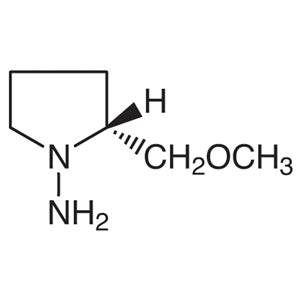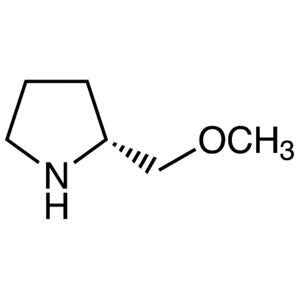
(R)-2-(Methoxymethyl)pyrrolidine is the enantiomeric counterpart of SMP and is widely known by the abbreviation RMP. The compound is a chiral cyclic amine bearing a stereogenic centre of (R) configuration at position 2 of the pyrrolidine ring. In the laboratory its role is identical to that of its partner enantiomer, namely to install chiral information into a chemical transformation, but with the opposite direction of induction. Its availability allows researchers to access both configurations of a target product simply by switching the chiral reagent, without having to redesign an entire synthetic route that has already been optimised.
The property that makes this compound valuable is the conformational rigidity of the pyrrolidine ring combined with the methoxymethyl group, which acts simultaneously as a steric director and an electron donor. This combination generates a tightly defined chiral environment around the nitrogen atom, so that discrimination between the two prochiral faces of a substrate proceeds effectively. The secondary amine nitrogen nevertheless remains reactive enough to form enamines, hydrazones, carbamates and amides, giving the chemist a broad choice of derivatisation chemistry from a single starting reagent.
Because the material is generally liquid at room temperature, addition to a reaction mixture can be carried out volumetrically with a micropipette or a syringe. This suits the working practice of Indonesian laboratories, where asymmetric synthesis is typically performed on small to moderate scale in university research groups, graduate research projects and pharmaceutical or fine-chemical development units that need both enantiomeric series of a product for comparative evaluation.
TCI brochures (PDF)
- Asymmetric Organocatalysts 2025-06-12 · p. 7
- Asymmetric Synthesis 2026-03-18 · p. 8
Related TCI products
- TCI M1161 63126-47-6 (S)-2-(Methoxymethyl)pyrrolidine
- TCI A0945 64030-44-0 (S)-(+)-2-(Anilinomethyl)pyrrolidine
- TCI P1241 51207-66-0 (S)-(+)-1-(2-Pyrrolidinylmethyl)pyrrolidine
- TCI M1183 84466-85-3 (S)-(-)-1-Methyl-2-(1-piperidinomethyl)pyrrolidine
- TCI B6611 848821-61-4 (2S)-2-[Bis[3,5-bis(trifluoromethyl)phenyl][(trimethylsilyl)oxy]methyl]pyrrolidine
- TCI T3080 1089663-51-3 N-(2-Thiophenesulfonyl)-L-prolinamide
- Asymmetric enamine chemistry — the secondary amine condenses readily with carbonyl substrates, and the rigid chiral pocket around nitrogen directs the approaching electrophile to one prochiral face.
- Chiral auxiliary attachment — the nitrogen forms stable amides and carbamates with substrates, carrying stereochemical information through subsequent steps before being removed again.
- Chiral hydrazone formation — conversion to the corresponding hydrazone derivative provides a stereodirecting handle for alkylation work that requires reliable facial discrimination at the carbonyl carbon.
- Enantiodivergent route development — using RMP in place of SMP reverses the sense of induction, letting a laboratory obtain the opposite product configuration without redesigning an optimised synthesis.
- Chiral ligand preparation — the amine serves as a building block for ligands whose methoxymethyl oxygen can participate as an additional donor site in a coordinated metal centre.
| Brand | TCI |
|---|---|
| CAS number | 84025-81-0 |
| Molecular formula | — |
| Purity | — |
| Category | Chemistry > Asymmetric Synthesis > Chiral Catalysts, Chiral Ligands, Chiral Reagents |
| Pack sizes | available in the standard TCI research pack sizes; please confirm the size required when ordering |
| Physical form | generally liquid at room temperature, suitable for volumetric transfer by micropipette or syringe |
| Storage | keep tightly closed in the original container under the conditions stated on the manufacturer's label |
- Catalogue reference: M1169
Store the container tightly closed in a cool, dry and well-ventilated area, away from heat sources, direct sunlight and incompatible materials, following the conditions stated on the manufacturer's label and safety data sheet. Keep the material in its original supplier container, or in a chemically compatible sealed glass vessel if transfer is necessary, and reseal immediately after each withdrawal because amines readily absorb atmospheric moisture and carbon dioxide. Handle only in a functioning fume hood while wearing safety goggles, a laboratory coat and chemically resistant gloves. Use clean, dry syringes or pipettes for each transfer to avoid contamination, and label all secondary containers clearly. Consult the manufacturer's safety data sheet before first use.
—
Produk Terkait
-
(S)-2-(Methoxymethyl)pyrrolidine TCI M1161
Regular price Rp 3.285.450,00Regular priceRp 2.313.150,00Sale price Rp 3.285.450,00 -
(S)-(+)-2-(Anilinomethyl)pyrrolidine TCI A0945
Regular price Rp 1.881.600,00Regular priceRp 1.331.400,00Sale price Rp 1.881.600,00 -
(S)-(+)-1-(2-Pyrrolidinylmethyl)pyrrolidine TCI P1241
Regular price Rp 2.332.050,00Regular priceRp 1.646.400,00Sale price Rp 2.332.050,00 -
(S)-(-)-1-Methyl-2-(1-piperidinomethyl)pyrrolidine TCI M1183
Regular price Rp 3.763.200,00Regular priceRp 2.647.050,00Sale price Rp 3.763.200,00 -
(2S)-2-[Bis[3,5-bis(trifluoromethyl)phenyl][(trimethylsilyl)oxy]methyl]pyrrolidine TCI B6611
Regular price Rp 7.182.000,00Regular priceRp 5.037.900,00Sale price Rp 7.182.000,00 -
N-(2-Thiophenesulfonyl)-L-prolinamide TCI T3080
Regular price Rp 3.207.750,00Regular priceRp 2.258.550,00Sale price Rp 3.207.750,00 -
trans-4-(tert-Butyldiphenylsilyloxy)-L-proline TCI B3440
Regular price Rp 4.876.200,00Regular priceRp 3.425.100,00Sale price Rp 4.876.200,00 -
(R)-(+)-1-Amino-2-(methoxymethyl)pyrrolidine TCI A1337
Regular price Rp 8.135.400,00Regular priceRp 5.704.650,00Sale price Rp 8.135.400,00


![(2S)-2-[Bis[3,5-bis(trifluoromethyl)phenyl][(trimethylsilyl)oxy]methyl]pyrrolidine (CAS 848821-61-4) - TCI B6611 - AMI Scientific](http://amiscientific.com/cdn/shop/files/TCI2510B6611.jpg?v=1767094028&width=533)