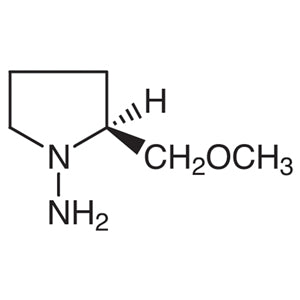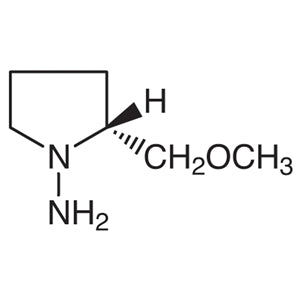
(R)-(+)-1-Amino-2-(methoxymethyl)pyrrolidine is a chiral building block widely used in asymmetric synthesis to create complex molecular structures with defined stereochemistry. This compound plays a crucial role in the development of pharmaceuticals and bioactive molecules, where the spatial arrangement of atoms significantly influences biological activity. In the laboratory, it serves as a versatile intermediate, enabling chemists to synthesize a wide range of chiral compounds with specific functional groups. Its presence allows for the construction of molecules with unique properties that are essential in drug discovery and chemical research.
The compound's chiral nature and functional groups, such as the amino and methoxymethyl moieties, make it a preferred choice for synthetic chemists. These features provide flexibility in further chemical modifications, allowing for the creation of diverse derivatives with tailored properties. Additionally, its chemical stability under controlled conditions ensures reliable performance in various synthetic processes. The compound’s ability to participate in multiple reaction pathways enhances its utility in both academic and industrial research settings.
In Indonesian laboratories, (R)-(+)-1-Amino-2-(methoxymethyl)pyrrolidine is commonly used in scientific research and the development of chemical products. It is a key component in studies related to biological activity, drug synthesis, and chemical innovation. Its availability and reliability make it a valuable tool for researchers and institutions focused on advancing chemical and pharmaceutical knowledge.
TCI brochures (PDF)
- Asymmetric Synthesis 2026-03-18 · p. 8
- Chiral Building Blocks 2025-04-14 · p. 3
Related TCI products
- TCI A1335 59983-39-0 (S)-(-)-1-Amino-2-(methoxymethyl)pyrrolidine
- TCI M1170 121817-71-8 (R)-(+)-2-(Methoxymethyl)-1-pyrrolidinecarboxaldehyde
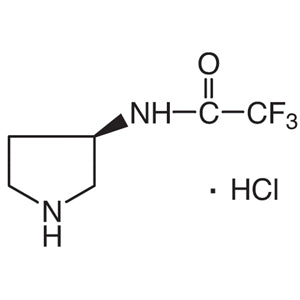
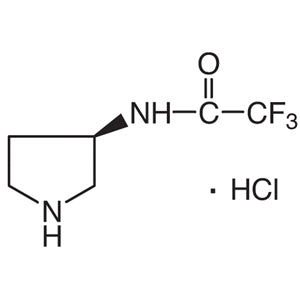
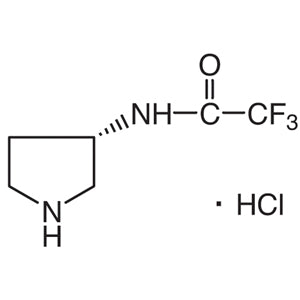
- TCI T1369 141043-16-5 (3R)-(+)-3-(Trifluoroacetamido)pyrrolidine Hydrochloride
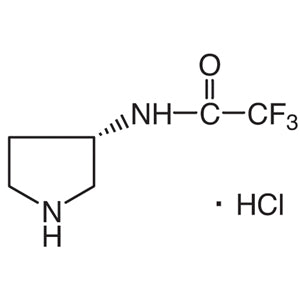
- TCI T1366 132883-43-3 (3S)-(-)-3-(Trifluoroacetamido)pyrrolidine Hydrochloride
- TCI B3662 61478-26-0 (2S,4R)-1-(tert-Butoxycarbonyl)-4-hydroxy-2-(hydroxymethyl)pyrrolidine
- TCI B1932 131878-23-4 (3R)-(+)-1-Benzyl-3-(tert-butoxycarbonylamino)pyrrolidine
- Asymmetric synthesis is a primary application where this compound enables the creation of chiral molecules with specific stereochemistry, essential for pharmaceutical development.
- Pharmaceutical research benefits from its use in synthesizing bioactive compounds, where stereochemistry directly affects drug efficacy and safety.
- Organic chemistry experiments often incorporate this compound to explore reaction mechanisms and functional group transformations in complex molecules.
- Drug discovery programs rely on its chiral structure to develop new therapeutic agents with targeted biological activity.
- Academic research institutions use it to study the properties of chiral compounds and their impact on molecular interactions and biological functions.
| Brand | TCI |
|---|---|
| CAS number | 72748-99-3 |
| Molecular formula | — |
| Purity | — |
| Category | Chemistry > Asymmetric Synthesis > Chiral Building Blocks |
| Pack sizes | Available in various quantities as per supplier specifications |
| Physical form | Solid or liquid, depending on the specific product variant |
| Storage | Store in a cool, dry place away from light and moisture |
This compound should be stored in a cool, dry place, away from direct light and moisture to maintain its chemical integrity. It is recommended to use airtight containers to prevent exposure to humidity and air, which could lead to degradation. In a laboratory setting, proper ventilation should be ensured when handling the compound to minimize inhalation risks. Personal protective equipment, such as gloves and safety goggles, should be worn during handling. The compound should not be stored near incompatible materials, such as strong oxidizers or acids, to avoid potential chemical reactions. Regular monitoring of storage conditions is advised to ensure the compound remains stable and suitable for use in research applications.
—
Produk Terkait
-
(S)-(-)-1-Amino-2-(methoxymethyl)pyrrolidine TCI A1335
Regular price From Rp 4.982.250,00Regular price -
(R)-(+)-2-(Methoxymethyl)-1-pyrrolidinecarboxaldehyde TCI M1170
Regular price Rp 1.458.450,00Regular price -
(3R)-(+)-3-(Trifluoroacetamido)pyrrolidineHydrochloride TCI T1369
Regular price From Rp 2.386.650,00Regular price -
(3S)-(-)-3-(Trifluoroacetamido)pyrrolidineHydrochloride TCI T1366
Regular price From Rp 1.298.850,00Regular price -
(2S,4R)-1-(tert-Butoxycarbonyl)-4-hydroxy-2-(hydroxymethyl)pyrrolidine TCI B3662
Regular price From Rp 1.273.650,00Regular price -
(3R)-(+)-1-Benzyl-3-(tert-butoxycarbonylamino)pyrrolidine TCI B1932
Regular price Rp 2.068.500,00Regular price -
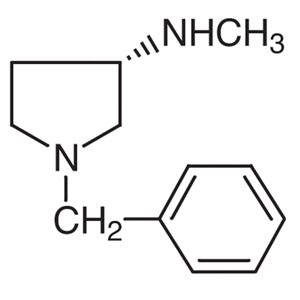
(3S)-(+)-1-Benzyl-3-(methylamino)pyrrolidine TCI B1583
Regular price From Rp 955.500,00Regular price -
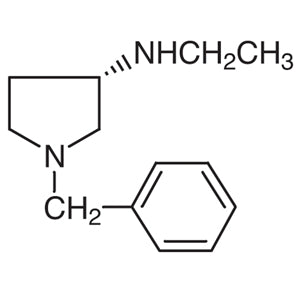
(3S)-(+)-1-Benzyl-3-(ethylamino)pyrrolidine TCI B1581
Regular price From Rp 2.199.750,00Regular price