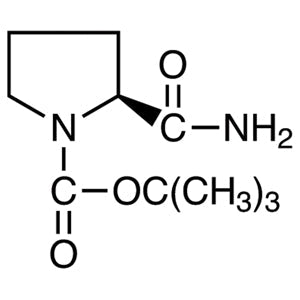
N-(tert-Butoxycarbonyl)-L-prolinamide is a chemical compound widely used in laboratory experiments involving chemical and biochemical research. It belongs to the category of peptide chemistry and is commonly employed in the synthesis of peptides and proteins. This compound serves as a derivative of proline, which gives it a complex molecular structure and makes it essential in peptide bond formation reactions. Its presence in various research settings highlights its importance in advancing biochemical and pharmaceutical studies.
The compound’s chemical stability under specific conditions makes it a preferred choice for synthetic processes in the laboratory. The tert-Butoxycarbonyl (Boc) group on its molecule provides resistance to hydrolysis, thereby extending its active lifetime in chemical reactions. This stability ensures that the compound remains effective during synthesis and manipulation, making it a reliable reagent for researchers. Its unique structural properties also allow for controlled chemical modifications, enhancing its utility in complex synthetic pathways.
In Indonesian laboratories, N-(tert-Butoxycarbonyl)-L-prolinamide is frequently used in biochemical and pharmacological research. It plays a crucial role in the development of bioactive compounds and in studying complex chemical reaction mechanisms. Its availability in the local market ensures that researchers and educational institutions can easily access this essential reagent for their experiments.
Related TCI products
- TCI P2083 62937-45-5 D-Prolinamide
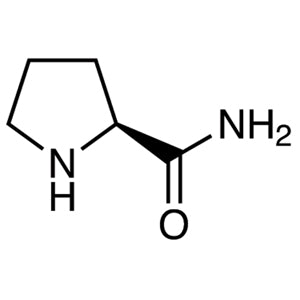
- TCI P1382 7531-52-4 L-Prolinamide
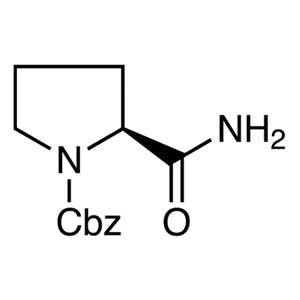
- TCI C3005 34079-31-7 N-Carbobenzoxy-L-prolinamide
- TCI B5350 68856-96-2 N-(tert-Butoxycarbonyl)-4-methoxy-D-phenylalanine
- TCI B5322 159622-10-3 (1R,2S)-1-[(tert-Butoxycarbonyl)amino]-2-vinylcyclopropanecarboxylic Acid
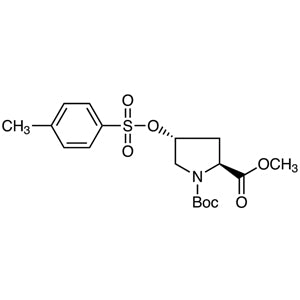
- TCI B5247 88043-21-4 N-(tert-Butoxycarbonyl)-trans-4-(p-toluenesulfonyloxy)-L-proline Methyl Ester
- Peptide Synthesis: This compound is ideal for synthesizing peptides and proteins due to its stable Boc group, which protects the amino group during reaction sequences.
- Biochemical Research: Its role in peptide bond formation makes it a key reagent in studying biochemical pathways and molecular interactions.
- Pharmaceutical Development: It is used in the creation of bioactive compounds, supporting drug discovery and development efforts.
- Organic Chemistry Experiments: The compound’s chemical stability allows it to be used in various organic synthesis reactions requiring controlled reactivity.
- Educational Research: It is commonly used in academic settings to teach and demonstrate peptide chemistry and synthetic methodologies.
| Brand | TCI |
|---|---|
| CAS number | 35150-07-3 |
| Molecular formula | — |
| Purity | — |
| Category | Chemistry > Chemical Biology > Peptide Chemistry |
| Pack sizes | Available in various quantities as per supplier specifications |
| Physical form | Solid powder |
| Storage | Store in a cool, dry place away from moisture and light |
This compound should be stored in a cool, dry environment to maintain its chemical stability. It is recommended to keep it in a sealed container to prevent exposure to moisture and air, which could affect its integrity. Due to its chemical nature, it should be handled with appropriate laboratory safety measures, such as wearing gloves and using a fume hood when necessary. Avoid direct contact with skin or inhalation of vapors. Ensure that storage conditions are consistent with standard chemical safety protocols to preserve its effectiveness and ensure safe handling in the laboratory.
—
Product Categories
Produk Terkait
-
D-Prolinamide TCI P2083
Regular price From Rp 1.140.300,00Regular priceRp 812.700,00Sale price From Rp 1.140.300,00 -
L-Prolinamide TCI P1382
Regular price From Rp 582.750,00Regular priceRp 423.150,00Sale price From Rp 582.750,00 -
N-Carbobenzoxy-L-prolinamide TCI C3005
Regular price From Rp 980.700,00Regular priceRp 701.400,00Sale price From Rp 980.700,00 -
N-(tert-Butoxycarbonyl)-4-methoxy-D-phenylalanine TCI B5350
Regular price From Rp 1.723.050,00Regular priceRp 1.220.100,00Sale price From Rp 1.723.050,00 -
(1R,2S)-1-[(tert-Butoxycarbonyl)amino]-2-vinylcyclopropanecarboxylicAcid TCI B5322
Regular price From Rp 689.850,00Regular priceRp 497.700,00Sale price From Rp 689.850,00 -
N-(tert-Butoxycarbonyl)-trans-4-(p-toluenesulfonyloxy)-L-prolineMethylEster TCI B5247
Regular price From Rp 610.050,00Regular priceRp 442.050,00Sale price From Rp 610.050,00 -
tert-ButylN-(tert-Butoxycarbonyl)-L-pyroglutamate TCI B5216
Regular price From Rp 1.087.800,00Regular priceRp 775.950,00Sale price From Rp 1.087.800,00 -
N-(tert-Butoxycarbonyl)-N-methyl-D-phenylalanine TCI B5011
Regular price From Rp 1.643.250,00Regular priceRp 1.164.450,00Sale price From Rp 1.643.250,00