


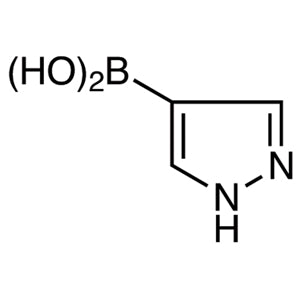
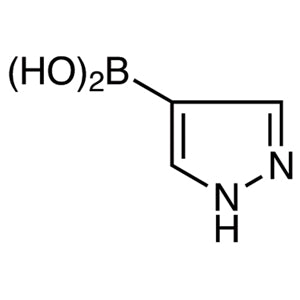
1H-Pyrazole-4-boronic Acid from TCI (product code P2478) is an organoboron reagent with a boronic acid group at the 4-position of a pyrazole ring that has no substituent on nitrogen. In synthesis laboratories it is used mainly as a coupling partner in Suzuki–Miyaura reactions, where it introduces a pyrazol-4-yl unit into aromatic or heteroaromatic molecules. As the product name states, the material contains varying amounts of anhydride. This is the boroxine form, which forms naturally when boronic acids lose water.
The main strength of this reagent is that it forms carbon–carbon bonds between the pyrazole ring and a wide range of aryl halides under established palladium-catalysed conditions. The pyrazole motif is very important in medicinal chemistry and appears in many kinase inhibitors, so this reagent offers a short, efficient route to these frameworks. The free N–H on the pyrazole ring can also be modified later, for example by alkylation or arylation, which gives chemists more freedom in molecular design. The anhydride content usually does not interfere with coupling, because the boroxine form also reacts under Suzuki conditions.
In Indonesia, this reagent is useful in university organic chemistry laboratories, pharmaceutical research and development groups, and institutions working on heterocyclic synthesis. Researchers who build compound libraries for biological screening can use it to attach pyrazole units to many aryl and heteroaryl scaffolds. It also suits teaching and research projects on palladium-catalysed cross-coupling. In those settings it gives a dependable example of how boronic acids are used to build complex nitrogen-containing heterocyclic structures.
TCI brochures (PDF)
- Suzuki-Miyaura Cross Coupling Reaction 2025-12-01 · p. 14
Related TCI products
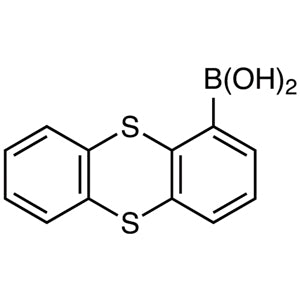
- TCI T3706 108847-76-3 1-Thianthrenylboronic Acid (contains varying amounts of Anhydride)
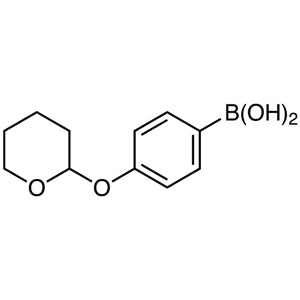
- TCI T3325 182281-01-2 4-(Tetrahydro-2H-pyran-2-yloxy)phenylboronic Acid (contains varying amounts of Anhydride)
- TCI T2621 160032-40-6 Thieno[3,2-b]thiophene-2-boronic Acid (contains varying amounts of Anhydride)
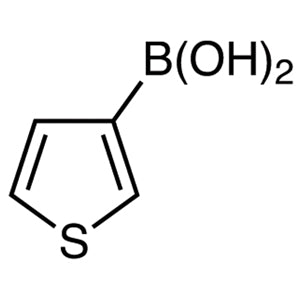
- TCI T1975 6165-69-1 3-Thiopheneboronic Acid (contains varying amounts of Anhydride)
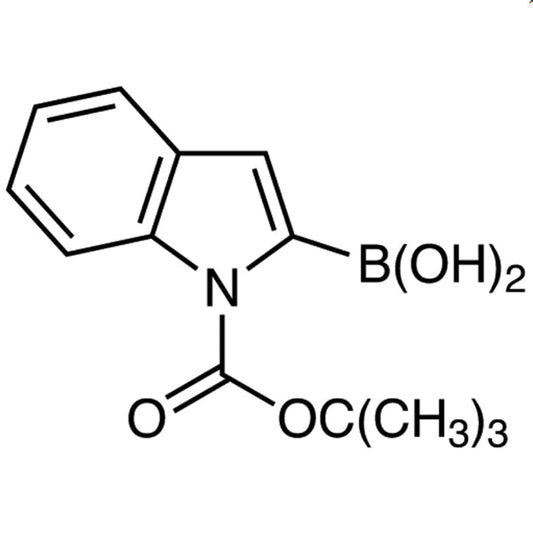
- TCI B5145 213318-44-6 1-(tert-Butoxycarbonyl)indole-2-boronic Acid (contains varying amounts of Anhydride)
- TCI B4774 113893-08-6 Benzo[b]thiophene-3-boronic Acid (contains varying amounts of Anhydride)
- Suzuki–Miyaura cross-coupling: the boronic acid group at the 4-position reacts with aryl and heteroaryl halides under palladium catalysis to install a pyrazol-4-yl unit directly.
- Medicinal chemistry scaffold building: pyrazole is a common motif in kinase inhibitors and other bioactive molecules, so this reagent offers an efficient route to these core frameworks.
- Building compound libraries: one boronic acid can be coupled with many different halide partners, so researchers can quickly make a series of pyrazole-containing analogues for screening.
- Further N-functionalisation: the free N–H on the pyrazole ring can be alkylated or arylated after coupling, so the same building block leads to many different substituted products.
- Teaching and research on cross-coupling: the reagent shows boronic acid and boroxine chemistry in practice and illustrates heterocyclic carbon–carbon bond formation under established catalytic conditions.
| Brand | TCI (product code P2478) |
|---|---|
| CAS number | 763120-58-7 |
| Molecular formula | — |
| Purity | — |
| Category | Chemistry > Organometallic Reagents > Organoboron [Organometallic Reagents] |
| Pack sizes | see the available options on the product listing |
| Physical form | — |
| Storage | keep tightly closed in a cool, dry place, protected from moisture |
- Composition note: contains varying amounts of anhydride (boroxine)
Store 1H-Pyrazole-4-boronic Acid in its original tightly sealed container in a cool, dry, well-ventilated place, away from moisture and incompatible materials such as strong oxidising agents. Boronic acids and their boroxine forms can change into each other depending on humidity, so close the container promptly after each use. Handle the material in a fume hood or another well-ventilated area. Wear standard personal protective equipment, including safety glasses, gloves and a laboratory coat. Avoid creating or breathing in dust and avoid contact with skin and eyes. Follow the TCI Safety Data Sheet for detailed hazard information, first-aid measures and disposal guidance in line with local regulations.
—
Produk Terkait
-
1-ThianthrenylboronicAcid(containsvaryingamountsofAnhydride) TCI T3706
Regular price From Rp 610.050,00Regular price -
4-(Tetrahydro-2H-pyran-2-yloxy)phenylboronicAcid(containsvaryingamountsofAnhydride) TCI T3325
Regular price From Rp 1.776.600,00Regular price -
Thieno[3,2-b]thiophene-2-boronicAcid(containsvaryingamountsofAnhydride) TCI T2621
Regular price Rp 5.830.650,00Regular price -
3-ThiopheneboronicAcid(containsvaryingamountsofAnhydride) TCI T1975
Regular price From Rp 823.200,00Regular price -
1-(tert-Butoxycarbonyl)indole-2-boronicAcid(containsvaryingamountsofAnhydride) TCI B5145
Regular price Rp 2.411.850,00Regular price -
Benzo[b]thiophene-3-boronicAcid(containsvaryingamountsofAnhydride) TCI B4774
Regular price From Rp 1.220.100,00Regular price -
1,4-Benzodioxane-6-boronicAcid(containsvaryingamountsofAnhydride) TCI B4181
Regular price Rp 3.551.100,00Regular price -
1-(tert-Butoxycarbonyl)-2-pyrroleboronicAcid(containsvaryingamountsofAnhydride) TCI B4063
Regular price From Rp 1.644.300,00Regular price

![160032-40-6 Thieno[3,2-b]thiophene-2-boronic Acid (contains varying amounts of Anhydride) - AMI Scientific](http://amiscientific.com/cdn/shop/files/TCI2510T2621.jpg?v=1768206488&width=533)

![113893-08-6 Benzo[b]thiophene-3-boronic Acid (contains varying amounts of Anhydride) - AMI Scientific](http://amiscientific.com/cdn/shop/files/TCI2510B4774_65b85fee-ce4d-45b9-ad87-4962d8f3452c.jpg?v=1767853515&width=533)

