


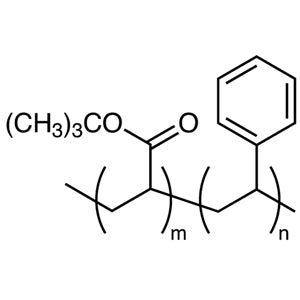
Poly(tert-Butyl Acrylate)-block-Poly(styrene) is a block copolymer used extensively in scientific research, particularly in the fields of materials science and chemistry. This material is composed of two distinct polymer segments—Poly(tert-Butyl Acrylate) and Poly(styrene)—chemically bonded together. Its unique structure allows for tunable physical and chemical properties, making it a versatile tool in laboratory settings. The copolymer is often employed in the development of new materials, surface modification studies, and investigations into molecular interactions. Its ability to form stable thin films and coatings further enhances its utility in various experimental applications.
The preferred choice for many researchers is due to its non-polar nature and the ability to control surface properties with precision. This copolymer exhibits excellent stability under a range of environmental conditions, which is crucial for maintaining consistent results in experiments. Its block structure enables the creation of materials with tailored functionalities, such as controlled release properties or enhanced mechanical strength. These characteristics make it ideal for applications requiring precise manipulation of surface chemistry and interfacial behavior.
In Indonesian laboratories, this material is commonly used in research related to materials science, chemical engineering, and surface chemistry. It plays a key role in studies involving polymer synthesis, coating technologies, and the development of advanced functional materials. Its versatility and reliability make it a valuable asset for both academic and industrial research initiatives.
TCI brochures (PDF)
- Biomaterials Research Reagents 2025-02-19 · p. 4
Related TCI products
- TCI P2555 697765-49-4 Poly(tert-Butyl Acrylate)-block-Poly(styrene) (Copolymer, 10:25)
- TCI P2554 697765-49-4 Poly(tert-Butyl Acrylate)-block-Poly(styrene) (Copolymer, 10:11)
- TCI P0385 25086-89-9 Poly(1-vinylpyrrolidone-co-Vinyl Acetate) (Copolymer, 3:7) (50% in Ethanol)
- TCI P0382 25086-89-9 Poly(1-vinylpyrrolidone-co-Vinyl Acetate) (Copolymer, 7:3) (50% in Ethanol)
- TCI P2584 25232-27-3 Poly(tert-butyl Acrylate) Number Average Molecular Wt. 50000
- TCI P2583 25232-27-3 Poly(tert-butyl Acrylate) Number Average Molecular Wt. 25000
- Surface modification studies benefit from this copolymer's ability to form stable thin films, allowing precise control over surface chemistry and reactivity.
- Polymer synthesis research utilizes its block structure to create materials with tailored properties, enhancing the development of new functional polymers.
- Coating technologies leverage its non-polar nature to produce durable and stable surface coatings, suitable for various industrial applications.
- Molecular interaction studies take advantage of its structured composition to investigate intermolecular forces and binding behavior.
- Advanced material development relies on its tunable properties to create materials with specific mechanical and chemical characteristics.
| Brand | TCI |
|---|---|
| CAS number | 697765-49-4 |
| Molecular formula | — |
| Purity | — |
| Category | Materials Science > Polymer/Macromolecule Reagents > Polymers |
| Pack sizes | As listed on the product page |
| Physical form | Solid |
| Storage | Store in a cool, dry place away from direct sunlight |
This copolymer should be stored in a cool, dry environment to maintain its structural integrity and chemical stability. It is recommended to keep it in a sealed container to prevent exposure to moisture and contaminants. Due to its non-polar nature, it is generally compatible with most standard laboratory storage containers, provided they are clean and free from reactive substances. Avoid storing near heat sources or in areas with high humidity. Always handle with care to prevent physical damage, which could affect its performance in experimental applications. Proper storage ensures consistent quality and reliability in research settings.
—
Produk Terkait
-
Poly(tert-ButylAcrylate)-block-Poly(styrene)(Copolymer,10:25) TCI P2555
Regular price Rp 2.411.850,00Regular priceRp 1.702.050,00Sale price Rp 2.411.850,00 -
Poly(tert-ButylAcrylate)-block-Poly(styrene)(Copolymer,10:11) TCI P2554
Regular price Rp 2.411.850,00Regular priceRp 1.702.050,00Sale price Rp 2.411.850,00 -
Poly(1-vinylpyrrolidone-co-VinylAcetate)(Copolymer,3:7)(50%inEthanol) TCI P0385
Regular price From Rp 557.550,00Regular priceRp 389.550,00Sale price From Rp 557.550,00 -
Poly(1-vinylpyrrolidone-co-VinylAcetate)(Copolymer,7:3)(50%inEthanol) TCI P0382
Regular price From Rp 557.550,00Regular priceRp 389.550,00Sale price From Rp 557.550,00 -
Poly(tert-butylAcrylate)NumberAverageMolecularWt.50000 TCI P2584
Regular price Rp 4.320.750,00Regular priceRp 3.020.850,00Sale price Rp 4.320.750,00 -
Poly(tert-butylAcrylate)NumberAverageMolecularWt.25000 TCI P2583
Regular price Rp 4.320.750,00Regular priceRp 3.020.850,00Sale price Rp 4.320.750,00 -
Poly(tert-butylAcrylate)NumberAverageMolecularWt.10000 TCI P2582
Regular price Rp 4.320.750,00Regular priceRp 3.020.850,00Sale price Rp 4.320.750,00 -
(S)-StyreneOxide TCI S0517
Regular price From Rp 2.254.350,00Regular priceRp 1.576.050,00Sale price From Rp 2.254.350,00


