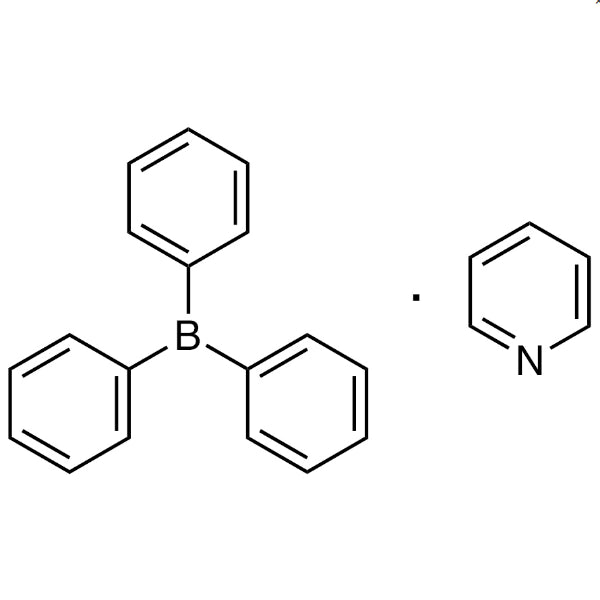
Triphenylborane-Pyridine Complex (TCI P2785) is a specialized organoboron compound used in various organometallic chemical reactions. This reagent plays a crucial role in laboratories where complex synthesis and functional group transformations are required. Its unique structure, involving boron bonded to phenyl groups and pyridine, makes it highly effective in promoting specific chemical interactions. It is particularly valuable in reactions that demand precise control over reactivity and selectivity, making it an essential tool for advanced chemical research.
The compound is known for its stability under controlled conditions, yet it remains sensitive to moisture and oxidation, which requires careful handling. Its ability to interact with electron-deficient substrates enhances its utility in achieving high-efficiency reactions. This reagent is especially favored for its capacity to act as a catalyst or reagent with high activity, enabling the development of novel synthetic methodologies. Its reactivity and specificity make it a preferred choice for researchers aiming to optimize reaction outcomes.
In Indonesian laboratories, the Triphenylborane-Pyridine Complex is widely used in organic chemistry research, complex compound synthesis, and the development of new reaction protocols. It is a common reagent in academic and industrial settings, supporting both teaching and research activities. Its availability in the local market ensures that it remains accessible for a wide range of experimental needs, contributing to the advancement of chemical sciences in Indonesia.
TCI brochures (PDF)
- Boron Compounds 2025-10-07 · p. 22
Related TCI products
- TCI B4523 1537876-31-5 Bis(3-bromophenylboronic Acid) scyllo-Inositol Complex Dipotassium Pentahydrate
- TCI T2468 40210-84-2 Tetrathiafulvalene - 7,7,8,8-Tetracyanoquinodimethane Complex
- TCI T1442 42152-46-5 Copper(I) Trifluoromethanesulfonate Benzene Complex
- TCI T1416 105029-70-7 Tetrabutylphosphonium Bis(1,3-dithiole-2-thione-4,5-dithiolato)nickel(III) Complex
- TCI T1282 55492-86-9 Tris(tetrathiafulvalene) Bis(tetrafluoroborate) Complex
- TCI T1272 68401-88-7 Tetrabutylammonium Bis(1,3-dithiole-2-thione-4,5-dithiolato)nickel(III) Complex
- Organic synthesis reactions where electron-deficient substrates require a reagent with high reactivity and selectivity.
- Development of new catalytic systems that benefit from the unique organoboron structure of this compound.
- Research into complex molecule formation, leveraging the compound’s ability to participate in nucleophilic and substitution reactions.
- Teaching and experimental setups in Indonesian universities and research institutions requiring reliable organoboron reagents.
- Optimization of reaction conditions in industrial chemical processes that rely on precise reagent performance.
| Brand | TCI |
|---|---|
| CAS number | 971-66-4 |
| Molecular formula | — |
| Purity | — |
| Category | Chemistry > Organometallic Reagents > Organoboron [Organometallic Reagents] |
| Pack sizes | — |
| Physical form | — |
| Storage | Requires protection from moisture and oxidation |
This compound should be stored in a dry, cool environment away from moisture and oxidizing agents. It is recommended to use airtight containers made of inert materials such as glass or polyethylene to prevent exposure to humidity. Due to its sensitivity, it should be kept in a controlled atmosphere, ideally under an inert gas like nitrogen. Laboratory personnel should wear appropriate personal protective equipment when handling the material. The compound should not be exposed to direct sunlight or high temperatures. Proper labeling and storage conditions are essential to maintain its chemical integrity and ensure safe usage in laboratory settings.
—
Produk Terkait
-
Bis(3-bromophenylboronicAcid)scyllo-InositolComplexDipotassiumPentahydrate TCI B4523
Regular price From Rp 717.150,00Regular price -
Tetrathiafulvalene-7,7,8,8-TetracyanoquinodimethaneComplex TCI T2468
Regular price Rp 8.665.650,00Regular price -
Copper(I)TrifluoromethanesulfonateBenzeneComplex TCI T1442
Regular price From Rp 2.041.200,00Regular price -
TetrabutylphosphoniumBis(1,3-dithiole-2-thione-4,5-dithiolato)nickel(III)Complex TCI T1416
Regular price Rp 4.213.650,00Regular price -
Tris(tetrathiafulvalene)Bis(tetrafluoroborate)Complex TCI T1282
Regular price Rp 4.957.050,00Regular price -
TetrabutylammoniumBis(1,3-dithiole-2-thione-4,5-dithiolato)nickel(III)Complex TCI T1272
Regular price Rp 1.538.250,00Regular price -
Borane-AmmoniaComplex TCI B5082
Regular price From Rp 4.849.950,00Regular price -
Bromine-1,4-DioxaneComplex TCI B2719
Regular price From Rp 2.995.650,00Regular price