Bis(3-bromophenylboronic Acid) scyllo-Inositol Complex Dipotassium Pentahydrate is a specialized chemical compound used in organic laboratory settings for its unique reactivity and structural complexity. This reagent plays a crucial role in facilitating carbon-carbon bond formation, particularly in coupling reactions such as the Suzuki-Miyaura and Heck reactions. These reactions are essential in the synthesis of heterocyclic compounds and pharmacologically relevant molecules. Its presence in laboratory workflows supports the development of advanced chemical structures with high efficiency and selectivity.
The compound’s preferred status in the laboratory stems from its excellent solubility in both organic solvents and water, enabling versatile use across a wide range of experimental conditions. Its molecular structure, which includes boron and potassium ions, contributes to its reactivity under various chemical environments. This makes it suitable for applications requiring both stability and reactivity. Additionally, its compatibility with standard laboratory procedures enhances its usability in both academic and industrial research settings.
In Indonesian laboratories, this compound is commonly utilized in organic chemistry research, particularly in educational institutions and research centers focused on complex molecule synthesis. Its role in pharmaceutical and medicinal chemistry research further underscores its importance in advancing scientific innovation within the region.
TCI brochures (PDF)
- Suzuki-Miyaura Cross Coupling Reaction 2025-12-01 · p. 21
- Boron Compounds 2025-10-07 · p. 21
Related TCI products
- TCI P2282 867044-33-5 4-(2-Phenyl-1H-benzimidazol-1-yl)phenylboronic Acid (contains varying amounts of Anhydride)
- TCI P2158 952514-79-3 4-(1-Phenyl-1H-benzimidazol-2-yl)phenylboronic Acid (contains varying amounts of Anhydride)
- TCI H1280 5735-41-1 2-(Hydroxymethyl)phenylboronic Acid Cyclic Monoester
- TCI D2494 68716-47-2 2,4-Dichlorophenylboronic Acid (contains varying amounts of Anhydride)
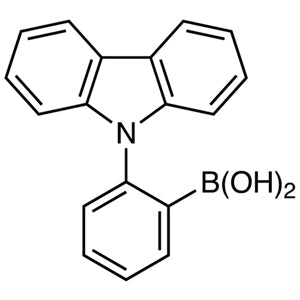
- TCI C3352 1189047-28-6 2-(9H-Carbazol-9-yl)phenylboronic Acid (contains varying amounts of Anhydride)
- TCI C2967 864377-33-3 3-(9H-Carbazol-9-yl)phenylboronic Acid (contains varying amounts of Anhydride)
- Organic synthesis applications benefit from its role in coupling reactions, enabling the efficient formation of carbon-carbon bonds in complex molecule construction.
- Pharmaceutical research utilizes this compound for the development of heterocyclic structures, which are essential in drug design and medicinal chemistry.
- Academic research in Indonesian universities employs it for teaching and experimental purposes in advanced organic chemistry courses.
- Industrial chemical processes incorporate it to produce high-purity compounds used in various commercial applications.
- Analytical chemistry laboratories use it as a reference material for the study of reactivity and structural behavior in synthetic pathways.
| Brand | TCI |
|---|---|
| CAS number | 1537876-31-5 |
| Molecular formula | — |
| Purity | — |
| Category | Chemistry > Organometallic Reagents > Organoboron [Organometallic Reagents] |
| Pack sizes | Available in various quantities as per standard supplier offerings |
| Physical form | Solid, pentahydrate crystalline structure |
| Storage | Store in a cool, dry place away from moisture and direct sunlight |
This compound should be stored in a cool, dry environment to maintain its chemical integrity and prevent degradation. It is recommended to keep it in airtight containers to minimize exposure to moisture and air. Due to its reactivity, it should be handled with care in a well-ventilated laboratory setting. Avoid contact with incompatible materials such as strong oxidizers. Always use appropriate personal protective equipment when handling this substance. Proper storage conditions ensure its effectiveness and safety in laboratory applications.
—
Produk Terkait
-
4-(2-Phenyl-1H-benzimidazol-1-yl)phenylboronicAcid(containsvaryingamountsofAnhydride) TCI P2282
Regular price Rp 2.677.500,00Regular priceRp 1.887.900,00Sale price Rp 2.677.500,00 -
4-(1-Phenyl-1H-benzimidazol-2-yl)phenylboronicAcid(containsvaryingamountsofAnhydride) TCI P2158
Regular price From Rp 1.351.350,00Regular priceRp 960.750,00Sale price From Rp 1.351.350,00 -
2-(Hydroxymethyl)phenylboronicAcidCyclicMonoester TCI H1280
Regular price From Rp 1.033.200,00Regular priceRp 738.150,00Sale price From Rp 1.033.200,00 -
2,4-DichlorophenylboronicAcid(containsvaryingamountsofAnhydride) TCI D2494
Regular price From Rp 505.050,00Regular priceRp 352.800,00Sale price From Rp 505.050,00 -
2-(9H-Carbazol-9-yl)phenylboronicAcid(containsvaryingamountsofAnhydride) TCI C3352
Regular price Rp 4.796.400,00Regular priceRp 3.369.450,00Sale price Rp 4.796.400,00 -
3-(9H-Carbazol-9-yl)phenylboronicAcid(containsvaryingamountsofAnhydride) TCI C2967
Regular price From Rp 1.298.850,00Regular priceRp 924.000,00Sale price From Rp 1.298.850,00 -
4-(9H-Carbazol-9-yl)phenylboronicAcid(containsvaryingamountsofAnhydride) TCI C2926
Regular price From Rp 1.538.250,00Regular priceRp 1.090.950,00Sale price From Rp 1.538.250,00