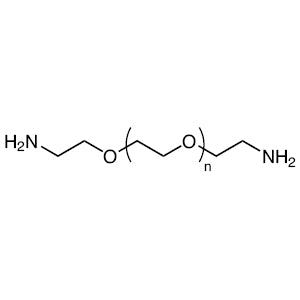
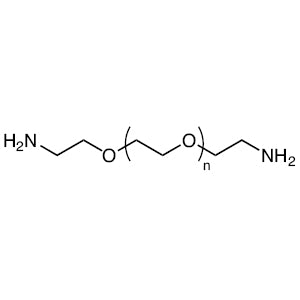
TCI P2858 PEG Diamine 5000 is a polyethylene glycol whose chain ends in a primary amine at each end. Its average molecular weight is approximately 5000. TCI groups this product with its research reagents for biomaterials and biocompatible materials, under polymers. PEG is one of the most widely used synthetic polymers in biomaterials work. The two reactive amine groups at the chain ends make this product a practical building block for polymer networks, antifouling surfaces and polymer–biomolecule conjugates.
Several properties make PEG a preferred choice for biomaterials research. It dissolves in water, carries no charge, and tends to resist protein adsorption. A chain length of about 5000 sits in the middle of the commonly used range of PEG diamines. It is longer than the 2000 variant, so hydrogel networks made from it have larger pores, are more flexible and absorb more water. The chain is still short enough to keep reasonable mechanical strength. Its primary amine ends react with NHS esters, activated carboxylic acids and aldehydes. This gives researchers several well-established ways to attach the polymer to other molecules or surfaces.
In Indonesian laboratories, PEG Diamine 5000 suits biomaterials, polymer chemistry and surface science groups at universities and research institutes. Researchers can use it to build crosslinked hydrogels, to graft hydrophilic layers that reduce protein and cell attachment on material surfaces, and to link polymers to biomolecules. Because the product comes from TCI, a well-known brand, research teams can run their work with a consistent, documented reagent and compare results across experiments.
TCI brochures (PDF)
- Biomaterials Research Reagents 2025-02-19 · p. 6
Related TCI products
- TCI P2862 24991-53-5 PEG Diamine 8000
- TCI P2857 24991-53-5 PEG Diamine 2000
- TCI T4164 88849-55-2 Triptycene-1,4-diamine
- TCI T3689 185690-39-5 N1-(Naphthalen-1-yl)-N4,N4-bis(4-(naphthalen-1-yl(phenyl)amino)phenyl)-N1-phenylbenzene-1,4-diamine
- TCI T3657 145898-89-1 N,N,N',N'-Tetraphenyl[1,1':4',1'':4'',1'''-quaterphenyl]-4,4'''-diamine
- TCI T3656 952431-34-4 N,N,N',N'-Tetra([1,1'-biphenyl]-4-yl)[1,1':4',1''-terphenyl]-4,4''-diamine
- Hydrogel network formation: the two terminal amine groups let the polymer act as a crosslinker, and the roughly 5000 chain gives larger pores, more flexibility and higher water uptake than shorter PEG diamines.
- Antifouling surface coatings: grafting PEG chains of this length onto a surface forms a hydrophilic layer that reduces the attachment of proteins and cells, which is useful in biomaterial and device research.
- Polymer–biomolecule conjugation: the primary amines react with NHS esters and activated carboxylic acids, so researchers can couple the PEG chain to proteins, peptides or other functional molecules.
- Aldehyde-based coupling and crosslinking: the amine ends react with aldehydes, which gives researchers another route to connect PEG to aldehyde-bearing polymers or surfaces when designing materials.
- Comparative studies of chain length: the mid-range chain of about 5000 can be tested alongside shorter variants such as 2000 to study how PEG length affects network structure and mechanical behaviour.
| Brand | TCI (product code P2858) |
|---|---|
| CAS number | 24991-53-5 |
| Molecular formula | approximately 5000 (primary amine at both chain ends) |
| Purity | — |
| Category | Materials Science > Biomaterials/Biocompatible Materials Research Reagents > Polymers |
| Pack sizes | see the current product listing for available pack sizes |
| Physical form | — |
| Storage | follow the storage conditions on the TCI label and safety data sheet |
Keep PEG Diamine 5000 in its original, tightly closed container, in a cool, dry place away from direct light and moisture, unless the label or the safety data sheet (SDS) states otherwise. Amine-terminated polymers can react with air and moisture over time, so close the container quickly after use and keep exposure to humid air short. Use clean, dry spatulas and glassware so the reactive amine groups stay intact. Follow standard laboratory precautions: wear gloves, safety glasses and a lab coat, avoid inhaling dust, and work in a well-ventilated area. Read the TCI SDS before first use, and dispose of waste according to your institution's chemical waste procedures.
—
Produk Terkait
-
PEGDiamine8000 TCI P2862
Regular price Rp 2.782.500,00Regular priceRp 1.945.650,00Sale price Rp 2.782.500,00 -
PEGDiamine2000 TCI P2857
Regular price Rp 2.782.500,00Regular priceRp 1.945.650,00Sale price Rp 2.782.500,00 -
Triptycene-1,4-diamine TCI T4164
Regular price From Rp 2.227.050,00Regular priceRp 1.572.900,00Sale price From Rp 2.227.050,00 -
N1-(Naphthalen-1-yl)-N4,N4-bis(4-(naphthalen-1-yl(phenyl)amino)phenyl)-N1-phenylbenzene-1,4-diamine TCI T3689
Regular price Rp 6.042.750,00Regular priceRp 4.240.950,00Sale price Rp 6.042.750,00 -
N,N,N',N'-Tetraphenyl[1,1':4',1'':4'',1'''-quaterphenyl]-4,4'''-diamine TCI T3657
Regular price From Rp 1.908.900,00Regular priceRp 1.350.300,00Sale price From Rp 1.908.900,00 -
N,N,N',N'-Tetra([1,1'-biphenyl]-4-yl)[1,1':4',1''-terphenyl]-4,4''-diamine TCI T3656
Regular price Rp 4.001.550,00Regular priceRp 2.814.000,00Sale price Rp 4.001.550,00 -
N,N,N',N'-Tetrakis(4-methoxyphenyl)-9H-carbazole-3,6-diamine TCI T3642
Regular price From Rp 9.778.650,00Regular priceRp 6.853.350,00Sale price From Rp 9.778.650,00 -
1,3,4-Thiadiazole-2,5-diamine TCI T3544
Regular price Rp 3.048.150,00Regular priceRp 2.147.250,00Sale price Rp 3.048.150,00