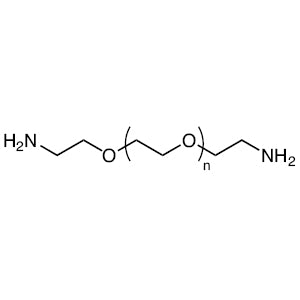
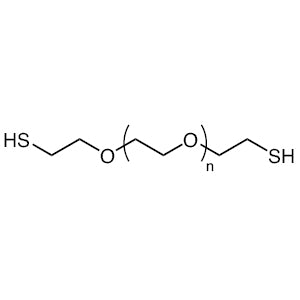
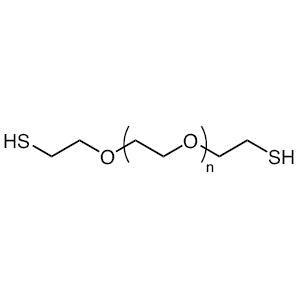
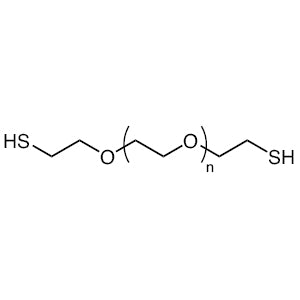
TCI P2862 PEG Diamine 8000 is a polyethylene glycol with a primary amine group at each end of the chain and an average molecular weight of around 8000. It is the longest-chain option among the PEG diamines in this range. As a homobifunctional PEGylation reagent, it pairs a long, hydrophilic, biocompatible PEG chain with two reactive amine groups. In the laboratory, PEG Diamine 8000 is used as a long crosslinker, as a flexible spacer between two molecules or surfaces, and as a monomer for copolymers that contain large PEG segments.
The chain of about 8000 places the two amine groups far apart, and much of this reagent's value comes from that distance. In hydrogel preparation, it gives networks with low crosslink density, so the gels are softer, more elastic and able to hold a lot of water. In surface modification, the long chains form a thicker PEG layer that blocks protein adsorption more effectively. The primary amine groups react with NHS esters, EDC-activated carboxylic acids, aldehydes through reductive amination, isothiocyanates and epoxides. This gives researchers a very wide choice of conjugation chemistry, so the reagent fits into many existing protocols without major changes.
Indonesian laboratories working on biomaterials, nanomedicine, cosmetic formulation research and polymer chemistry can use PEG Diamine 8000 when a design needs a long, flexible and water-friendly linker. University research groups, pharmaceutical development teams and materials science laboratories commonly use it to build soft hydrogel scaffolds, to coat nanoparticles for less nonspecific binding and to make PEG-containing block copolymers. Because it comes from TCI, a well-known reagent brand, researchers can keep the same material quality across repeated experiments and long research projects.
TCI brochures (PDF)
- Biomaterials Research Reagents 2025-02-19 · p. 6
- Monomers 2025-05-28 · p. 33
- Soft hydrogel fabrication: the long chain of about 8000 between the two amine groups gives low crosslink density, so the gels are elastic and hold a lot of water.
- Antifouling surface modification: grafting the long PEG chains onto a surface forms a thicker hydrated layer that resists protein adsorption better than shorter PEG diamines.
- Long flexible spacer for bioconjugation: the two terminal amines can link two molecules or surfaces while the long PEG chain keeps them well apart and flexible.
- Nanoparticle PEGylation: the amine ends react with NHS esters or EDC-activated carboxyl groups on particle surfaces, adding a biocompatible PEG coating for nanomedicine research.
- Synthesis of PEG-containing copolymers: as a bifunctional amine monomer, it adds large hydrophilic PEG segments to polyamides, polyureas and other step-growth polymers.
| Brand | TCI (product code P2862) |
|---|---|
| CAS number | 24991-53-5 |
| Molecular formula | — |
| Purity | — |
| Category | Chemistry > Chemical Biology > PEGylation |
| Pack sizes | Please contact AMI Scientific for the pack sizes available |
| Physical form | Refer to the TCI product label and Safety Data Sheet |
| Storage | — |
- Chemical description: Polyethylene glycol diamine with an average molecular weight of about 8000
Store PEG Diamine 8000 in its original tightly closed container, following the storage conditions on the TCI label and Safety Data Sheet. Keep it in a cool, dry place away from moisture, heat and direct sunlight. Polyethylene glycols can absorb moisture, and primary amines can react with carbon dioxide in the air, so close the container quickly after use and consider handling it under dry or inert conditions. Keep it away from strong oxidizers, acids and acylating agents. Wear standard laboratory protective equipment, including gloves, safety glasses and a lab coat. Avoid creating dust or getting the material on skin or in eyes, and work in a well-ventilated area. Dispose of waste according to local regulations.
—
Product Categories
Produk Terkait
-
PEGDiamine2000 TCI P2857
Regular price Rp 2.782.500,00Regular priceRp 1.945.650,00Sale price Rp 2.782.500,00 -
PEGDithiol8000 TCI P2861
Regular price Rp 4.347.000,00Regular priceRp 3.039.750,00Sale price Rp 4.347.000,00 -
PEGDithiol5000 TCI P2860
Regular price Rp 4.771.200,00Regular priceRp 3.335.850,00Sale price Rp 4.771.200,00 -
PEGDithiol2000 TCI P2859
Regular price Rp 4.771.200,00Regular priceRp 3.335.850,00Sale price Rp 4.771.200,00 -
N-Biotinyl-N'-(3-maleimidopropionyl)-3,6-dioxaoctane-1,8-diamine TCI B3174
Regular price Rp 6.731.550,00Regular priceRp 4.722.900,00Sale price Rp 6.731.550,00 -
PEGDiamine5000 TCI P2858
Regular price Rp 2.889.600,00Regular priceRp 2.020.200,00Sale price Rp 2.889.600,00 -
2,4(or4,6)-Diethyl-6(or2)-methylbenzene-1,3-diamine(mixtureofisomers) TCI D6282
Regular price From Rp 1.670.550,00Regular priceRp 1.183.350,00Sale price From Rp 1.670.550,00 -
Naphthalene-2,6-diamine TCI D6067
Regular price Rp 4.001.550,00Regular priceRp 2.814.000,00Sale price Rp 4.001.550,00