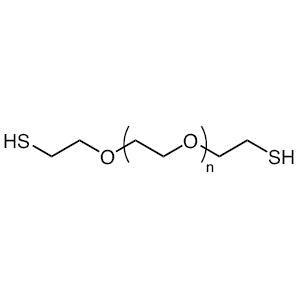
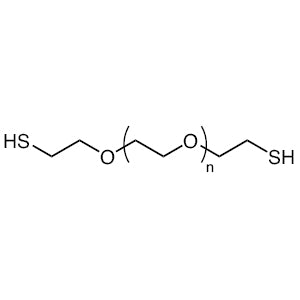
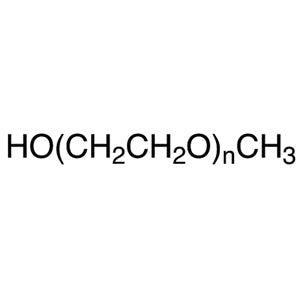
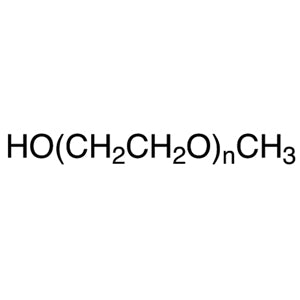
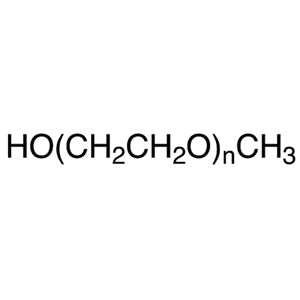
TCI P2861 PEG Dithiol 8000 is a polyethylene glycol with a thiol group at each end and an average molecular weight of about 8000. It has the longest chain of the PEG dithiol variants in this series. Like the shorter variants, its two terminal thiol groups react with maleimides, acrylates, vinyl sulfones and norbornenes, form disulfide bonds, and anchor to gold surfaces. In the laboratory it is mainly used as a long, flexible crosslinker for building soft hydrogels and thick surface coatings.
The chain length of about 8000 puts the crosslink points far apart. Hydrogels made with this crosslinker tend to be softer and more elastic, absorb more water, and have a wider mesh size. This helps when researchers want to mimic the softness of the body's soft tissues, or when large molecules need to diffuse freely through the network. The long chain also reaches further when bridging two surfaces or particles. On a surface, it forms a thicker PEG layer, which helps suppress non-specific interactions. Because it reacts with several thiol-reactive groups, researchers can choose the crosslinking chemistry that best suits their system.
In Indonesia, this material supports cell culture research, biomaterials work and tissue engineering studies at universities, research institutes and biotechnology laboratories. Groups developing soft hydrogel scaffolds, three-dimensional cell culture matrices or controlled-release systems can use it to make networks that are more compliant and more permeable than those made with shorter PEG dithiols. Laboratories working with gold nanoparticles, sensor chips or modified surfaces can also use it to build thicker PEG layers that resist fouling.
TCI brochures (PDF)
- Biomaterials Research Reagents 2025-02-19 · p. 6
- Monomers 2025-05-28 · p. 27
- Soft hydrogel fabrication: the long PEG chain of about 8000 spaces the crosslinks widely, producing soft, elastic, highly swollen gels with a wide mesh size.
- Three-dimensional cell culture matrices: the soft networks can mimic the compliance of soft body tissues and let nutrients and large molecules diffuse freely to the cells.
- Thiol-Michael and thiol-ene crosslinking: both thiol ends react with maleimide, acrylate, vinyl sulfone or norbornene groups, so researchers can choose the network chemistry they need.
- Gold surface and nanoparticle modification: the terminal thiols anchor to gold, and the long chain forms a thick PEG layer that helps suppress non-specific interactions.
- Bridging particles or surfaces: the long, flexible chain reaches further than shorter PEG dithiols, so it can link two surfaces, particles or functional components spaced further apart.
| Brand | TCI (product code P2861) |
|---|---|
| CAS number | 68865-60-1 |
| Molecular formula | approximately 8000 |
| Purity | — |
| Category | Chemistry > Chemical Biology > PEGylation |
| Pack sizes | please contact AMI Scientific for the pack sizes currently available |
| Physical form | — |
| Storage | keep tightly closed and follow the storage conditions on the TCI label and Safety Data Sheet |
Store PEG Dithiol 8000 in its original, tightly sealed container, away from moisture, heat and direct light, under the conditions shown on the TCI label and Safety Data Sheet. Thiol groups can slowly oxidize to disulfides when exposed to air. Keep exposure to air short, reseal the container promptly after use, and consider blanketing it with an inert gas such as nitrogen or argon. Keep it away from oxidizing agents. Wear gloves, safety glasses and a lab coat, avoid generating dust or contacting skin and eyes, and handle it in a well-ventilated area. Prepare reactive solutions fresh where possible, and dispose of waste according to institutional and local regulations.
—
Product Categories
Produk Terkait
-
PEGDithiol5000 TCI P2860
Regular price Rp 4.771.200,00Regular priceRp 3.335.850,00Sale price Rp 4.771.200,00 -
PEGDithiol2000 TCI P2859
Regular price Rp 4.771.200,00Regular priceRp 3.335.850,00Sale price Rp 4.771.200,00 -
PEGDiamine8000 TCI P2862
Regular price Rp 2.782.500,00Regular priceRp 1.945.650,00Sale price Rp 2.782.500,00 -
PEGDiamine2000 TCI P2857
Regular price Rp 2.782.500,00Regular priceRp 1.945.650,00Sale price Rp 2.782.500,00 -
PolyethyleneGlycolMonomethylEther4000 TCI P2187
Regular price From Rp 505.050,00Regular priceRp 352.800,00Sale price From Rp 505.050,00 -
PolyethyleneGlycolMonomethylEther2000 TCI P2186
Regular price From Rp 505.050,00Regular priceRp 352.800,00Sale price From Rp 505.050,00 -
PolyethyleneGlycolMonomethylEther1000 TCI P2185
Regular price From Rp 505.050,00Regular priceRp 352.800,00Sale price From Rp 505.050,00 -
PolyethyleneGlycolMonomethylEther550 TCI P2184
Regular price From Rp 557.550,00Regular priceRp 405.300,00Sale price From Rp 557.550,00