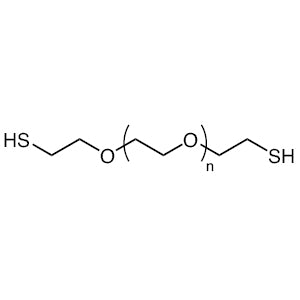
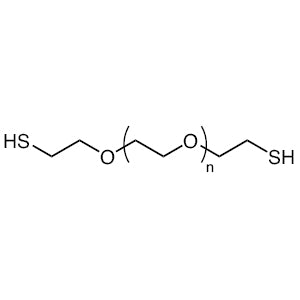
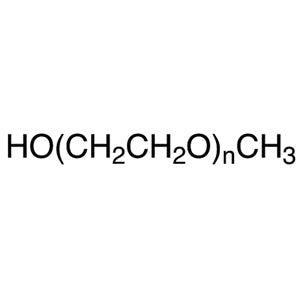
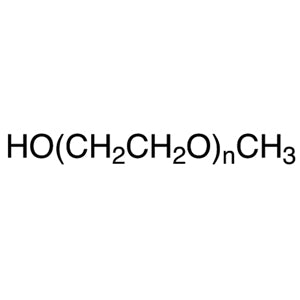
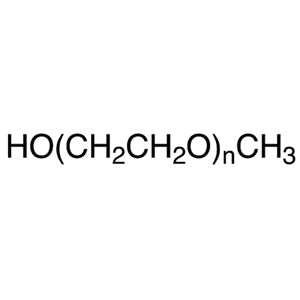
TCI P2860 PEG Dithiol 5000 is a polyethylene glycol with a thiol group at each end of the chain and an average molecular weight of approximately 5000. It is a homobifunctional PEGylation reagent: a hydrophilic, biocompatible PEG chain with a reactive thiol at both termini. The thiols can react with maleimides and acrylates, form disulfide bonds, or anchor onto gold surfaces. In the laboratory it is used as a hydrogel crosslinker, as a surface linker, and as a building block for responsive drug delivery systems.
A chain length of around 5000 gives a balance that is often wanted in hydrogel design. Networks built with this reagent are looser and swell more easily than those made with the 2000 variant, so large molecules such as proteins or growth factors can diffuse through them more freely. The chain is still shorter than the 8000 variant, so the resulting gels keep enough mechanical strength to be handled. Thiol-maleimide and thiol-ene reactions with this material proceed rapidly in water under physiological conditions. Living cells can therefore be encapsulated without organic solvents or high temperatures.
In Indonesian laboratories, PEG Dithiol 5000 is useful to researchers working on tissue engineering scaffolds, drug delivery systems, and functionalised surfaces. University biomaterials groups, pharmaceutical research teams, and nanotechnology laboratories can use it to build cell-compatible hydrogels, to link PEG chains onto gold nanoparticles or sensor surfaces, and to prepare disulfide-based networks that respond to their environment. Because the reactions run in water, the material also suits laboratories that prefer aqueous protocols over organic solvents.
TCI brochures (PDF)
- Biomaterials Research Reagents 2025-02-19 · p. 6
- Monomers 2025-05-28 · p. 27
- Hydrogel crosslinking: the two terminal thiols react with maleimide- or acrylate-functionalised polymers to form crosslinked networks, and the approximately 5000 chain gives a loose but still handleable gel.
- Live-cell encapsulation: thiol-maleimide and thiol-ene reactions proceed quickly in water under physiological conditions, so cells can be encapsulated without organic solvents or high temperatures.
- Tissue engineering scaffolds: the swellable network lets large molecules such as proteins and growth factors diffuse freely, which helps when designing scaffolds that need to deliver or exchange biomolecules.
- Gold surface functionalisation: thiol groups anchor onto gold surfaces, so the reagent can attach a hydrophilic, biocompatible PEG layer to gold nanoparticles, electrodes, or sensor chips.
- Responsive drug delivery systems: the thiols can form disulfide bonds, which makes the reagent useful for building delivery systems that respond to their environment.
| Brand | TCI (product code P2860) |
|---|---|
| CAS number | 68865-60-1 |
| Molecular formula | approximately 5000 |
| Purity | — |
| Category | Chemistry > Chemical Biology > PEGylation |
| Pack sizes | please contact AMI Scientific for available pack sizes |
| Physical form | — |
| Storage | follow the manufacturer's label and Safety Data Sheet; keep tightly sealed |
Store PEG Dithiol 5000 according to the conditions on the TCI label and Safety Data Sheet. Keep the original container tightly closed in a cool, dry place away from direct light and moisture. Thiol groups can slowly oxidise in air to form disulfides, so reseal the container promptly after use and consider flushing it with an inert gas such as nitrogen or argon. Keep the reagent away from strong oxidising agents. Wear standard laboratory protective equipment, including gloves, safety glasses, and a lab coat, and handle the material in a well-ventilated area. Avoid creating dust and avoid contact with skin and eyes. Dispose of waste according to local regulations and your institution's chemical waste procedures.
—
Product Categories
Produk Terkait
-
PEGDithiol8000 TCI P2861
Regular price Rp 4.347.000,00Regular priceRp 3.039.750,00Sale price Rp 4.347.000,00 -
PEGDithiol2000 TCI P2859
Regular price Rp 4.771.200,00Regular priceRp 3.335.850,00Sale price Rp 4.771.200,00 -
PEGDiamine8000 TCI P2862
Regular price Rp 2.782.500,00Regular priceRp 1.945.650,00Sale price Rp 2.782.500,00 -
PEGDiamine2000 TCI P2857
Regular price Rp 2.782.500,00Regular priceRp 1.945.650,00Sale price Rp 2.782.500,00 -
PolyethyleneGlycolMonomethylEther4000 TCI P2187
Regular price From Rp 505.050,00Regular priceRp 352.800,00Sale price From Rp 505.050,00 -
PolyethyleneGlycolMonomethylEther2000 TCI P2186
Regular price From Rp 505.050,00Regular priceRp 352.800,00Sale price From Rp 505.050,00 -
PolyethyleneGlycolMonomethylEther1000 TCI P2185
Regular price From Rp 505.050,00Regular priceRp 352.800,00Sale price From Rp 505.050,00 -
PolyethyleneGlycolMonomethylEther550 TCI P2184
Regular price From Rp 557.550,00Regular priceRp 405.300,00Sale price From Rp 557.550,00