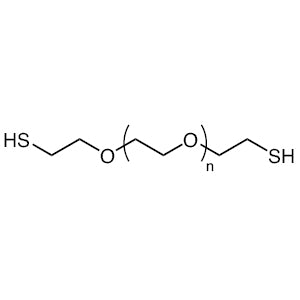
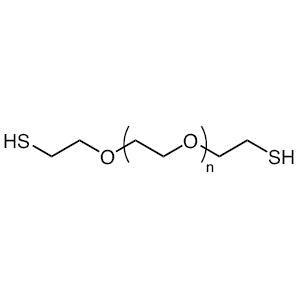
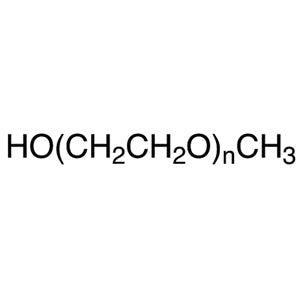
TCI P2859 PEG Dithiol 2000 is a polyethylene glycol whose two chain ends each carry a thiol (-SH) group, with an average molecular weight of about 2000. The thiol group is one of the most useful functional groups in bioconjugation chemistry. It reacts quickly and selectively with maleimides, acrylates and vinyl sulfones, forms disulfide bonds readily, and binds strongly to gold and other noble-metal surfaces. Because it has a reactive group at each end, PEG dithiol is an important crosslinker for building hydrogels and a useful linker for surface modification in the laboratory.
PEG dithiol's main advantage is that it takes part in "click" reactions such as thiol-maleimide Michael addition and thiol-ene chemistry. These reactions run under mild conditions in water, at close to physiological pH, and give no harmful by-products. That makes them well suited to encapsulating cells or proteins inside hydrogels. The chain of about 2000 is relatively short, so it produces denser and stiffer networks. Thiols also form disulfide bonds, which reducing agents can break, so researchers can design networks that respond to a reductive environment.
In Indonesian laboratories, PEG Dithiol 2000 is mainly used in university and research-institute groups working on biomaterials, polymer chemistry, chemical biology and nanotechnology. Typical work includes making crosslinked hydrogels for cell culture and controlled-release studies, functionalizing gold nanoparticles and gold surfaces, and preparing PEGylated conjugates. As a TCI reagent with a defined CAS number, it gives a consistent starting material for thesis research, method development and studies that will be published.
TCI brochures (PDF)
- Biomaterials Research Reagents 2025-02-19 · p. 6
- Monomers 2025-05-28 · p. 27
- Hydrogel crosslinking: the two terminal thiol groups react with multi-arm maleimide, acrylate or vinyl sulfone partners to form crosslinked PEG networks under mild aqueous conditions.
- Cell and protein encapsulation: thiol-maleimide and thiol-ene click reactions run in water near physiological pH without harmful by-products, so sensitive biological cargo can be enclosed in the gel.
- Gold surface and nanoparticle modification: thiol groups bind strongly to gold and other noble metals, so PEG Dithiol 2000 can anchor and link PEG layers on these surfaces.
- Redox-responsive materials: the disulfide bonds that thiols form can be broken by reducing agents, so networks can be built to degrade or change in reductive environments.
- Bioconjugation and linker chemistry: the bifunctional thiol PEG serves as a hydrophilic bridge between two maleimide- or acrylate-functionalized molecules in PEGylation and conjugation work.
| Brand | TCI (product code P2859) |
|---|---|
| CAS number | 68865-60-1 |
| Molecular formula | — |
| Purity | — |
| Category | Chemistry > Chemical Biology > PEGylation |
| Pack sizes | as listed on the product page; contact AMI Scientific for current options |
| Physical form | — |
| Storage | follow the conditions on the TCI label and safety data sheet; protect from air and moisture |
- Chemical description: polyethylene glycol with thiol (-SH) groups at both chain ends, average molecular weight about 2000
Keep PEG Dithiol 2000 in its original, tightly closed container at the temperature given on the TCI label and safety data sheet, away from heat, light and moisture. Thiol groups can oxidize in air to form disulfides, so limit exposure to air. Reseal the container promptly after use, and consider storing it under an inert gas such as nitrogen or argon. Let refrigerated containers reach room temperature before opening to prevent condensation. Weigh and handle the material in a well-ventilated area or fume hood, because thiols can have an unpleasant odor. Wear gloves, safety glasses and a lab coat. Read the safety data sheet before use, and dispose of waste according to institutional and local regulations.
—
Product Categories
Produk Terkait
-
PEGDithiol8000 TCI P2861
Regular price Rp 4.347.000,00Regular priceRp 3.039.750,00Sale price Rp 4.347.000,00 -
PEGDithiol5000 TCI P2860
Regular price Rp 4.771.200,00Regular priceRp 3.335.850,00Sale price Rp 4.771.200,00 -
PEGDiamine8000 TCI P2862
Regular price Rp 2.782.500,00Regular priceRp 1.945.650,00Sale price Rp 2.782.500,00 -
PEGDiamine2000 TCI P2857
Regular price Rp 2.782.500,00Regular priceRp 1.945.650,00Sale price Rp 2.782.500,00 -
PolyethyleneGlycolMonomethylEther4000 TCI P2187
Regular price From Rp 505.050,00Regular priceRp 352.800,00Sale price From Rp 505.050,00 -
PolyethyleneGlycolMonomethylEther2000 TCI P2186
Regular price From Rp 505.050,00Regular priceRp 352.800,00Sale price From Rp 505.050,00 -
PolyethyleneGlycolMonomethylEther1000 TCI P2185
Regular price From Rp 505.050,00Regular priceRp 352.800,00Sale price From Rp 505.050,00 -
PolyethyleneGlycolMonomethylEther550 TCI P2184
Regular price From Rp 557.550,00Regular priceRp 405.300,00Sale price From Rp 557.550,00