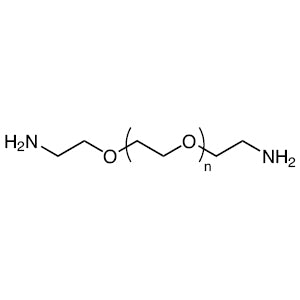
TCI P2857 PEG Diamine 2000 is a polyethylene glycol (PEG) carrying a primary amine group at both ends of its chain, with an average molecular weight of about 2000. PEG is known as a water-soluble, flexible, and biocompatible polymer. Because it has an amine group at each end, this polymer is a homobifunctional reagent: a single molecule can react with two partners at once. In the laboratory it serves mainly as a crosslinker, spacer, and linker in PEGylation, biomolecule conjugation, and hydrogel preparation.
Primary amine groups react readily with NHS esters, EDC-activated carboxylic acids, aldehydes, isothiocyanates, and epoxides. This makes PEG diamine very versatile for joining two molecules together or for crosslinking polymers into three-dimensional networks. A chain of about 2000 is short to medium in length. It is long enough to give flexibility and resist protein adsorption, yet short enough to form tighter hydrogel networks. The hydrophilic character of PEG also helps improve the water solubility of molecules attached to it, which is useful when working with poorly soluble payloads.
In Indonesia, interest in biomaterials, drug delivery systems, and bioconjugation keeps growing in university research groups, pharmaceutical development laboratories, and biotechnology institutes. Researchers in these settings use PEG diamine to build crosslinked hydrogels, to link peptides, proteins, or dyes to other molecules, and to modify surfaces so they become more hydrophilic and less prone to nonspecific binding. As a TCI product, it gives laboratories a consistent, well-documented reagent for these studies.
- PEGylation of biomolecules: the amine ends attach to activated carboxyl or NHS ester groups, adding a flexible, hydrophilic PEG chain that can improve solubility and reduce protein adsorption.
- Hydrogel crosslinking: as a homobifunctional reagent, each molecule bridges two polymer chains, and the short-to-medium chain length gives tighter three-dimensional hydrogel networks.
- Bioconjugation linker: the two primary amines let researchers join two different molecules, such as a protein and a fluorescent label, through a flexible and biocompatible PEG spacer.
- Surface modification: amine groups couple to epoxide-, aldehyde-, or NHS-activated surfaces, leaving a PEG layer that makes the surface more hydrophilic and resists nonspecific protein adsorption.
- Drug delivery research: the water-soluble, biocompatible PEG backbone links carriers and payloads and helps improve the water solubility of the conjugated molecules.
| Brand | TCI (product code P2857) |
|---|---|
| CAS number | 24991-53-5 |
| Molecular formula | about 2000 (PEG with primary amine groups at both ends) |
| Purity | — |
| Category | Chemistry > Chemical Biology > PEGylation |
| Pack sizes | as listed on the product page; contact AMI Scientific to confirm the options available |
| Physical form | — |
| Storage | follow the conditions on the TCI label and Safety Data Sheet |
Store PEG Diamine 2000 in its original, tightly closed container, following the storage conditions printed on the TCI label and Safety Data Sheet. Keep it in a cool, dry place away from moisture, because amine-functional PEGs can absorb water. Keep it away from strong oxidizers, acids, and reactive electrophiles such as NHS esters or aldehydes, since the amine groups react with them easily. Reseal the container promptly after each use to limit air and moisture exposure. Handle the material in a well-ventilated area and wear standard laboratory protective equipment, including gloves, safety glasses, and a lab coat. Review the Safety Data Sheet before use, and dispose of waste according to local regulations and your institution's procedures.
—
Produk Terkait
-
PEGDiamine8000 TCI P2862
Regular price Rp 2.782.500,00Regular price -
PEGDithiol8000 TCI P2861
Regular price Rp 4.347.000,00Regular price -
PEGDithiol5000 TCI P2860
Regular price Rp 4.771.200,00Regular price -
PEGDithiol2000 TCI P2859
Regular price Rp 4.771.200,00Regular price -
N-Biotinyl-N'-(3-maleimidopropionyl)-3,6-dioxaoctane-1,8-diamine TCI B3174
Regular price Rp 6.679.050,00Regular price -
PEGDiamine5000 TCI P2858
Regular price Rp 2.889.600,00Regular price -
2,4(or4,6)-Diethyl-6(or2)-methylbenzene-1,3-diamine(mixtureofisomers) TCI D6282
Regular price From Rp 1.618.050,00Regular price -
Naphthalene-2,6-diamine TCI D6067
Regular price Rp 3.949.050,00Regular price