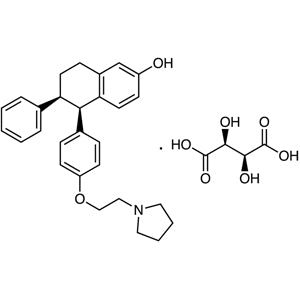
Raloxifene Hydrochloride is a chemical compound widely used in pharmacological and biochemical research. It plays a crucial role in laboratory experiments focused on the effects of drugs on bone health and the endocrine system. As a pharmaceutical research reagent, it is essential for studying osteoporosis treatments and hormonal regulation. Its presence in experimental studies helps scientists understand how drugs interact with biological systems and how they can be optimized for therapeutic use. This compound is a key component in various research projects aimed at developing new treatments and improving existing ones.
Raloxifene Hydrochloride is valued for its chemical stability and solubility in organic solvents, which simplifies its use in analytical methods and experimental procedures. These properties make it a reliable and versatile reagent for a wide range of laboratory applications. Its non-toxic nature and relative safety in experimental settings further enhance its appeal to researchers. The compound’s consistent performance and ease of handling make it a preferred choice for both academic and industrial research environments, ensuring accurate and reproducible results.
In Indonesian laboratories, Raloxifene Hydrochloride is commonly used in scientific research related to pharmacology, biochemistry, and pharmaceutical sciences. It is frequently employed in academic and industrial studies to develop new drugs and understand the effects of existing medications. Its availability in various packaging options supports its use in diverse laboratory settings, making it an essential tool for researchers in Indonesia.
TCI brochures (PDF)
- Bone Metabolism Research Reagents 2026-04-21 · p. 2
- Thiophenes 2026-06-29 · p. 12
- Antimicrobials and Antitumor Agents for Research and Experimental Use 2025-04-24 · p. 17
- Pharmaceutical Ingredients for Research and Experimental Use 2026-03-09 · p. 17
- Reagents for Biological Research 2025-03-11 · p. 47
- Osteoporosis Therapy Research: Raloxifene Hydrochloride is used to study the efficacy of drugs in preventing bone loss and improving bone density in experimental models.
- Hormonal Regulation Studies: This compound helps in analyzing the impact of estrogen-like compounds on endocrine systems and metabolic processes.
- Drug Development and Screening: It is employed in high-throughput screening to evaluate the pharmacological properties of new drug candidates.
- Biochemical Assays: Raloxifene Hydrochloride is utilized in assays that measure receptor interactions and cellular responses to therapeutic agents.
- Endocrine System Research: It supports investigations into the role of selective estrogen receptor modulators in various physiological and pathological conditions.
| Brand | TCI |
|---|---|
| CAS number | 82640-04-8 |
| Molecular formula | — |
| Purity | — |
| Category | Life Science > Biochemicals and Reagents > Pharmaceutical Research Reagents |
| Pack sizes | Available in various sizes to suit different laboratory needs |
| Physical form | Powder |
| Storage | Store in a cool, dry place away from light |
Raloxifene Hydrochloride should be stored in a cool, dry place away from direct light to maintain its chemical stability. It is recommended to use airtight containers to prevent moisture absorption and contamination. As a powder, it should be handled with care to avoid inhalation or skin contact. In laboratory settings, it is important to follow standard safety protocols, such as using gloves and a fume hood when working with large quantities. Proper labeling of storage containers ensures safe handling and easy identification. Regular monitoring of storage conditions helps maintain the integrity of the compound for reliable experimental results.
—
Product Categories
- Biochemicals and ReagentsPharmaceutical Research Reagents (for Experimental Use)Antitumor Research Reagents (for Experimental Use)
- Biochemicals and ReagentsPharmaceutical Research Reagents (for Experimental Use)Anti-osteoporosis Ingredients (for Research and Experimental Use)
- Biochemicals and Reagents
- Cell BiologyCancer ResearchAntitumor Agents for Research
- Cell BiologyCancer ResearchChemopreventive Agents [Cancer Research]
- Cell BiologyCancer ResearchTumor Growth Regulation [Cancer Research]
- Cell BiologyBone Metabolism ResearchSelective Estrogen Receptor Modulators (SERM) [Bone Metabolism Research]
- Pharmaceutical Development and Drug Discovery ResearchPharmaceutical Research Reagents (for Experimental Use)Antitumor Research Reagents (for Experimental Use)
- Pharmaceutical Development and Drug Discovery ResearchPharmaceutical Research Reagents (for Experimental Use)Anti-osteoporosis Ingredients (for Research and Experimental Use)
Produk Terkait
-
Ospemifene TCI O0441
Regular price From Rp 2.942.100,00Regular priceRp 2.072.700,00Sale price From Rp 2.942.100,00 -
LasofoxifeneTartrate TCI L0336
Regular price From Rp 2.359.350,00Regular priceRp 1.665.300,00Sale price From Rp 2.359.350,00 -
beta-Estradiol TCI E0025
Regular price From Rp 1.087.800,00Regular priceRp 775.950,00Sale price From Rp 1.087.800,00 -
Dexamethasone TCI D1961
Regular price Rp 1.988.700,00Regular priceRp 1.405.950,00Sale price Rp 1.988.700,00 -
MegestrolAcetate TCI M1949
Regular price From Rp 1.618.050,00Regular priceRp 1.146.600,00Sale price From Rp 1.618.050,00 -
LeuprorelinAcetate TCI L0249
Regular price Rp 5.830.650,00Regular priceRp 4.092.900,00Sale price Rp 5.830.650,00 -
TyrphostinAG490 TCI T2962
Regular price Rp 1.431.150,00Regular priceRp 1.016.400,00Sale price Rp 1.431.150,00 -
TyrphostinAG1478 TCI T2944
Regular price Rp 6.704.250,00Regular priceRp 4.704.000,00Sale price Rp 6.704.250,00