

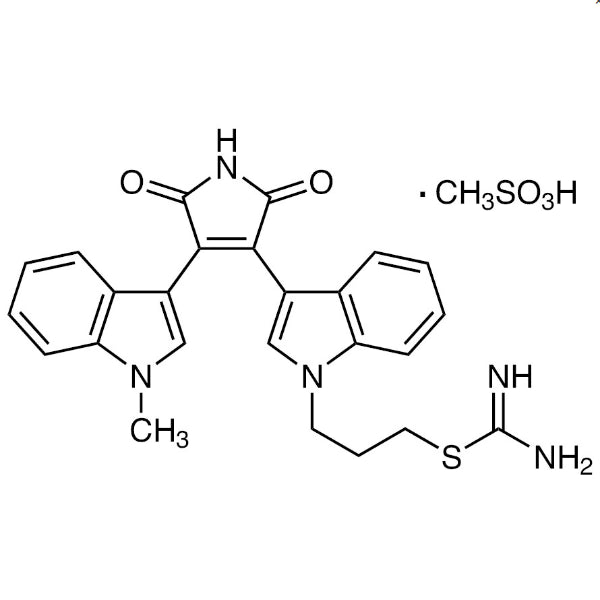
TCI R0257 138489-18-6 Ro 31-8220 Mesylate is a chemical compound widely used in life science research, particularly in cell biology and neuroscience. This compound functions as a signaling modulator, capable of influencing key biological pathways such as MAPK and neurotransmitter-related mechanisms. Its role in laboratory settings is critical for understanding cellular responses to external stimuli and the underlying mechanisms of neurological activity. Researchers rely on this compound to explore the molecular basis of various physiological and pathological processes.
The compound is prized for its high purity and specificity in targeting biological systems. It exhibits stability and solubility in organic solvents, making it compatible with a wide range of experimental techniques. These properties allow for consistent and reproducible results in experiments involving cell culture, enzyme activity assays, and molecular analysis. Its ability to interact selectively with specific receptors or enzymes enhances its utility in targeted research applications.
In Indonesian laboratories, this compound is commonly used by researchers in higher education institutions and research organizations. It plays a vital role in studies related to neurodegenerative diseases, drug development, and cellular mechanisms. Its availability in small quantities (10mg) supports practical application in laboratory settings, enabling efficient use without compromising experimental integrity.
TCI brochures (PDF)
- Leucine-Rich Repeat Kinase 2 (LRRK2) Inhibitors 2025-12-25 · p. 1
- Reagents for Biological Research 2025-03-11 · p. 47
- Neurodegenerative disease research: This compound is used to investigate the molecular pathways involved in conditions like Alzheimer’s and Parkinson’s, aiding in the development of therapeutic strategies.
- Drug discovery and development: It supports the screening of potential drug candidates by modulating cellular signaling pathways, helping identify compounds with therapeutic potential.
- Cell signaling studies: The compound is employed to study the activation and regulation of signaling cascades, providing insights into cellular communication mechanisms.
- Enzyme activity assays: Its ability to interact with specific enzymes makes it useful for evaluating enzyme function and inhibition in biochemical experiments.
- Molecular biology research: It is integrated into molecular studies to explore gene expression, protein interactions, and cellular responses to external stimuli.
From the TCI brochure
- Used as a tool in Parkinson's disease (PD) research as a LRRK2 inhibitor
| Brand | TCI |
|---|---|
| CAS number | 138489-18-6 |
| Molecular formula | — |
| Purity | — |
| Category | Life Science > Cell Biology > Cell Signaling and Neuroscience |
| Pack sizes | 10mg |
| Physical form | Solid |
| Storage | Store at controlled room temperature, away from moisture and light |
This compound should be stored in a cool, dry place, away from direct sunlight and sources of heat. It is recommended to use airtight containers to prevent exposure to moisture, which may affect its stability. Due to its chemical nature, it should be handled with appropriate personal protective equipment, such as gloves and safety goggles, to ensure laboratory safety. Proper ventilation is essential when working with this compound to minimize inhalation risks. It is important to follow standard laboratory protocols for chemical handling to maintain a safe working environment. Always ensure that the compound is stored in a designated chemical storage area to prevent accidental contamination or exposure.
References cited in the TCI brochure
- Thomas Kramer. Small Molecule Kinase Inhibitors for LRRK2 and Their Application to Parkinson's Disease Models ACS Chemical Neuroscience, 2012. doi:10.1021/cn200117j
Produk Terkait
-
ImatinibMesylate TCI I0936
Regular price Rp 2.173.500,00Regular priceRp 1.535.100,00Sale price Rp 2.173.500,00 -
BenztropineMesylate TCI B5592
Regular price Rp 2.994.600,00Regular priceRp 2.109.450,00Sale price Rp 2.994.600,00 -
PefloxacineMesylateDihydrate TCI P3024
Regular price Rp 3.498.600,00Regular priceRp 2.462.250,00Sale price Rp 3.498.600,00 -
PhentolamineMesylate TCI P1985
Regular price Rp 822.150,00Regular priceRp 590.100,00Sale price Rp 822.150,00 -
PazufloxacinMesylate TCI P1962
Regular price Rp 1.749.300,00Regular priceRp 1.239.000,00Sale price Rp 1.749.300,00 -
NelfinavirMesylate TCI N0986
Regular price Rp 4.559.100,00Regular priceRp 3.203.550,00Sale price Rp 4.559.100,00 -
NafamostatMesylate TCI N0959
Regular price Rp 1.087.800,00Regular priceRp 775.950,00Sale price Rp 1.087.800,00 -
GemifloxacinMesylate TCI G0617
Regular price Rp 3.207.750,00Regular priceRp 2.258.550,00Sale price Rp 3.207.750,00


