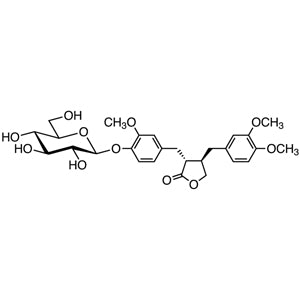
Salicin is a chemical compound belonging to the group of glycosides and serves as a natural precursor to salicylic acid. It plays a crucial role in chemical biology and glycoscience research, particularly in the study of phenolic compounds and their biological activity mechanisms. In the laboratory, Salicin is widely used as a starting material for the synthesis of pharmaceutical compounds, chemical analysis, and investigations into the pharmacological effects of natural substances. Its presence in scientific research is significant due to its stability and availability, making it a go-to material for various experimental applications.
Salicin is valued for its high purity and consistent quality, which are essential for precise and reliable research outcomes. It has a complex molecular structure composed of a glucose group attached to a phenolic compound, which contributes to its chemical stability under normal conditions. The compound is typically available as a white powder or solid, and it dissolves easily in organic solvents such as ethyl acetate and ethanol. These properties make it highly suitable for use in a wide range of chemical reactions and analytical procedures.
In Indonesian laboratories, Salicin is commonly used in pharmaceutical and chemical research. Its role in drug development and the study of natural compounds is well established. Researchers rely on its consistent quality and predictable behavior to ensure accurate and reproducible results. Its versatility in different experimental setups further enhances its importance in scientific investigations within the region.
TCI brochures (PDF)
- Pharmaceutical research for the synthesis of salicylic acid derivatives and drug development due to its natural precursor properties.
- Chemical analysis in laboratories to study phenolic compounds and their biological activity mechanisms.
- Glycoscience studies to explore the structure and function of glycosidic bonds in natural compounds.
- Pharmacological research to investigate the effects of natural substances on biological systems.
- Organic synthesis experiments where Salicin serves as a starting material for various chemical reactions.
| Brand | TCI |
|---|---|
| CAS number | 138-52-3 |
| Molecular formula | — |
| Purity | — |
| Category | Chemistry > Chemical Biology > Glycoscience |
| Pack sizes | Available in various quantities as per standard laboratory requirements |
| Physical form | White powder or solid |
| Storage | Store in a cool, dry place away from direct sunlight |
Salicin should be stored in a cool, dry environment to maintain its chemical stability and prevent degradation. It is recommended to keep the compound in airtight containers to avoid moisture exposure, which could affect its purity. Since it is a solid, it should be stored in a place that is free from extreme temperature fluctuations. In laboratory settings, it is important to handle Salicin with care, using appropriate personal protective equipment to ensure safety. Its solubility in organic solvents means that it should be handled in well-ventilated areas to prevent inhalation of vapors. Proper storage and handling practices help preserve the integrity of the compound for reliable research applications.
—
Product Categories
- GlycoscienceFunctional OligosaccharidesNatural Glycosides [Functional Oligosaccharides]
- GlycoscienceGlyco Building BlocksProtected Sugars [Oligosaccharides by Component Sugar]
- GlycoscienceMonosaccharides [Glycoscience]Glucoses [Glycoscience]
- Biochemicals and ReagentsCarbohydrates
- Biochemicals and ReagentsCrude Medicine Ingredients for Research and Experimental Use
- Pharmaceutical Development and Drug Discovery ResearchCrude Medicine Ingredients for Research and Experimental Use
Produk Terkait
-
Arbutin TCI A0522
Regular price From Rp 505.050,00Regular priceRp 368.550,00Sale price From Rp 505.050,00 -
Indican(PlantIndican) TCI I1012
Regular price Rp 2.835.000,00Regular priceRp 1.998.150,00Sale price Rp 2.835.000,00 -
Helicin TCI H0908
Regular price From Rp 1.538.250,00Regular priceRp 1.090.950,00Sale price From Rp 1.538.250,00 -
Gastrodin TCI G0468
Regular price From Rp 1.510.950,00Regular priceRp 1.072.050,00Sale price From Rp 1.510.950,00 -
Arctiin TCI A3118
Regular price From Rp 1.483.650,00Regular priceRp 1.053.150,00Sale price From Rp 1.483.650,00 -
Sophoricoside TCI S0835
Regular price Rp 8.718.150,00Regular priceRp 6.112.050,00Sale price Rp 8.718.150,00 -
Sinigrin TCI S0156
Regular price Rp 4.716.600,00Regular priceRp 3.313.800,00Sale price Rp 4.716.600,00 -
Puerarin TCI P1886
Regular price From Rp 1.458.450,00Regular priceRp 1.035.300,00Sale price From Rp 1.458.450,00