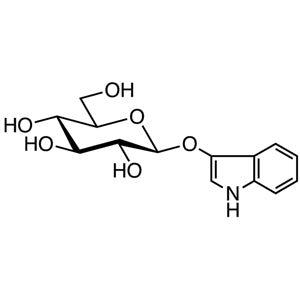
Indican (Plant Indican), also known as TCI I1012 with CAS number 487-60-5, is a chemical compound widely used in chemical and biochemical experiments. It plays a crucial role in the study of indigoid compounds, which are naturally occurring pigments found in various plant species. This compound is often utilized as a starting material for the synthesis of other bioactive substances, making it an essential component in research involving natural product chemistry. Its presence in laboratory settings supports the development of new compounds with potential applications in medicine and agriculture.
Indican is valued for its chemical stability under controlled conditions, although it is highly sensitive to ultraviolet light and oxidation. These properties make it a preferred choice for researchers seeking compounds that can participate in complex chemical reactions. Its reactivity with various reagents allows for the exploration of diverse chemical pathways, making it a versatile tool in both organic and biochemical research. The compound’s ability to serve as a natural pigment also enhances its utility in studies related to plant metabolism and biochemistry.
In Indonesian laboratories, Indican is commonly used in biochemical, pharmacological, and organic chemistry research. It is a key component in experiments involving natural product isolation, pigment analysis, and the development of bioactive compounds. Its role in these contexts highlights its importance as a fundamental reagent in the scientific community. The compound’s unique properties ensure its continued relevance in both academic and industrial research settings.
TCI brochures (PDF)
- Alkaloids 2025-10-10 · p. 6
- Phytochemicals 2025-12-17 · p. 3
- Reagents for Glyco Chemistry & Biology 5th Edition · p. 33
- Biochemical Research: Indican is used to study natural pigments and their role in plant metabolism, offering insights into metabolic pathways and bioactive compound synthesis.
- Pharmacological Studies: It serves as a precursor for the synthesis of bioactive compounds, aiding in the development of new pharmaceutical agents with therapeutic potential.
- Organic Chemistry Experiments: Its reactivity with various reagents makes it ideal for complex chemical reactions, supporting the synthesis of novel organic compounds.
- Pigment Analysis: Indican is employed in the identification and characterization of natural pigments, contributing to the understanding of plant-derived colorants.
- Natural Product Isolation: It is used in the extraction and purification of bioactive compounds from plant sources, facilitating further chemical and biological investigations.
| Brand | TCI |
|---|---|
| CAS number | 487-60-5 |
| Molecular formula | — |
| Purity | — |
| Category | Chemistry > Chemical Biology > Glycoscience |
| Pack sizes | Available in various quantities as per standard laboratory supply |
| Physical form | Solid or crystalline, depending on the specific formulation |
| Storage | Should be stored in a cool, dark place away from UV light and oxidizing agents |
Indican should be stored in a cool, dark environment to prevent degradation due to UV exposure and oxidation. It is recommended to use airtight containers made of glass or inert polymer materials to maintain its chemical integrity. The compound is sensitive to light and should be protected from direct sunlight or fluorescent lighting. In laboratory settings, it is important to handle Indican with care, using appropriate personal protective equipment such as gloves and safety goggles. Proper labeling of storage containers is essential to ensure safe handling and prevent accidental exposure. Regular monitoring of storage conditions helps maintain the compound’s stability and effectiveness for research applications.
—
Product Categories
- GlycoscienceFunctional OligosaccharidesNatural Glycosides [Functional Oligosaccharides]
- GlycoscienceGlyco Building BlocksProtected Sugars [Oligosaccharides by Component Sugar]
- GlycoscienceMonosaccharides [Glycoscience]Glucoses [Glycoscience]
- Biochemicals and ReagentsAlkaloidsIndole Alkaloids
- Biochemicals and ReagentsCarbohydrates
- Cell BiologyNutrition ResearchPhytochemicals
Produk Terkait
-
Arbutin TCI A0522
Regular price From Rp 505.050,00Regular priceRp 368.550,00Sale price From Rp 505.050,00 -
Gastrodin TCI G0468
Regular price From Rp 1.510.950,00Regular priceRp 1.072.050,00Sale price From Rp 1.510.950,00 -
Salicin TCI S0003
Regular price From Rp 1.033.200,00Regular priceRp 738.150,00Sale price From Rp 1.033.200,00 -
Helicin TCI H0908
Regular price From Rp 1.538.250,00Regular priceRp 1.090.950,00Sale price From Rp 1.538.250,00 -
4-Formylphenylbeta-D-Allopyranoside TCI F0542
Regular price Rp 3.048.150,00Regular priceRp 2.147.250,00Sale price Rp 3.048.150,00 -
Arctiin TCI A3118
Regular price From Rp 1.483.650,00Regular priceRp 1.053.150,00Sale price From Rp 1.483.650,00 -
Sophoricoside TCI S0835
Regular price Rp 8.718.150,00Regular priceRp 6.112.050,00Sale price Rp 8.718.150,00 -
Puerarin TCI P1886
Regular price From Rp 1.458.450,00Regular priceRp 1.035.300,00Sale price From Rp 1.458.450,00