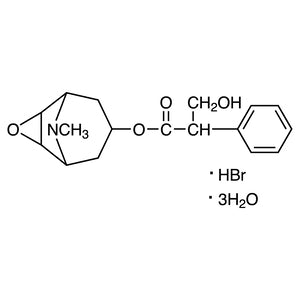
Scopolamine Methyl Nitrate from TCI, product code S0230, is also known as methscopolamine nitrate. It is a quaternary ammonium derivative of scopolamine, a tropane alkaloid found naturally in plants of the Solanaceae family. Methylation at the nitrogen atom converts scopolamine into a quaternary cation, which is paired with a nitrate anion. In the laboratory, this compound serves as a biochemical and pharmacological reagent. Its main use is as a muscarinic acetylcholine receptor antagonist in research on the autonomic nervous system.
The key feature of Scopolamine Methyl Nitrate is the permanent positive charge on its quaternary nitrogen. This charge makes the molecule highly polar, so it has difficulty crossing the blood-brain barrier. Its parent compound, scopolamine, acts strongly on the central nervous system, so the two behave quite differently. Researchers use this difference to separate peripheral antimuscarinic effects from central effects when designing experiments. Because TCI supplies it as an alkaloid of defined purity, the compound is also a useful reference material for developing analytical methods for tropane compounds.
In Indonesia, this reagent is relevant to pharmacology laboratories in faculties of pharmacy and medicine, neuroscience research laboratories, and analytical laboratories that work with natural products and alkaloids. Academic researchers can use it in teaching and research on cholinergic pharmacology, and analytical teams can use it to build and check methods for tropane alkaloids. As a TCI product supplied through AMI Scientific, it suits institutions that need a well-identified alkaloid reagent from an established manufacturer for reproducible experimental work.
TCI brochures (PDF)
- Alkaloids 2025-10-10 · p. 3
- Quaternary Ammonium Salts 2025-11-10 · p. 10
- Pharmaceutical Ingredients for Research and Experimental Use 2026-03-09 · p. 30
- Muscarinic receptor antagonism studies: the compound blocks muscarinic acetylcholine receptors, so it is a suitable tool for studying how cholinergic signalling works in experimental models of the autonomic nervous system.
- Separating peripheral and central effects: its permanent charge limits passage across the blood-brain barrier, so researchers can tell peripheral antimuscarinic actions apart from central actions when comparing it with scopolamine.
- Autonomic nervous system research: it acts mainly on peripheral muscarinic receptors, which makes it useful for studies of the parasympathetic control of organs and tissues in pharmacology laboratories.
- Analytical method development for tropane alkaloids: as a TCI alkaloid of defined purity, it can serve as reference material when developing and checking chromatographic or other analytical methods for tropane compounds.
- Teaching in cholinergic pharmacology: pharmacy and medical faculties can use it to show students how a quaternary derivative changes a parent alkaloid's polarity, distribution, and pharmacological profile.
| Brand | TCI (product code S0230) |
|---|---|
| CAS number | 6106-46-3 |
| Molecular formula | — |
| Purity | — |
| Category | Life Science > Biochemicals and Reagents > Alkaloids |
| Pack sizes | available in TCI's standard pack sizes; confirm the current options with AMI Scientific |
| Physical form | refer to TCI's product label and Certificate of Analysis |
| Storage | follow the conditions stated on TCI's label and Safety Data Sheet |
Keep Scopolamine Methyl Nitrate in its original, tightly closed TCI container. Store it in a cool, dry, well-ventilated place away from direct light, moisture, and incompatible materials, and follow the specific storage conditions on the product label and Safety Data Sheet. The compound is a pharmacologically active anticholinergic alkaloid and a nitrate salt, so handle it carefully. Wear laboratory gloves, safety glasses, and a lab coat. Weigh it in a fume hood or ventilated enclosure to avoid inhaling dust, and do not let it touch skin or eyes. Label all containers clearly, keep the reagent away from heat and reducing agents, and dispose of waste according to institutional and local chemical waste regulations.
—
Product Categories
- Biochemicals and ReagentsAlkaloidsTropane Alkaloids
- Biochemicals and ReagentsPharmaceutical Research Reagents (for Experimental Use)Neurotransmitter Agent Ingredients (for Research and Experimental Use)
- Pharmaceutical Development and Drug Discovery ResearchPharmaceutical Research Reagents (for Experimental Use)Neurotransmitter Agent Ingredients (for Research and Experimental Use)
Produk Terkait
-
ScopolamineMethylBromide TCI S0231
Regular price Rp 3.048.150,00Regular priceRp 2.147.250,00Sale price Rp 3.048.150,00 -
ScopolamineHydrobromideTrihydrate TCI S0021
Regular price From Rp 2.730.000,00Regular priceRp 1.924.650,00Sale price From Rp 2.730.000,00 -
AtropineSulfateMonohydrate TCI A0550
Regular price From Rp 1.908.900,00Regular priceRp 1.350.300,00Sale price From Rp 1.908.900,00 -
TropisetronHydrochloride TCI T2743
Regular price From Rp 3.392.550,00Regular priceRp 2.387.700,00Sale price From Rp 3.392.550,00 -
Atropine TCI A0754
Regular price From Rp 3.551.100,00Regular priceRp 2.499.000,00Sale price From Rp 3.551.100,00 -
HomatropineHydrobromide TCI H0155
Regular price Rp 1.298.850,00Regular priceRp 924.000,00Sale price Rp 1.298.850,00 -
Buscopan TCI B6485
Regular price From Rp 1.881.600,00Regular priceRp 1.331.400,00Sale price From Rp 1.881.600,00 -
SulconazoleNitrate TCI U0112
Regular price From Rp 3.312.750,00Regular priceRp 2.332.050,00Sale price From Rp 3.312.750,00