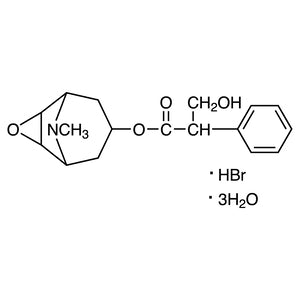
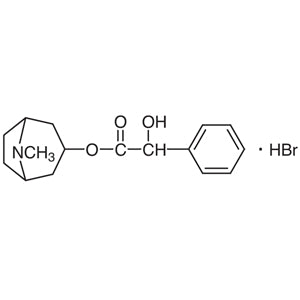
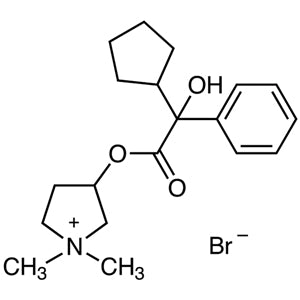
Scopolamine Methyl Bromide from TCI, product code S0231, is also known as methscopolamine bromide. It is a quaternary ammonium salt of scopolamine with a bromide anion. Scopolamine is a tropane alkaloid found in plants of the Solanaceae family, and methylating its nitrogen atom produces a cation with a permanent charge. In the laboratory, this compound is used as a biochemical reagent in pharmacological research, mainly as a muscarinic acetylcholine receptor antagonist that acts mostly on peripheral tissues.
The permanent positive charge on the quaternary nitrogen makes Scopolamine Methyl Bromide highly polar, so it does not readily cross into the central nervous system. Researchers choose it for this reason when they want to block muscarinic receptors in peripheral organs without the strong central effects of scopolamine itself. The bromide is the best-known salt of this compound in the pharmacological literature, more so than the nitrate. That makes reference data easier to find when researchers design and compare their experimental protocols.
In Indonesian laboratories, this reagent is relevant to pharmacology researchers in faculties of pharmacy and medicine, and to related life science research groups. These teams study the cholinergic system, peripheral receptor pharmacology and the differences between central and peripheral drug action. Because the TCI product code S0231 and the CAS number 155-41-9 are clearly stated, procurement staff and researchers can match the reagent to their protocols, literature references and internal documentation.
TCI brochures (PDF)
- Neurotransmission Research Reagents 2026-07-17 · p. 1
- Alkaloids 2025-10-10 · p. 3
- Quaternary Ammonium Salts 2025-11-10 · p. 6
- Pharmaceutical Ingredients for Research and Experimental Use 2026-03-09 · p. 30
- Muscarinic receptor antagonism studies: As a muscarinic acetylcholine receptor antagonist, the compound lets researchers block cholinergic signalling and study how receptors respond in experimental systems.
- Peripheral versus central pharmacology comparisons: Its limited penetration into the central nervous system makes it a useful comparator to scopolamine when separating peripheral effects from central ones.
- Peripheral organ pharmacology research: Its permanently charged, highly polar structure suits experiments that aim to block muscarinic receptors in peripheral organs without strong central effects.
- Cholinergic system research: Researchers studying acetylcholine signalling pathways can use this well-characterised tropane alkaloid derivative to probe how muscarinic receptors are involved in physiological responses.
- Protocol development and literature-based comparison: The bromide is the most widely documented salt form, so researchers can compare their results with published pharmacological data when designing experimental protocols.
| Brand | TCI (product code S0231) |
|---|---|
| CAS number | 155-41-9 |
| Molecular formula | — |
| Purity | — |
| Category | Life Science > Biochemicals and Reagents > Alkaloids |
| Pack sizes | Please confirm the available pack sizes with AMI Scientific before ordering |
| Physical form | Refer to TCI product documentation |
| Storage | Follow the conditions stated on the TCI label and Safety Data Sheet |
Keep Scopolamine Methyl Bromide in its original, tightly closed manufacturer container in a cool, dry and well-ventilated place, away from direct light and moisture, unless the TCI label or Safety Data Sheet states other conditions. As a pharmacologically active alkaloid derivative, it should be handled only by trained personnel. Wear suitable protective equipment, including gloves, a laboratory coat and safety glasses. Avoid creating dust, avoid inhaling it or letting it touch skin or eyes, and weigh the material in a fume hood or ventilated enclosure. Label containers clearly, keep the reagent away from food and drink, and dispose of waste according to institutional and local regulations.
—
Product Categories
- Biochemicals and ReagentsAlkaloidsTropane Alkaloids
- Biochemicals and ReagentsPharmaceutical Research Reagents (for Experimental Use)Neurotransmitter Agent Ingredients (for Research and Experimental Use)
- Biochemicals and Reagents
- Cell BiologyCell Signaling and NeuroscienceNeuroscience
- Pharmaceutical Development and Drug Discovery ResearchPharmaceutical Research Reagents (for Experimental Use)Neurotransmitter Agent Ingredients (for Research and Experimental Use)
Produk Terkait
-
ScopolamineHydrobromideTrihydrate TCI S0021
Regular price From Rp 2.730.000,00Regular priceRp 1.924.650,00Sale price From Rp 2.730.000,00 -
Atropine TCI A0754
Regular price From Rp 3.551.100,00Regular priceRp 2.499.000,00Sale price From Rp 3.551.100,00 -
ScopolamineMethylNitrate TCI S0230
Regular price From Rp 4.504.500,00Regular priceRp 3.165.750,00Sale price From Rp 4.504.500,00 -
PyridostigmineBromide TCI P1339
Regular price From Rp 4.266.150,00Regular priceRp 2.998.800,00Sale price From Rp 4.266.150,00 -
AtropineSulfateMonohydrate TCI A0550
Regular price From Rp 1.908.900,00Regular priceRp 1.350.300,00Sale price From Rp 1.908.900,00 -
HomatropineHydrobromide TCI H0155
Regular price Rp 1.298.850,00Regular priceRp 924.000,00Sale price Rp 1.298.850,00 -
Glycopyrrolate TCI G0392
Regular price Rp 5.592.300,00Regular priceRp 3.925.950,00Sale price Rp 5.592.300,00 -
Buscopan TCI B6485
Regular price From Rp 1.881.600,00Regular priceRp 1.331.400,00Sale price From Rp 1.881.600,00