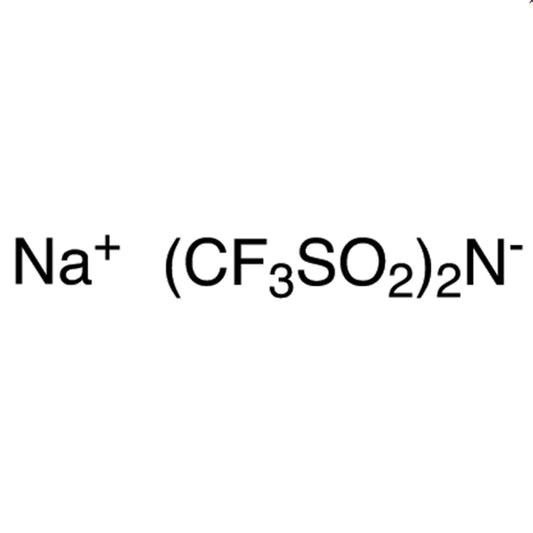
Sodium Bis(fluorosulfonyl)imide is a chemical compound widely used in laboratory settings for its unique reactivity and versatility in catalytic and synthetic processes. As a key component in inorganic chemistry, it plays a crucial role in various chemical reactions, particularly in the synthesis of organic and inorganic compounds. Its ability to act as both a catalyst and a reagent makes it an essential material for researchers working in catalysis and chemical synthesis. This compound is especially valuable in environments where high reactivity and precise chemical control are required.
The compound's chemical properties, including its stability under certain conditions and its reactivity towards water and heat, make it a preferred choice for specialized applications. Its high melting point ensures it remains stable in high-temperature environments, which is beneficial for laboratory processes that require elevated temperatures. Additionally, its high purity level ensures consistent results in experiments, making it ideal for applications that demand accuracy and reliability. These properties make it a valuable tool in both academic and industrial research settings.
In Indonesian laboratories, Sodium Bis(fluorosulfonyl)imide is commonly used in pure and applied chemistry research, particularly in higher education institutions and research organizations. It is relevant in the development of new materials and in studies involving fluorinated compounds, which have applications in various scientific and industrial fields. Its use is widespread in both fundamental and applied research, contributing to advancements in chemical science and technology.
TCI brochures (PDF)
- Sodium Electrolytes 2025-09-19 · p. 1
- Metallic Salts 2025-11-06 · p. 13
Related TCI products
- TCI P2509 14984-76-0 Potassium Bis(fluorosulfonyl)imide
- TCI P2410 860653-59-4 Potassium (Fluorosulfonyl)(trifluoromethanesulfonyl)imide
- TCI L0295 192998-62-2 Lithium (Fluorosulfonyl)(trifluoromethanesulfonyl)imide
- TCI C3476 1906900-37-5 Calcium Bis(fluorosulfonyl)imide
- TCI S0989 91742-21-1 Sodium Bis(trifluoromethanesulfonyl)imide
- TCI O0492 129135-86-0 Sodium Bis(nonafluorobutanesulfonyl)imide
- Catalytic Reactions: Sodium Bis(fluorosulfonyl)imide is ideal for catalytic reactions due to its high reactivity and ability to facilitate complex chemical transformations.
- Organic Synthesis: This compound is frequently used in organic synthesis to promote the formation of new chemical bonds and structures with high efficiency.
- Inorganic Chemistry Research: Its role in inorganic chemistry allows researchers to explore the behavior of main-group elements in various reaction conditions.
- Fluorinated Compound Studies: The compound is essential in studies involving fluorinated materials, which have applications in pharmaceuticals and advanced materials.
- High-Temperature Processes: Its high melting point makes it suitable for use in reactions that require elevated temperatures without decomposition.
| Brand | TCI |
|---|---|
| CAS number | 100669-96-3 |
| Molecular formula | — |
| Purity | — |
| Category | Chemistry > Catalysis and Inorganic Chemistry > Main-group Elements |
| Pack sizes | Available in standard laboratory quantities |
| Physical form | Solid |
| Storage | Store in a dry, cool place away from moisture and heat |
Sodium Bis(fluorosulfonyl)imide should be stored in a dry, cool environment to maintain its chemical stability and prevent degradation. It is recommended to use airtight containers to protect it from moisture and humidity, as it is highly reactive towards water. Due to its reactivity with heat, it should be kept away from direct heat sources and stored in a well-ventilated area. Laboratory personnel should handle the compound with care, using appropriate personal protective equipment to ensure safety during handling and use. Proper storage and handling are essential to maintain its effectiveness and ensure safe laboratory operations.
—
Produk Terkait
-
PotassiumBis(fluorosulfonyl)imide TCI P2509
Regular price From Rp 1.035.300,00Regular priceRp 723.450,00Sale price From Rp 1.035.300,00 -
Potassium(Fluorosulfonyl)(trifluoromethanesulfonyl)imide TCI P2410
Regular price From Rp 2.041.200,00Regular priceRp 1.442.700,00Sale price From Rp 2.041.200,00 -
Lithium(Fluorosulfonyl)(trifluoromethanesulfonyl)imide TCI L0295
Regular price From Rp 2.809.800,00Regular priceRp 1.980.300,00Sale price From Rp 2.809.800,00 -
CalciumBis(fluorosulfonyl)imide TCI C3476
Regular price From Rp 2.969.400,00Regular priceRp 2.075.850,00Sale price From Rp 2.969.400,00 -
SodiumBis(trifluoromethanesulfonyl)imide TCI S0989
Regular price From Rp 1.405.950,00Regular priceRp 998.550,00Sale price From Rp 1.405.950,00 -
SodiumBis(nonafluorobutanesulfonyl)imide TCI O0492
Regular price From Rp 1.643.250,00Regular priceRp 1.164.450,00Sale price From Rp 1.643.250,00 -
LithiumBis(fluorosulfonyl)imide TCI L0281
Regular price From Rp 1.644.300,00Regular priceRp 1.149.750,00Sale price From Rp 1.644.300,00 -
Zinc(II)Bis(trifluoromethanesulfonyl)imide TCI Z0027
Regular price From Rp 1.618.050,00Regular priceRp 1.146.600,00Sale price From Rp 1.618.050,00