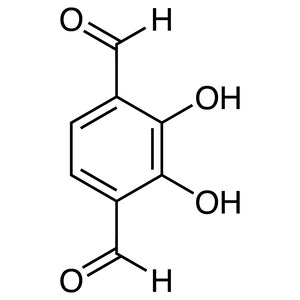
Methyl Terephthalaldehydate is a chemical compound widely used in laboratory settings for its versatile reactivity and structural characteristics. It serves as a key building block in organic synthesis, particularly in the creation of complex organic molecules. This compound is valued for its ability to participate in a variety of chemical reactions, making it a crucial reagent for chemists working on synthetic pathways. Its unique molecular structure, featuring both an aldehyde group and an ester group, allows it to interact with multiple reagents, enhancing its utility in laboratory research.
The compound’s reactivity stems from its aldehyde functional group, which is highly susceptible to nucleophilic attack, while its ester group provides a degree of stability. These properties make it ideal for reactions such as condensation, reduction, and nucleophilic substitution. Its ability to form stable intermediates during synthesis also makes it a preferred choice for researchers aiming to develop new compounds with specific functional groups. The combination of reactivity and stability ensures that Methyl Terephthalaldehydate remains a reliable and effective reagent in synthetic chemistry.
In Indonesian laboratories, Methyl Terephthalaldehydate is commonly used in academic and industrial research settings. It is frequently employed in the development of heterocyclic compounds, polymers, and specialty chemicals. Its availability in the local market supports ongoing research efforts, enabling scientists to access high-quality reagents for their experiments. The compound’s role in creating complex molecular structures makes it an essential component in various chemical processes within the country’s scientific community.
Related TCI products
- Organic synthesis is a primary application where Methyl Terephthalaldehydate is used to create complex organic molecules due to its reactive aldehyde group and stable ester group.
- Heterocyclic compound development benefits from its ability to participate in nucleophilic reactions, making it ideal for synthesizing ring structures.
- Polymer research utilizes this compound as a building block for creating polymers with specific functional groups due to its reactivity and structural versatility.
- Specialty chemical production relies on its unique properties to develop compounds with tailored chemical functionalities for industrial applications.
- Academic research in Indonesian universities frequently incorporates this compound to explore new synthetic pathways and chemical transformations.
| Brand | TCI |
|---|---|
| CAS number | 1571-08-0 |
| Molecular formula | — |
| Purity | — |
| Category | Chemistry > Building Blocks > Non-Heterocyclic Building Blocks |
| Pack sizes | Available in various quantities as per standard laboratory supply |
| Physical form | Solid or liquid depending on the specific product variant |
| Storage | Store in a cool, dry place away from direct sunlight and moisture |
Methyl Terephthalaldehydate should be stored in a cool, dry environment to maintain its chemical integrity. It is recommended to keep it in a sealed container to prevent exposure to moisture and air, which could affect its reactivity. Due to its potential for chemical interactions, it should be stored away from incompatible substances such as strong oxidizers or reducing agents. In laboratory settings, proper ventilation is essential when handling this compound to minimize inhalation risks. Always use appropriate personal protective equipment, including gloves and safety goggles, to ensure safe handling. Regular monitoring of storage conditions is advised to maintain the compound’s effectiveness and safety for use in chemical experiments.
—
Produk Terkait
-
TerephthalaldehydeMono(diethylAcetal) TCI T1401
Regular price Rp 3.578.400,00Regular priceRp 2.502.150,00Sale price Rp 3.578.400,00 -
Terephthalaldehyde TCI T0010
Regular price From Rp 980.700,00Regular priceRp 685.650,00Sale price From Rp 980.700,00 -
TerephthalaldehydicAcid TCI T0011
Regular price From Rp 1.378.650,00Regular priceRp 979.650,00Sale price From Rp 1.378.650,00 -
2,3-Dihydroxyterephthalaldehyde TCI D6103
Regular price From Rp 2.174.550,00Regular priceRp 1.520.400,00Sale price From Rp 2.174.550,00 -
2,3-Dimethoxyterephthalaldehyde TCI D6102
Regular price From Rp 3.232.950,00Regular priceRp 2.260.650,00Sale price From Rp 3.232.950,00 -
2,5-Divinylterephthalaldehyde TCI D6078
Regular price From Rp 2.359.350,00Regular priceRp 1.649.550,00Sale price From Rp 2.359.350,00 -
2,5-Dimethoxyterephthalaldehyde TCI D6056
Regular price From Rp 1.644.300,00Regular priceRp 1.149.750,00Sale price From Rp 1.644.300,00 -
2,5-Dibromoterephthalaldehyde TCI D5793
Regular price Rp 1.961.400,00Regular priceRp 1.371.300,00Sale price Rp 1.961.400,00