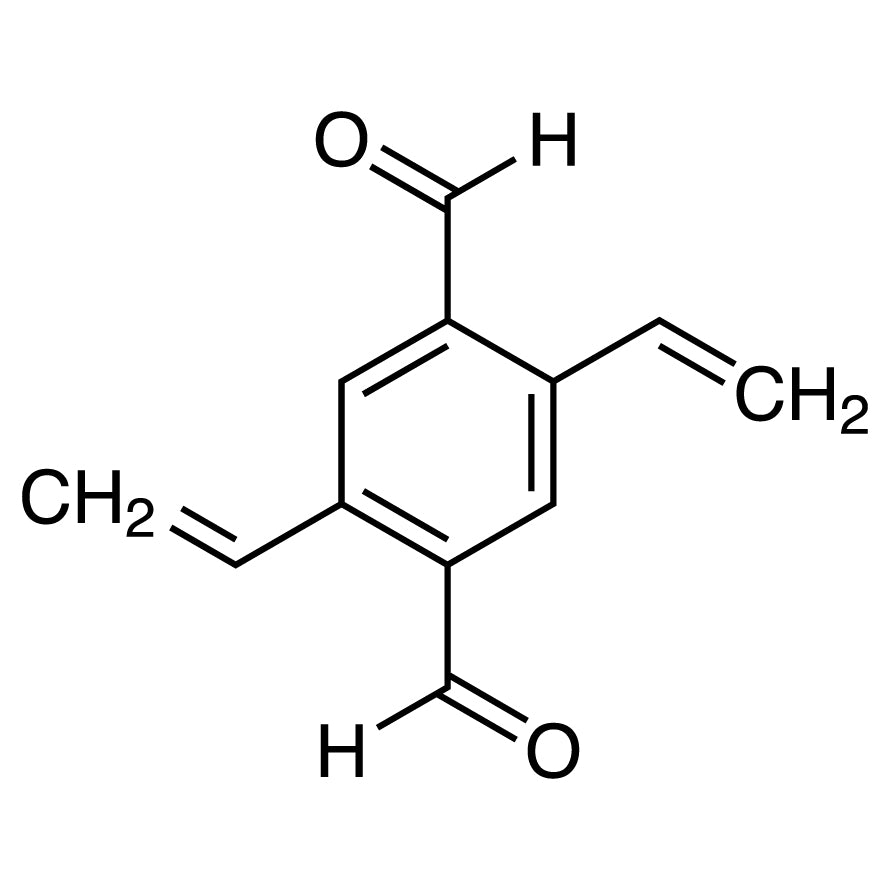
2,5-Divinylterephthalaldehyde is a chemical compound widely used as a building block in the synthesis of complex organic molecules. It serves as a versatile reagent in laboratory settings, offering unique structural features that enable participation in various chemical reactions. Its molecular structure consists of a terephthalaldehyde core with two vinyl groups positioned at the 2 and 5 positions, making it highly reactive and suitable for advanced synthetic applications. This compound is particularly valuable in organic chemistry due to its ability to form new bonds and participate in multiple reaction mechanisms.
The reactivity of 2,5-Divinylterephthalaldehyde is a key factor in its popularity among researchers. It exhibits strong tendencies toward addition and substitution reactions, making it an ideal candidate for reactions such as Diels-Alder and cross-coupling. Its molecular structure provides multiple functional groups that can be modified or reacted with, allowing for the development of complex and functional molecules. These properties make it a preferred choice in laboratories aiming to create novel compounds with specific applications in pharmaceuticals and materials science.
In Indonesian laboratories, 2,5-Divinylterephthalaldehyde is commonly used in research projects focused on organic synthesis and chemical innovation. It is particularly favored in academic and industrial settings where the development of new materials or pharmaceutical compounds is required. Its stability under controlled conditions also facilitates safe handling and storage, ensuring consistent performance in experimental processes.
TCI brochures (PDF)
- Monomers 2025-05-28 · p. 15
Related TCI products
- Organic synthesis is a primary application due to its reactivity and ability to form complex structures through various reaction mechanisms.
- Pharmaceutical research benefits from its potential to be modified into bioactive compounds with therapeutic applications.
- Material science applications leverage its structural versatility for the development of advanced polymers and functional materials.
- Cross-coupling reactions are enhanced by its ability to participate in bond-forming processes under controlled conditions.
- Academic research utilizes it as a key reagent in teaching and experimental studies on organic chemistry principles.
| Brand | TCI |
|---|---|
| CAS number | 2065232-74-6 |
| Molecular formula | — |
| Purity | — |
| Category | Chemistry > Building Blocks > Non-Heterocyclic Building Blocks |
| Pack sizes | Available in various quantities as per supplier specifications |
| Physical form | Solid or liquid depending on formulation |
| Storage | Store in a cool, dry place away from light and moisture |
This compound should be stored in a cool, dry environment, away from direct sunlight and moisture to maintain its stability and reactivity. It is recommended to use airtight containers made of glass or high-density polyethylene to prevent contamination and degradation. Due to its chemical reactivity, it should be handled with appropriate personal protective equipment, including gloves and safety goggles. In laboratory settings, it should be kept in a well-ventilated area to minimize exposure. Proper labeling and storage practices are essential to ensure safe handling and prevent accidental contact with incompatible substances.
—
Produk Terkait
-
TerephthalaldehydeMono(diethylAcetal) TCI T1401
Regular price Rp 3.578.400,00Regular price -
Terephthalaldehyde TCI T0010
Regular price From Rp 980.700,00Regular price -
TerephthalaldehydicAcid TCI T0011
Regular price From Rp 1.326.150,00Regular price -
MethylTerephthalaldehydate TCI T0012
Regular price From Rp 1.829.100,00Regular price -
PhthalaldehydicAcid TCI P0281
Regular price From Rp 1.378.650,00Regular price -
2-HydroxyethylMethylTerephthalate TCI T1679
Regular price From Rp 1.803.900,00Regular price -
Bis(2-hydroxyethyl)Terephthalate TCI B3429
Regular price From Rp 928.200,00Regular price -
DisodiumTerephthalate TCI T1097
Regular price From Rp 1.510.950,00Regular price