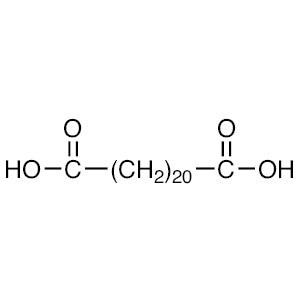
Tridecanedioic Acid (TCA), also known as TCI T0021 with CAS number 505-52-2, is a dicarboxylic acid that plays a crucial role in various chemical reactions within the laboratory. As a building block in organic chemistry, it serves as a versatile reagent for synthesizing complex compounds. Its two carboxylic acid groups allow it to react with amines, alcohols, and esters, making it an essential component in the development of polymers, solvents, and industrial chemicals. This compound is widely used in both academic and industrial research settings due to its stability and reactivity.
One of the key properties that make TCA a preferred choice is its stable molecular structure and high melting point, which ensures it remains effective under a variety of laboratory conditions. Its non-hazardous nature and lack of strong odor make it suitable for use in both small-scale and large-scale experiments. Additionally, its ability to form esters and participate in esterification reactions makes it a valuable tool in organic synthesis. These characteristics contribute to its widespread use in chemical laboratories.
In Indonesian laboratories, Tridecanedioic Acid is commonly found in chemical, pharmaceutical, and industrial research settings. It is used in the development of new materials, the synthesis of complex organic compounds, and in the study of molecular interactions. Its availability through suppliers like AMI Scientific ensures that researchers have access to this essential reagent for their experiments and innovations.
TCI brochures (PDF)
- Lipids 2025-12-17 · p. 8
- Organic synthesis is a primary application where TCA is used to create complex compounds through esterification and other reactions.
- Polymer development benefits from TCA as it can be used to form ester linkages, contributing to the structure of synthetic polymers.
- Industrial chemical production relies on TCA due to its reactivity and ability to form various functional groups in chemical compounds.
- Pharmaceutical research utilizes TCA for the synthesis of drug molecules and the development of new therapeutic agents.
- Material science applications involve TCA in the creation of advanced materials with specific chemical and physical properties.
| Brand | TCI |
|---|---|
| CAS number | 505-52-2 |
| Molecular formula | — |
| Purity | — |
| Category | Chemistry > Building Blocks > Non-Heterocyclic Building Blocks |
| Pack sizes | Available in various quantities as per supplier specifications |
| Physical form | Solid |
| Storage | Store in a cool, dry place away from moisture and direct sunlight |
Tridecanedioic Acid should be stored in a cool, dry environment to maintain its chemical stability and prevent degradation. It is recommended to keep it in airtight containers to avoid exposure to moisture and air, which can affect its reactivity. Due to its solid form, it should be stored in a place that prevents physical damage. In laboratory settings, it is important to handle the compound with care, using appropriate personal protective equipment to ensure safety. Regular monitoring of storage conditions is advised to maintain the integrity of the material for use in experiments.
—
Produk Terkait
-
DodecanedioicAcid TCI D0013
Regular price From Rp 637.350,00Regular priceRp 460.950,00Sale price From Rp 637.350,00 -
TetradecanedioicAcid TCI T0704
Regular price From Rp 2.173.500,00Regular priceRp 1.535.100,00Sale price From Rp 2.173.500,00 -
PentadecanedioicAcid TCI P0909
Regular price From Rp 530.250,00Regular priceRp 386.400,00Sale price From Rp 530.250,00 -
HexadecanedioicAcid TCI H0293
Regular price From Rp 1.298.850,00Regular priceRp 924.000,00Sale price From Rp 1.298.850,00 -
Tridecanal TCI T0410
Regular price Rp 3.710.700,00Regular priceRp 2.594.550,00Sale price Rp 3.710.700,00 -
12-Methyltridecanal TCI M3275
Regular price Rp 5.910.450,00Regular priceRp 4.132.800,00Sale price Rp 5.910.450,00 -
DocosanedioicAcid TCI D3137
Regular price Rp 7.128.450,00Regular priceRp 5.000.100,00Sale price Rp 7.128.450,00 -
DodecanedioylDichloride TCI D2544
Regular price From Rp 1.405.950,00Regular priceRp 998.550,00Sale price From Rp 1.405.950,00