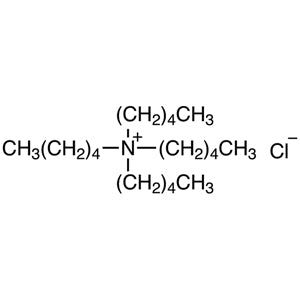
TCI T0055 Tetrabutylammonium Chloride (CAS 1112-67-0) is a quaternary ammonium salt made up of a tetrabutylammonium cation and a chloride anion. In the specialty synthesis category it is known as a building block for ionic liquids and deep eutectic solvents. It is also widely used as a phase-transfer catalyst and as a source of chloride ions that dissolve in organic solvents. In the laboratory it supports research on alternative reaction media and biphasic reactions. It also serves a wide range of transformations that need chloride in a readily soluble form.
Researchers choose this compound because its large, lipophilic cation makes the salt soluble in many organic solvents. As a result, the chloride ion is more "naked" and reactive than chloride supplied by ordinary inorganic salts. As a component of ionic liquids or eutectic solvents, it can be combined with hydrogen-bond donors to form media whose properties can be tuned. The dissolved chloride ion can also disrupt hydrogen-bonding networks. This makes the compound relevant to studies of biopolymer dissolution and anion exchange, where chloride availability in non-aqueous systems is essential.
In Indonesia, this material is relevant to green chemistry laboratories, biomass research groups, and organic synthesis teams at universities and research institutions. Researchers studying sustainable solvents can use it to prepare and test deep eutectic solvent formulations. Groups working on locally abundant biomass can use it to explore cellulose and lignocellulose dissolution. Synthetic chemists rely on it for phase-transfer reactions and chloride-mediated transformations, making it a versatile reagent for both teaching and advanced research.
TCI brochures (PDF)
- Pyrylium Salt for Nucleophilic Aromatic Substitution Reactions 2023-10-17 · p. 1
- NHC Reagent for Redox Activation of Alcohols Deoxazole 2025-09-18 · p. 2
- Titanium Reagents Julia-Kocienski Olefination Reagents Peterson Reaction Reagents Z-Selective Horner-Wadsworth-Emmons Reagents 2025-03-28 · p. 3
- Ionic Liquids 2026-06-08 · p. 6
- Quaternary Ammonium Salts 2025-11-10 · p. 3
- Colloidal Quantum Dot (QD) Research Reagents 2026-05-21 · p. 10
Related TCI products
- Deep eutectic solvent preparation: the salt can be combined with hydrogen-bond donors to form tunable solvent media for green chemistry and alternative reaction medium research.
- Ionic liquid research: its tetrabutylammonium cation and chloride anion make it a useful component for building and studying ionic liquid systems with adjustable properties.
- Phase-transfer catalysis: the lipophilic cation carries reactive anions between aqueous and organic phases, which helps biphasic reactions proceed efficiently under mild laboratory conditions.
- Soluble chloride source in organic synthesis: it delivers chloride ions that dissolve in organic solvents, which are more reactive than chloride from conventional inorganic salts.
- Biopolymer dissolution and anion exchange studies: dissolved chloride disrupts hydrogen-bonding networks, so the compound is relevant to cellulose and biomass dissolution and anion exchange experiments.
From the TCI brochure
- Chloride source in deaminative chlorination of amino heteroaromatics (shown with P2823 in scheme)
| Brand | TCI (product code T0055) |
|---|---|
| CAS number | 1112-67-0 |
| Molecular formula | — |
| Purity | — |
| Category | Chemistry > Specialty Synthesis > Ionic Liquids [Specialty Synthesis] |
| Pack sizes | as listed by TCI for product T0055; please confirm available sizes with AMI Scientific |
| Physical form | solid quaternary ammonium salt; refer to the TCI certificate of analysis for details |
| Storage | keep tightly closed in a cool, dry place, protected from moisture |
Store Tetrabutylammonium Chloride in its original, tightly sealed container in a cool, dry, well-ventilated area away from moisture and incompatible materials such as strong oxidizing agents. Quaternary ammonium salts can take up moisture from the air, so close containers promptly after use and consider storing them in a desiccator. Handle the material with standard laboratory protective equipment, including gloves, safety glasses, and a lab coat. Avoid creating or inhaling dust, prevent contact with skin and eyes, and work in a fume hood where appropriate. Always consult the TCI Safety Data Sheet before use and dispose of waste according to local regulations.
References cited in the TCI brochure
- Clément Ghiazza. Deaminative chlorination of aminoheterocycles Nature Chemistry, 2021. doi:10.1038/s41557-021-00812-0
Product Categories
Produk Terkait
-
TetrabutylammoniumIodide TCI T0057
Regular price From Rp 769.650,00Regular priceRp 553.350,00Sale price From Rp 769.650,00 -
TetrabutylammoniumBromide TCI T0054
Regular price From Rp 557.550,00Regular priceRp 405.300,00Sale price From Rp 557.550,00 -
TetrapropylammoniumChloride TCI T2106
Regular price Rp 1.908.900,00Regular priceRp 1.350.300,00Sale price Rp 1.908.900,00 -
TetraamylammoniumChloride TCI T1433
Regular price From Rp 3.551.100,00Regular priceRp 2.499.000,00Sale price From Rp 3.551.100,00 -
Tetrabutylammoniump-Toluenesulfonate TCI T3660
Regular price From Rp 1.405.950,00Regular priceRp 998.550,00Sale price From Rp 1.405.950,00 -
TetrabutylammoniumAcetate TCI T2694
Regular price From Rp 822.150,00Regular priceRp 590.100,00Sale price From Rp 822.150,00 -
TetrabutylammoniumTrifluoromethanesulfonate TCI T1568
Regular price From Rp 2.914.800,00Regular priceRp 2.053.800,00Sale price From Rp 2.914.800,00 -
TetrabutylammoniumHexafluorophosphate TCI T1279
Regular price From Rp 1.087.800,00Regular priceRp 775.950,00Sale price From Rp 1.087.800,00