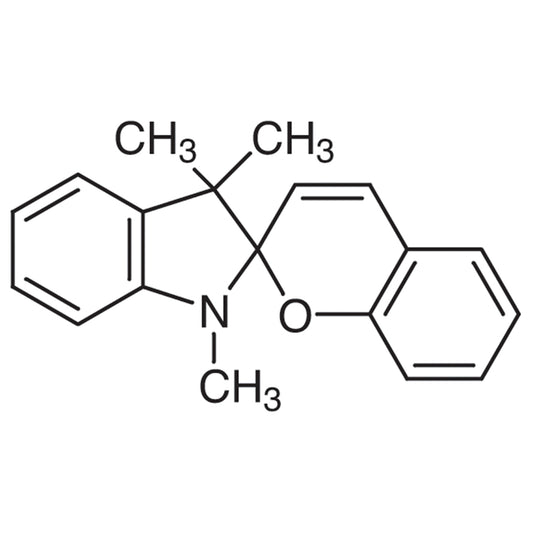
1,3,3-Trimethylindolino-6'-nitrobenzopyrylospiran is a photochromic dye used in laboratory settings for its unique ability to change color in response to specific wavelengths of light, such as ultraviolet or visible light. This chemical compound plays a crucial role in the development of optical and photonic materials, enabling researchers to study light-sensitive reactions and create functional materials with dynamic optical properties. Its application spans across various scientific disciplines, including materials science, optoelectronics, and chemical engineering.
The compound is preferred for its fast and reversible color-changing response, which makes it ideal for applications requiring precise optical control. It exhibits excellent chemical stability, ensuring consistent performance over time, even under varying laboratory conditions. These properties make it a reliable choice for experiments involving light-induced reactions, optical switching, and sensor development. Its reliability and reproducibility contribute to its widespread use in both academic and industrial research.
In Indonesian laboratories, this material is commonly used in research focused on optical materials, light-sensitive sensors, and the development of advanced photonic devices. It is particularly valuable for studies involving photochromism and the creation of functional materials with tailored optical responses. Many research institutions and universities in Indonesia incorporate this compound into their experimental workflows to explore new applications in optical technology and material science.
Related TCI products
- TCI H1042 16111-07-2 1-(2-Hydroxyethyl)-3,3-dimethylindolino-6'-nitrobenzopyrylospiran
- TCI T0423 1592-43-4 1,3,3-Trimethylindolino-beta-naphthopyrylospiran
- TCI T0416 13433-31-3 1,3,3-Trimethylindolino-8'-methoxybenzopyrylospiran
- TCI T0370 16650-14-9 1,3,3-Trimethylindolino-6'-bromobenzopyrylospiran
- TCI T0344 1485-92-3 1,3,3-Trimethylindolinobenzopyrylospiran
- TCI T1259 27333-47-7 1,3,3-Trimethylindolinonaphthospirooxazine
- Optical material development for photonic devices due to its reversible color change under light exposure.
- Light-sensitive sensor research because of its rapid and consistent response to ultraviolet and visible light.
- Photochromic dye testing in materials science to evaluate color-changing properties under different light conditions.
- Optical switching experiments for applications in advanced optoelectronic systems and smart materials.
- Functional material research for creating responsive materials with dynamic optical characteristics.
| Brand | TCI |
|---|---|
| CAS number | 1498-88-0 |
| Molecular formula | — |
| Purity | — |
| Category | Materials Science > Photonic Materials and Optical Materials > Photochromic Dyes |
| Pack sizes | Available in standard laboratory quantities |
| Physical form | Solid powder |
| Storage | Store in a cool, dark place away from direct light and moisture |
This compound should be stored in a cool, dark environment to prevent degradation due to light exposure. It is recommended to use airtight containers to minimize moisture absorption and maintain chemical stability. Laboratory personnel should handle the material with care, using appropriate personal protective equipment such as gloves and safety goggles. The compound should be kept away from heat sources and incompatible substances to ensure safe storage. Regular monitoring of storage conditions is advised to maintain the integrity of the material for long-term use in research applications.
—
Produk Terkait
-
1-(2-Hydroxyethyl)-3,3-dimethylindolino-6'-nitrobenzopyrylospiran TCI H1042
Regular price From Rp 3.735.900,00Regular priceRp 2.628.150,00Sale price From Rp 3.735.900,00 -
1,3,3-Trimethylindolino-beta-naphthopyrylospiran TCI T0423
Regular price From Rp 1.643.250,00Regular priceRp 1.164.450,00Sale price From Rp 1.643.250,00 -
1,3,3-Trimethylindolino-8'-methoxybenzopyrylospiran TCI T0416
Regular price From Rp 1.113.000,00Regular priceRp 793.800,00Sale price From Rp 1.113.000,00 -
1,3,3-Trimethylindolino-6'-bromobenzopyrylospiran TCI T0370
Regular price Rp 4.636.800,00Regular priceRp 3.258.150,00Sale price Rp 4.636.800,00 -
1,3,3-Trimethylindolinobenzopyrylospiran TCI T0344
Regular price From Rp 2.942.100,00Regular priceRp 2.072.700,00Sale price From Rp 2.942.100,00 -
1,3,3-Trimethylindolinonaphthospirooxazine TCI T1259
Regular price Rp 3.710.700,00Regular priceRp 2.610.300,00Sale price Rp 3.710.700,00 -
1,3,3-Trimethyl-2-[3-(1,3,3-trimethylindolin-2-ylidene)prop-1-en-1-yl]-3H-indol-1-iumIodide TCI T4273
Regular price From Rp 1.033.200,00Regular priceRp 738.150,00Sale price From Rp 1.033.200,00 -
1,3,3-Trimethyl-2-[7-(1,3,3-trimethylindolin-2-ylidene)hepta-1,3,5-trien-1-yl]-3H-indol-1-iumIodide TCI T4272
Regular price From Rp 1.033.200,00Regular priceRp 738.150,00Sale price From Rp 1.033.200,00