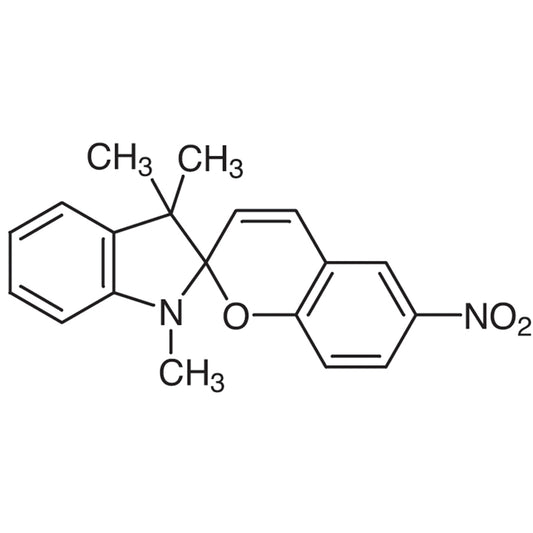
1,3,3-Trimethylindolino-8'-methoxybenzopyrylospiran is a photochromic dye that plays a crucial role in modern laboratory research, particularly in the field of optical materials. This compound is widely used in scientific studies to investigate the behavior of materials under different light conditions, especially ultraviolet radiation. Its unique ability to change color upon exposure to light makes it an essential tool for researchers working on photonic and optical applications. Due to its sensitivity to electromagnetic radiation, it is also valuable in the development of advanced optical devices and sensors.
The compound's photochromic properties are what make it a preferred choice for laboratory use. It exhibits a reversible color change, which allows for precise control and measurement in experimental settings. This property is highly beneficial in applications that require dynamic responses to light stimuli. Additionally, its chemical stability under certain conditions ensures consistent performance, making it reliable for long-term research projects. The molecular structure of this compound enables it to undergo conformational changes when exposed to light, which is a key factor in its effectiveness in optical studies.
In Indonesian laboratories, this compound is commonly used in research related to material science, physical chemistry, and sensor technology. Its unique optical properties make it a valuable resource for studying light-matter interactions. Researchers in Indonesia often rely on this compound to develop new optical materials and improve existing sensor technologies. Its versatility and reliability have made it a staple in many research labs across the country.
Related TCI products
- TCI T0423 1592-43-4 1,3,3-Trimethylindolino-beta-naphthopyrylospiran
- TCI T0370 16650-14-9 1,3,3-Trimethylindolino-6'-bromobenzopyrylospiran
- TCI T0366 1498-88-0 1,3,3-Trimethylindolino-6'-nitrobenzopyrylospiran
- TCI T0344 1485-92-3 1,3,3-Trimethylindolinobenzopyrylospiran
- TCI H1042 16111-07-2 1-(2-Hydroxyethyl)-3,3-dimethylindolino-6'-nitrobenzopyrylospiran
- TCI T1259 27333-47-7 1,3,3-Trimethylindolinonaphthospirooxazine
- Optical material development: This compound is ideal for creating new photonic materials that respond to light, enabling the design of advanced optical components.
- Sensor technology research: Its photochromic behavior makes it suitable for developing optical sensors that detect and measure light intensity and wavelength.
- Photocatalytic studies: The compound's light-sensitive nature is useful in experiments that explore the interaction between light and chemical reactions.
- Material characterization: It is used to analyze how different materials respond to light, aiding in the study of their optical properties.
- Educational research: It serves as a valuable tool for teaching and demonstrating photochromic phenomena in academic and research settings.
| Brand | TCI |
|---|---|
| CAS number | 13433-31-3 |
| Molecular formula | — |
| Purity | — |
| Category | Materials Science > Photonic Materials and Optical Materials > Photochromic Dyes |
| Pack sizes | Available in various quantities as per supplier specifications |
| Physical form | Solid (as per standard product description) |
| Storage | Store in a cool, dark place away from direct light and moisture |
This compound should be stored in a cool, dark environment to prevent degradation due to light exposure. It is recommended to keep it in a sealed container to minimize contact with air and moisture. Due to its photochromic nature, it is important to avoid prolonged exposure to light during storage and handling. Proper labeling of containers is essential to ensure safe handling and prevent accidental exposure. Laboratory personnel should wear appropriate personal protective equipment when handling this material. Regular monitoring of storage conditions is advised to maintain the integrity and effectiveness of the compound.
—
Produk Terkait
-
1,3,3-Trimethylindolino-beta-naphthopyrylospiran TCI T0423
Regular price From Rp 1.643.250,00Regular priceRp 1.164.450,00Sale price From Rp 1.643.250,00 -
1,3,3-Trimethylindolino-6'-bromobenzopyrylospiran TCI T0370
Regular price Rp 4.636.800,00Regular priceRp 3.258.150,00Sale price Rp 4.636.800,00 -
1,3,3-Trimethylindolino-6'-nitrobenzopyrylospiran TCI T0366
Regular price From Rp 1.776.600,00Regular priceRp 1.257.900,00Sale price From Rp 1.776.600,00 -
1,3,3-Trimethylindolinobenzopyrylospiran TCI T0344
Regular price From Rp 2.942.100,00Regular priceRp 2.072.700,00Sale price From Rp 2.942.100,00 -
1-(2-Hydroxyethyl)-3,3-dimethylindolino-6'-nitrobenzopyrylospiran TCI H1042
Regular price From Rp 3.735.900,00Regular priceRp 2.628.150,00Sale price From Rp 3.735.900,00 -
1,3,3-Trimethylindolinonaphthospirooxazine TCI T1259
Regular price Rp 3.710.700,00Regular priceRp 2.610.300,00Sale price Rp 3.710.700,00 -
1,3,3-Trimethyl-2-[3-(1,3,3-trimethylindolin-2-ylidene)prop-1-en-1-yl]-3H-indol-1-iumIodide TCI T4273
Regular price From Rp 1.033.200,00Regular priceRp 738.150,00Sale price From Rp 1.033.200,00 -
1,3,3-Trimethyl-2-[7-(1,3,3-trimethylindolin-2-ylidene)hepta-1,3,5-trien-1-yl]-3H-indol-1-iumIodide TCI T4272
Regular price From Rp 1.033.200,00Regular priceRp 738.150,00Sale price From Rp 1.033.200,00