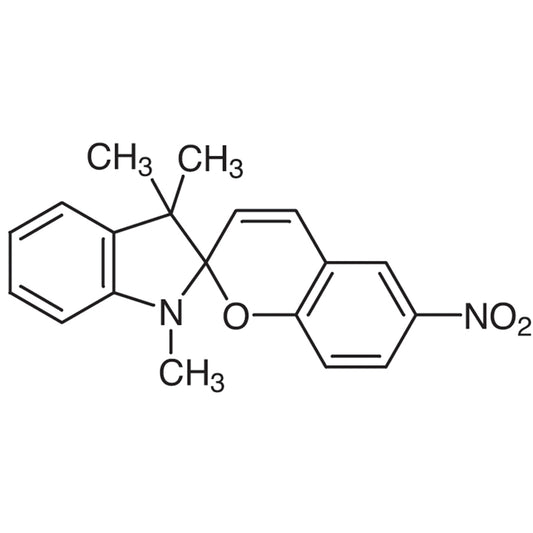
1,3,3-Trimethylindolino-beta-naphthopyrylospiran is a specialized photochromic dye used in materials science and optical research. This compound is widely utilized in laboratories for its unique ability to change color reversibly when exposed to light. Its optical properties make it an essential tool for studying and developing photochromic materials, which have applications in various scientific and industrial fields. In the laboratory, it serves as a key component in experiments related to optical materials, sensors, and light-responsive systems.
The compound is preferred for its rapid response to light exposure and its ability to return to its original state once the light source is removed. These properties are crucial for applications that require reversible optical transitions. Additionally, it exhibits good chemical stability, ensuring consistent performance over time. Its reliability and predictable behavior make it a favored choice for researchers working on advanced optical technologies and material science projects.
In Indonesian laboratories, this compound is commonly used in research related to photochromic materials, optical sensors, and light-sensitive devices. Scientists and researchers in educational institutions and research organizations rely on it for developing new technologies, such as optical devices, glare-reducing eyewear, and light-sensitive sensors. Its versatility and performance make it a valuable resource in the field of material and optical sciences.
Related TCI products
- TCI T0416 13433-31-3 1,3,3-Trimethylindolino-8'-methoxybenzopyrylospiran
- TCI T0370 16650-14-9 1,3,3-Trimethylindolino-6'-bromobenzopyrylospiran
- TCI T0366 1498-88-0 1,3,3-Trimethylindolino-6'-nitrobenzopyrylospiran
- TCI T0344 1485-92-3 1,3,3-Trimethylindolinobenzopyrylospiran
- TCI H1042 16111-07-2 1-(2-Hydroxyethyl)-3,3-dimethylindolino-6'-nitrobenzopyrylospiran
- TCI T1259 27333-47-7 1,3,3-Trimethylindolinonaphthospirooxazine
- Photochromic Material Development: This compound is ideal for creating materials that change color in response to light, enabling the development of advanced optical devices and sensors.
- Optical Sensor Research: Its reversible color change properties make it suitable for use in light-sensitive sensors, allowing for precise detection and measurement of light exposure.
- Light-Responsive Device Innovation: The compound’s ability to alter its optical properties under light exposure supports the creation of innovative optical devices and smart materials.
- Educational and Research Applications: It is widely used in academic and research settings to teach and explore the principles of photochromism and optical material behavior.
- Material Stability Testing: The compound’s chemical stability allows it to be used in long-term experiments to study the durability and performance of photochromic materials.
| Brand | TCI |
|---|---|
| CAS number | 1592-43-4 |
| Molecular formula | — |
| Purity | — |
| Category | Materials Science > Photonic Materials and Optical Materials > Photochromic Dyes |
| Pack sizes | As per supplier specifications |
| Physical form | Solid (as per standard product description) |
| Storage | Store in a cool, dry place away from direct light |
This compound should be stored in a cool, dry environment, away from direct sunlight and sources of heat. It is recommended to keep it in a sealed container to prevent moisture absorption and contamination. Due to its photochromic nature, exposure to light should be minimized during storage to maintain its chemical integrity. When handling, it is advisable to use appropriate personal protective equipment such as gloves and safety goggles to ensure safety. The compound is generally stable under normal laboratory conditions, but care should be taken to avoid prolonged exposure to light or extreme temperatures. Proper storage and handling practices will help preserve its optical properties and ensure consistent performance in experimental applications.
—
Produk Terkait
-
1,3,3-Trimethylindolino-8'-methoxybenzopyrylospiran TCI T0416
Regular price From Rp 1.089.000,00Regular priceRp 756.000,00Sale price From Rp 1.089.000,00 -
1,3,3-Trimethylindolino-6'-bromobenzopyrylospiran TCI T0370
Regular price Rp 4.538.000,00Regular priceRp 3.103.000,00Sale price Rp 4.538.000,00 -
1,3,3-Trimethylindolino-6'-nitrobenzopyrylospiran TCI T0366
Regular price From Rp 1.736.000,00Regular priceRp 1.198.000,00Sale price From Rp 1.736.000,00 -
1,3,3-Trimethylindolinobenzopyrylospiran TCI T0344
Regular price From Rp 2.878.000,00Regular priceRp 1.974.000,00Sale price From Rp 2.878.000,00 -
1-(2-Hydroxyethyl)-3,3-dimethylindolino-6'-nitrobenzopyrylospiran TCI H1042
Regular price From Rp 3.657.000,00Regular priceRp 2.503.000,00Sale price From Rp 3.657.000,00 -
1,3,3-Trimethylindolinonaphthospirooxazine TCI T1259
Regular price Rp 3.630.000,00Regular priceRp 2.486.000,00Sale price Rp 3.630.000,00 -
1,3,3-Trimethyl-2-[3-(1,3,3-trimethylindolin-2-ylidene)prop-1-en-1-yl]-3H-indol-1-iumIodide TCI T4273
Regular price From Rp 1.011.000,00Regular priceRp 703.000,00Sale price From Rp 1.011.000,00 -
1,3,3-Trimethyl-2-[7-(1,3,3-trimethylindolin-2-ylidene)hepta-1,3,5-trien-1-yl]-3H-indol-1-iumIodide TCI T4272
Regular price From Rp 1.011.000,00Regular priceRp 703.000,00Sale price From Rp 1.011.000,00