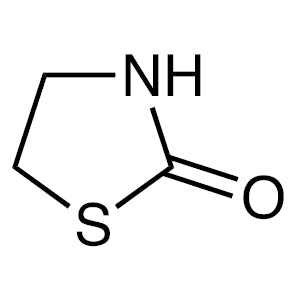
Thiazolidine is a chemical compound classified under the heterocyclic category, serving as a fundamental building block in the synthesis of complex organic compounds. It plays a crucial role in laboratory settings by enabling the formation of more intricate heterocyclic structures, such as thiazolidinones, which are known for their biological activities. Its versatility makes it an essential component in various chemical reactions, allowing researchers to construct molecular frameworks necessary for pharmaceutical and organic chemistry studies. Thiazolidine is widely used in academic and research laboratories across Indonesia due to its reliability and effectiveness in chemical synthesis.
Thiazolidine is preferred for its stable chemical structure and its ability to react readily with a variety of reagents. This reactivity facilitates efficient synthesis processes, making it a valuable tool for chemists. Its predictable chemical behavior allows researchers to control reactions with precision, ensuring consistent results. Additionally, its broad range of applications across different scientific disciplines further solidifies its position as a go-to compound in laboratory environments. The compound's adaptability and reliability make it a staple in both educational and research institutions in Indonesia.
In Indonesian laboratories, Thiazolidine is commonly used in chemical, pharmaceutical, and biochemical research. It is frequently found in academic settings, supporting studies in organic synthesis, drug development, and biological activity testing. Its presence in these laboratories underscores its importance in advancing scientific knowledge and innovation in various fields of study.
Related TCI products
- TCI T1974 127657-29-8 3-Ethyl (-)-Thiazolidine-3,4-dicarboxylate
- TCI T1325 30097-06-4 Thiazolidine-2,4-dicarboxylic Acid
- TCI T1324 16310-13-7 Thiazolidine-2-carboxylic Acid
- TCI T3926 2682-49-7 Thiazolidin-2-one
- TCI T1990 2295-31-0 2,4-Thiazolidinedione
- TCI H1299 74772-78-4 5-(4-Hydroxybenzyl)-2,4-thiazolidinedione
- Organic synthesis research utilizes Thiazolidine to construct complex molecular frameworks, enabling the development of new compounds with potential pharmaceutical applications.
- Pharmaceutical research benefits from Thiazolidine's ability to form thiazolidinone derivatives, which are known for their biological activities and therapeutic potential.
- Biochemical studies employ Thiazolidine to explore its role in synthesizing compounds with specific biological functions, aiding in drug discovery and development.
- Academic teaching laboratories use Thiazolidine as an essential building block for demonstrating heterocyclic chemistry and reaction mechanisms.
- Industrial research facilities incorporate Thiazolidine into their workflows to develop novel chemical products and optimize synthetic pathways.
| Brand | TCI |
|---|---|
| CAS number | 504-78-9 |
| Molecular formula | — |
| Purity | — |
| Category | Chemistry > Building Blocks > Heterocyclic Building Blocks |
| Pack sizes | Available in various quantities as per standard laboratory supply options |
| Physical form | Solid or liquid, depending on the specific product variant |
| Storage | Store in a cool, dry place away from direct sunlight and incompatible materials |
Thiazolidine should be stored in a cool, dry environment to maintain its chemical stability. It is recommended to keep the compound in a sealed container to prevent exposure to moisture and air. Suitable storage containers include glass or high-density polyethylene (HDPE) bottles, which provide a barrier against chemical interactions. In laboratory settings, it is important to handle Thiazolidine with appropriate personal protective equipment, such as gloves and safety goggles, to ensure safe handling. Avoid contact with incompatible substances, and ensure proper ventilation when working with the compound. Regular inspection of storage conditions is advised to maintain the integrity of the material.
—
Produk Terkait
-
3-Ethyl(-)-Thiazolidine-3,4-dicarboxylate TCI T1974
Regular price Rp 610.050,00Regular priceRp 442.050,00Sale price Rp 610.050,00 -
Thiazolidine-2,4-dicarboxylicAcid TCI T1325
Regular price Rp 2.013.900,00Regular priceRp 1.423.800,00Sale price Rp 2.013.900,00 -
Thiazolidine-2-carboxylicAcid TCI T1324
Regular price From Rp 822.150,00Regular priceRp 590.100,00Sale price From Rp 822.150,00 -
Thiazolidin-2-one TCI T3926
Regular price From Rp 1.113.000,00Regular priceRp 793.800,00Sale price From Rp 1.113.000,00 -
2,4-Thiazolidinedione TCI T1990
Regular price From Rp 848.400,00Regular priceRp 609.000,00Sale price From Rp 848.400,00 -
5-(4-Hydroxybenzyl)-2,4-thiazolidinedione TCI H1299
Regular price Rp 3.392.550,00Regular priceRp 2.387.700,00Sale price Rp 3.392.550,00 -
2,2-Dimethylthiazolidine TCI D1491
Regular price From Rp 795.900,00Regular priceRp 572.250,00Sale price From Rp 795.900,00 -
2-Mercapto-5-thiazolidone TCI M0263
Regular price Rp 4.266.150,00Regular priceRp 2.998.800,00Sale price Rp 4.266.150,00