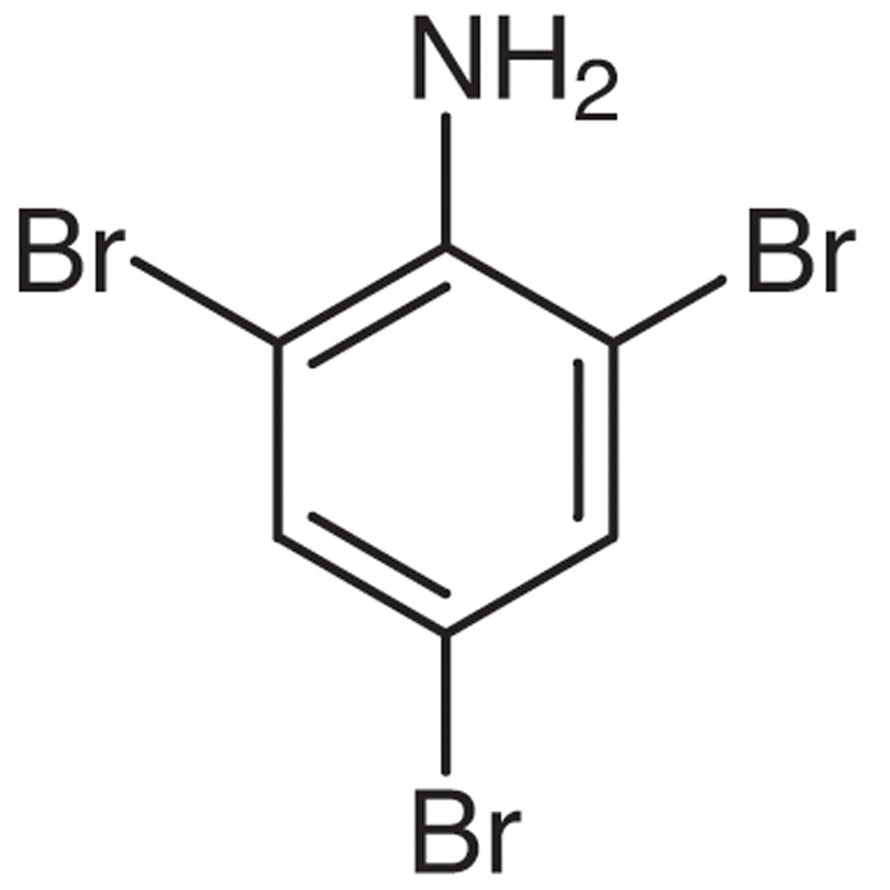
TCI T1088 is 2,4,6-Tribromoaniline (CAS 147-82-0), an aniline derivative in which three ring positions, the two ortho positions and the para position relative to the amino group, are occupied by bromine atoms. It belongs to the non-heterocyclic building block category and is widely recognised in organic chemistry as the characteristic product of aniline bromination. In the laboratory it serves as a starting material for the synthesis of halogenated aromatic compounds and as a classic example in teaching electrophilic aromatic substitution.
The features that make this compound a preferred choice are its reactive amino group and its three bromine atoms. The amino group remains available for further reaction, and it can be diazotised and replaced, which opens a route to 1,3,5-tribromobenzene or other derivatives with substitution patterns that are difficult to obtain directly. The bromine atoms can act as leaving groups in cross-coupling reactions. Because the molecule is so rich in bromine, it is also of interest in research on flame-retardant materials and dyes. The 25 g pack is enough for several series of experiments.
In Indonesian laboratories, 2,4,6-Tribromoaniline is well suited to advanced organic chemistry practicals, synthesis research, and work on functional materials. Lecturers can use it to explain the directing effect of the amino group, and to show how a strongly activated aromatic ring reacts with a halogen. Research groups can use it as an intermediate when they need a polyhalogenated aniline scaffold for further transformations.
- Teaching electrophilic aromatic substitution: the compound is the characteristic outcome of aniline bromination, so it gives students a clear and well-known example of how a strongly activating amino group directs substitution to the ortho and para positions.
- Synthesis of halogenated aromatic compounds: the amino group stays available for reaction and the three bromine atoms are already in place, so the compound is a convenient starting point for building more complex polyhalogenated aromatic structures.
- Preparation of 1,3,5-tribromobenzene: the amino group can be diazotised and then replaced, which gives access to this symmetrical derivative and to other substitution patterns that are hard to obtain by direct bromination of benzene.
- Cross-coupling research: the three bromine atoms can serve as leaving groups in cross-coupling reactions, which lets researchers attach different groups to the aromatic ring in a stepwise way and explore new molecular architectures.
- Flame-retardant and dye research: the high bromine content of the molecule makes it an interesting model or intermediate for investigating brominated functional materials, including flame-retardant systems and dye precursors.
| Brand | TCI |
|---|---|
| CAS number | 147-82-0 |
| Molecular formula | — |
| Purity | — |
| Category | Chemistry > Building Blocks > Non-Heterocyclic Building Blocks |
| Pack sizes | 25 g |
| Physical form | — |
| Storage | keep tightly closed in a cool, dry place, away from light and incompatible materials |
- Product code: T1088
Store 2,4,6-Tribromoaniline in its original, tightly closed container in a cool, dry and well-ventilated place, away from direct light, heat and incompatible substances such as strong oxidisers. Keep the container clearly labelled and record the date it was first opened. Handle the material in a fume hood or a well-ventilated area, and wear a laboratory coat, chemical-resistant gloves and safety glasses. Avoid creating dust and avoid contact with skin, eyes and clothing. Wash hands thoroughly after use. Dispose of waste according to your institution's procedures and local regulations for halogenated organic waste. Always consult the supplier's safety data sheet before use.
—
Produk Terkait
-
2,4,6-Tribromoaniline TCI T0345
Regular price Rp 743.400,00Regular priceRp 519.750,00Sale price Rp 743.400,00 -
4-Bromoaniline TCI B1393
Regular price Rp 1.193.850,00Regular priceRp 834.750,00Sale price Rp 1.193.850,00 -
2-BromoanilineHydrochloride TCI B0870
Regular price Rp 1.670.550,00Regular priceRp 1.167.600,00Sale price Rp 1.670.550,00 -
3-Bromoaniline TCI B0542
Regular price Rp 1.696.800,00Regular priceRp 1.186.500,00Sale price Rp 1.696.800,00 -
2-Bromoaniline TCI B0541
Regular price Rp 1.273.650,00Regular priceRp 890.400,00Sale price Rp 1.273.650,00 -
4-Chloro-2,6-dibromoaniline TCI B1516
Regular price Rp 2.068.500,00Regular priceRp 1.445.850,00Sale price Rp 2.068.500,00 -
3,5-Dibromoaniline TCI D4802
Regular price Rp 2.889.600,00Regular priceRp 2.020.200,00Sale price Rp 2.889.600,00 -
2,5-Dibromoaniline TCI D1989
Regular price Rp 1.326.150,00Regular priceRp 927.150,00Sale price Rp 1.326.150,00