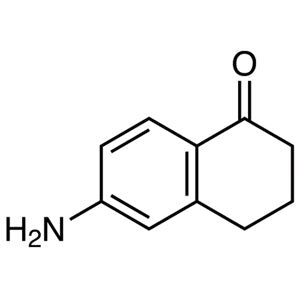
Beta-Tetralone is a chemical compound widely used as a building block in various chemical reactions. It plays a crucial role in the synthesis of complex molecules, particularly in the fields of organic chemistry and pharmacology. As a fundamental component, beta-tetralone enables the construction of larger molecular structures, such as heterocyclic compounds or aromatic substances. Its versatility makes it an essential tool for researchers aiming to modify molecular frameworks and develop new chemical entities.
One of the key properties that make beta-tetralone a preferred choice is its chemical stability. It can participate in a range of reactions, including substitution, reduction, and oxidation, which makes it adaptable to various synthetic pathways. Additionally, it exhibits good solubility in organic solvents like ethyl acetate and acetone, facilitating easy mixing and reaction processes. These characteristics contribute to its reliability and efficiency in laboratory settings.
In Indonesian laboratories, beta-tetralone is extensively used by researchers and educational institutions for research and development purposes. Its relevance spans across organic chemistry, pharmaceutical sciences, and material science. The compound's non-toxic nature and controllable properties further enhance its appeal as a safe and effective material for laboratory applications.
- Organic synthesis: Beta-tetralone is ideal for creating complex organic molecules due to its reactivity and structural versatility.
- Pharmaceutical research: It is commonly used in the development of new drugs, as it can be modified to produce various bioactive compounds.
- Heterocyclic compound synthesis: Its ability to form aromatic and heterocyclic structures makes it a valuable tool in medicinal chemistry.
- Material science applications: Beta-tetralone contributes to the development of new materials by enabling the synthesis of functional compounds.
- Educational research: It is widely used in academic settings to teach and demonstrate chemical synthesis techniques and molecular structure modification.
| Brand | TCI |
|---|---|
| CAS number | 530-93-8 |
| Molecular formula | — |
| Purity | — |
| Category | Chemistry > Building Blocks > Non-Heterocyclic Building Blocks |
| Pack sizes | Available in various quantities as per standard laboratory supply |
| Physical form | Solid |
| Storage | Store in a cool, dry place away from direct sunlight |
Beta-tetralone should be stored in a cool, dry environment to maintain its chemical stability and prevent degradation. It is recommended to keep it in airtight containers to avoid exposure to moisture and air, which could affect its properties. Since it is non-toxic, general laboratory safety protocols should be followed, including proper labeling and storage away from incompatible substances. Handling should be done with care to ensure safe usage, and it is advisable to use appropriate personal protective equipment when working with it. The compound's stability and solubility characteristics make it relatively safe to handle, provided standard laboratory practices are maintained.
—
Produk Terkait
-
6-Bromo-1-tetralone TCI B4841
Regular price From Rp 3.975.300,00Regular priceRp 2.795.100,00Sale price From Rp 3.975.300,00 -
7-Bromo-1-tetralone TCI B4545
Regular price From Rp 980.700,00Regular priceRp 701.400,00Sale price From Rp 980.700,00 -
6-Amino-1-tetralone TCI A2642
Regular price From Rp 1.140.300,00Regular priceRp 812.700,00Sale price From Rp 1.140.300,00 -
alpha-Tetralone TCI T0134
Regular price From Rp 769.650,00Regular priceRp 537.600,00Sale price From Rp 769.650,00 -
7-Nitro-1-tetralone TCI N0945
Regular price From Rp 1.167.600,00Regular priceRp 831.600,00Sale price From Rp 1.167.600,00 -
7-Methyl-1-tetralone TCI M3255
Regular price From Rp 1.776.600,00Regular priceRp 1.242.150,00Sale price From Rp 1.776.600,00 -
2-Methyl-1-tetralone TCI M3159
Regular price From Rp 1.565.550,00Regular priceRp 1.094.100,00Sale price From Rp 1.565.550,00 -
5-Methoxy-1-tetralone TCI M2297
Regular price From Rp 2.279.550,00Regular priceRp 1.609.650,00Sale price From Rp 2.279.550,00