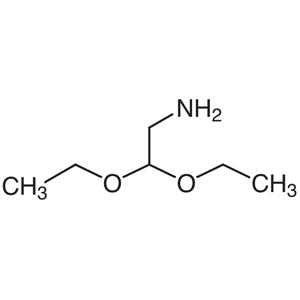
TCI A0247 Aminoacetal, also known as aminoacetaldehyde diethyl acetal, is an organic compound that combines a primary amine group and an acetal group in one small molecule. The acetal acts as a protected form of the aldehyde group, so the material can be treated in practice as a stable equivalent of aminoacetaldehyde. In the TCI catalogue it is classed as a non-heterocyclic building block, and in the laboratory it serves as a starting material for organic synthesis, especially for constructing nitrogen-containing compounds. This 250 mL pack from AMI Scientific is supplied for research groups that need a dependable source of this reagent.
The value of Aminoacetal lies in its two functional groups, which can work in sequence. The amine can react first with acyl chlorides, aldehydes or other electrophiles, while the acetal remains protected under basic and neutral conditions. Once the first step is complete, the acetal can be opened under acidic conditions to reveal the aldehyde, which then takes part in ring closure. This pattern is why the compound appears so often in synthetic routes to heterocyclic derivatives such as isoquinolines and imidazoles. Chemists therefore regard it as a flexible building block for multi-step work, since one reagent introduces both a nucleophilic nitrogen and a masked carbonyl.
In Indonesian laboratories, the 250 mL pack suits organic synthesis and medicinal chemistry research groups that run repeated reactions and want a ready supply of one reagent. University research laboratories, teaching laboratories running advanced synthesis practicals, and development teams that screen heterocyclic scaffolds can all use it. The larger bottle reduces the need for frequent reordering during a long project. As a TCI product supplied through AMI Scientific, it fits routine synthetic work where a well-known brand and a documented catalogue identity are expected.
- Synthesis of isoquinoline derivatives: the amine and the masked aldehyde allow stepwise bond formation followed by acid-mediated ring closure, so this reagent fits cyclisation routes that build isoquinoline frameworks.
- Preparation of imidazole compounds: the primary amine can be condensed or acylated first, and the protected aldehyde is later released to close the ring, making this material a convenient starting point for imidazole scaffolds.
- Amine functionalisation with acyl chlorides or aldehydes: the free amine reacts selectively while the acetal stays intact under neutral and basic conditions, so the product keeps a protected carbonyl for later steps.
- Medicinal chemistry building block work: chemists making nitrogen-containing candidate molecules value a small bifunctional unit that adds both an amine and a latent aldehyde, which shortens routes and widens the structures that can be explored.
- Teaching advanced synthesis and protecting-group strategy: the acetal-protected aldehyde gives students a clear, practical example of orthogonal reactivity, showing how a group is masked, carried through a reaction and then revealed under acid.
| Brand | TCI |
|---|---|
| CAS number | 645-36-3 |
| Molecular formula | — |
| Purity | — |
| Category | Chemistry > Building Blocks > Non-Heterocyclic Building Blocks |
| Pack sizes | 250 mL |
| Physical form | — |
| Storage | keep tightly closed, away from heat, moisture and strong acids; follow the supplier label and safety data sheet |
- Product code: A0247
Store Aminoacetal in its original tightly closed container in a cool, dry and well-ventilated chemical storage area, away from heat sources, open flames and strong acids, which can open the acetal group. Keep the bottle upright and protected from moisture and direct light, and check the supplier label and safety data sheet for the exact storage conditions. When handling, work in a fume hood or a well-ventilated space and wear gloves, safety glasses and a laboratory coat, because amine-containing liquids can irritate skin, eyes and airways. Avoid contact and inhalation, label any transfer containers clearly, and dispose of waste according to the laboratory's chemical waste procedures.
—
Produk Terkait
-
AminoacetaldehydeDimethylAcetal TCI A0801
Regular price Rp 1.590.750,00Regular priceRp 1.127.700,00Sale price Rp 1.590.750,00 -
MethylaminoacetaldehydeDimethylAcetal TCI M0884
Regular price From Rp 928.200,00Regular priceRp 664.650,00Sale price From Rp 928.200,00 -
Aminoacetal TCI A0247
Regular price From Rp 1.618.050,00Regular priceRp 1.146.600,00Sale price From Rp 1.618.050,00 -
4'-Aminoacetanilide TCI A0106
Regular price From Rp 822.150,00Regular priceRp 590.100,00Sale price From Rp 822.150,00 -
2'-Aminoacetanilide TCI A2426
Regular price Rp 1.272.600,00Regular priceRp 905.100,00Sale price Rp 1.272.600,00 -
3'-Aminoacetanilide TCI A1533
Regular price Rp 505.050,00Regular priceRp 368.550,00Sale price Rp 505.050,00 -
4'-AminoacetophenoneHydrochloride TCI A0252
Regular price Rp 2.411.850,00Regular priceRp 1.702.050,00Sale price Rp 2.411.850,00 -
2'-Aminoacetophenone TCI A0250
Regular price From Rp 662.550,00Regular priceRp 478.800,00Sale price From Rp 662.550,00