


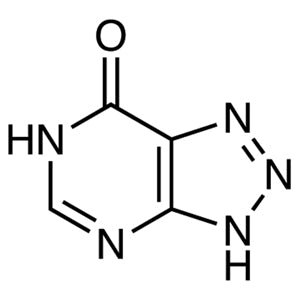
8-Azahypoxanthine is a chemical compound classified under heterocyclic building blocks, with a structure similar to purines. It plays a crucial role in laboratory settings where complex chemical synthesis is required, particularly in the development of bioactive compounds such as pharmaceuticals and biomedical research materials. This compound is widely used as a foundational element in organic chemistry reactions aimed at producing more complex heterocyclic structures. Its presence in research laboratories is essential for the synthesis of purine derivatives and their analogs, supporting advancements in medicinal chemistry and related fields.
The chemical properties of 8-Azahypoxanthine make it a preferred choice for researchers. It exhibits high reactivity, enabling participation in various chemical reactions such as nucleophilic substitution and condensation. However, it is sensitive to moisture and UV light, which can lead to degradation if not stored properly. Despite this, its reactivity and versatility allow it to be a valuable reagent in synthetic pathways, offering researchers a reliable tool for creating complex molecular structures.
In Indonesian laboratories, 8-Azahypoxanthine is commonly used in research focused on organic chemistry and pharmaceutical development. It is an essential component in the synthesis of bioactive compounds, supporting both academic and industrial research initiatives. Its application is widespread in laboratories that require high-reactivity building blocks for advanced chemical synthesis.
TCI brochures (PDF)
- Nucleosides, Nucleotides, Nucleic Acids and Related Reagents 2026-03-23 · p. 9
- Purine Derivative Synthesis: 8-Azahypoxanthine is ideal for creating purine-based compounds due to its structural similarity to purines, making it a key reagent in organic synthesis.
- Medicinal Chemistry Research: Its use in synthesizing bioactive compounds supports pharmaceutical research, aiding in the development of new drugs and therapeutic agents.
- Biomedical Compound Development: It contributes to the creation of compounds used in biomedical research, including drug delivery systems and therapeutic agents.
- Organic Reaction Studies: The compound's reactivity makes it suitable for studying nucleophilic substitution and condensation reactions in chemical research.
- Heterocyclic Compound Synthesis: Its role as a building block allows for the production of complex heterocyclic structures, essential in various chemical applications.
| Brand | TCI |
|---|---|
| CAS number | 2683-90-1 |
| Molecular formula | — |
| Purity | — |
| Category | Chemistry > Building Blocks > Heterocyclic Building Blocks |
| Pack sizes | Available in standard laboratory quantities as specified by the supplier |
| Physical form | Solid powder |
| Storage | Requires protection from moisture and UV light |
8-Azahypoxanthine should be stored in a cool, dry place away from direct sunlight and sources of moisture. It is recommended to use airtight containers made of glass or high-density polyethylene to prevent exposure to humidity. The compound is sensitive to UV light, so storage in a dark environment is essential to maintain its chemical integrity. In laboratory settings, it should be handled with care to avoid contamination and ensure safe usage. Proper labeling and storage conditions are crucial to prevent degradation and maintain its effectiveness in chemical reactions.
—
Produk Terkait
-
7-Deazahypoxanthine TCI D4324
Regular price Rp 1.167.600,00Regular priceRp 831.600,00Sale price Rp 1.167.600,00 -
2-Thioxanthine TCI T0225
Regular price From Rp 2.227.050,00Regular priceRp 1.572.900,00Sale price From Rp 2.227.050,00 -
Hypoxanthine TCI H0311
Regular price From Rp 795.900,00Regular priceRp 572.250,00Sale price From Rp 795.900,00 -
AdenineHydrochlorideHemihydrate TCI A0150
Regular price From Rp 717.150,00Regular priceRp 516.600,00Sale price From Rp 717.150,00 -
Uracil TCI U0013
Regular price From Rp 742.350,00Regular priceRp 534.450,00Sale price From Rp 742.350,00 -
4-Thiouracil TCI T2757
Regular price Rp 2.835.000,00Regular priceRp 1.998.150,00Sale price Rp 2.835.000,00 -
8-Bromo-7-(2-butyn-1-yl)-3-methylxanthine TCI B4454
Regular price Rp 1.458.450,00Regular priceRp 1.035.300,00Sale price Rp 1.458.450,00 -
O~6~-Benzylguanine TCI B4208
Regular price From Rp 1.220.100,00Regular priceRp 868.350,00Sale price From Rp 1.220.100,00


