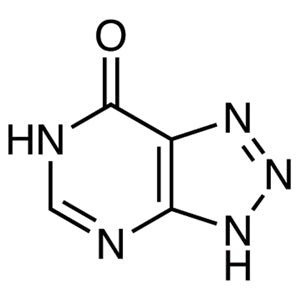
Hypoxanthine is a chemical compound classified under nucleotides and plays a crucial role in nucleotide metabolism. It is a key component in biochemical and genetic research, particularly in the study of purine metabolism and RNA synthesis. This compound is widely used in laboratory settings for its versatility and reliability in various experimental applications. Hypoxanthine serves as a substrate in enzymatic reactions and is also used as a building block for the synthesis of more complex compounds. Its presence in laboratory research supports the investigation of fundamental biological processes and the development of new biochemical methodologies.
Hypoxanthine is chemically stable under specific conditions and is highly soluble in water, making it easy to handle and incorporate into chemical reactions. Its high purity and consistent quality ensure accurate and reproducible results in experiments. The compound's ability to participate in complex reactions without interfering with the main reaction makes it a preferred choice for researchers. Additionally, its stability and solubility properties enhance its usability in a wide range of biochemical and genetic studies.
In Indonesian laboratories, Hypoxanthine is commonly used in biochemistry and genetic research, particularly in academic institutions and research centers. It supports studies related to enzyme activity, metabolic pathways, and molecular biology. Its reliability and availability make it an essential reagent for scientists working in these fields. The compound's role in advancing scientific understanding and innovation is well recognized in the Indonesian scientific community.
TCI brochures (PDF)
- Reactive Oxygen Species (ROS) and Oxidative Stress Research Reagents 2026-04-23 · p. 1
- Nucleosides, Nucleotides, Nucleic Acids and Related Reagents 2026-03-23 · p. 9
- Reagents for Biological Research 2025-03-11 · p. 60
- Biochemical Research: Hypoxanthine is used to study purine metabolism and enzyme activity, particularly in the investigation of xanthine oxidase.
- Genetic Studies: It supports RNA synthesis and is essential in experiments related to nucleotide-based molecular biology.
- Enzymatic Reactions: Hypoxanthine serves as a substrate in enzymatic processes, aiding in the analysis of metabolic pathways and biochemical transformations.
- Compound Synthesis: It is a key building block for the creation of more complex chemical structures, facilitating drug development and molecular design.
- Metabolic Pathway Analysis: Hypoxanthine is integral to understanding the biochemical processes involved in purine metabolism and related metabolic disorders.
| Brand | TCI |
|---|---|
| CAS number | 68-94-0 |
| Molecular formula | — |
| Purity | — |
| Category | Life Science > Biochemicals and Reagents > Nucleosides, Nucleotides, Oligonucleotides |
| Pack sizes | Available in various quantities as per standard laboratory requirements |
| Physical form | Powder or crystalline solid, depending on the packaging |
| Storage | Store in a cool, dry place away from light and moisture |
Hypoxanthine should be stored in a cool, dry location, away from direct light and moisture to maintain its stability and purity. It is recommended to use airtight containers to prevent contamination and degradation. Laboratory personnel should handle the compound with care, using appropriate personal protective equipment such as gloves and safety goggles. Proper ventilation is essential when working with this substance to avoid inhalation of airborne particles. Due to its chemical properties, it should be stored separately from incompatible materials. Regular inspection of storage conditions ensures the integrity of the compound and supports safe laboratory practices.
—
Produk Terkait
-
8-Azahypoxanthine TCI A0555
Regular price Rp 13.197.450,00Regular priceRp 9.244.200,00Sale price Rp 13.197.450,00 -
7-Deazahypoxanthine TCI D4324
Regular price Rp 1.167.600,00Regular priceRp 831.600,00Sale price Rp 1.167.600,00 -
Xanthine TCI X0004
Regular price Rp 1.856.400,00Regular priceRp 1.313.550,00Sale price Rp 1.856.400,00 -
Allopurinol TCI A0907
Regular price Rp 1.326.150,00Regular priceRp 942.900,00Sale price Rp 1.326.150,00 -
6-Thioxanthine TCI T4235
Regular price Rp 5.617.500,00Regular priceRp 3.943.800,00Sale price Rp 5.617.500,00 -
2-Thioxanthine TCI T0225
Regular price Rp 2.227.050,00Regular priceRp 1.572.900,00Sale price Rp 2.227.050,00 -
NU2058 TCI N0958
Regular price Rp 1.140.300,00Regular priceRp 812.700,00Sale price Rp 1.140.300,00 -
3-Methyladenine TCI M2518
Regular price Rp 3.472.350,00Regular priceRp 2.443.350,00Sale price Rp 3.472.350,00