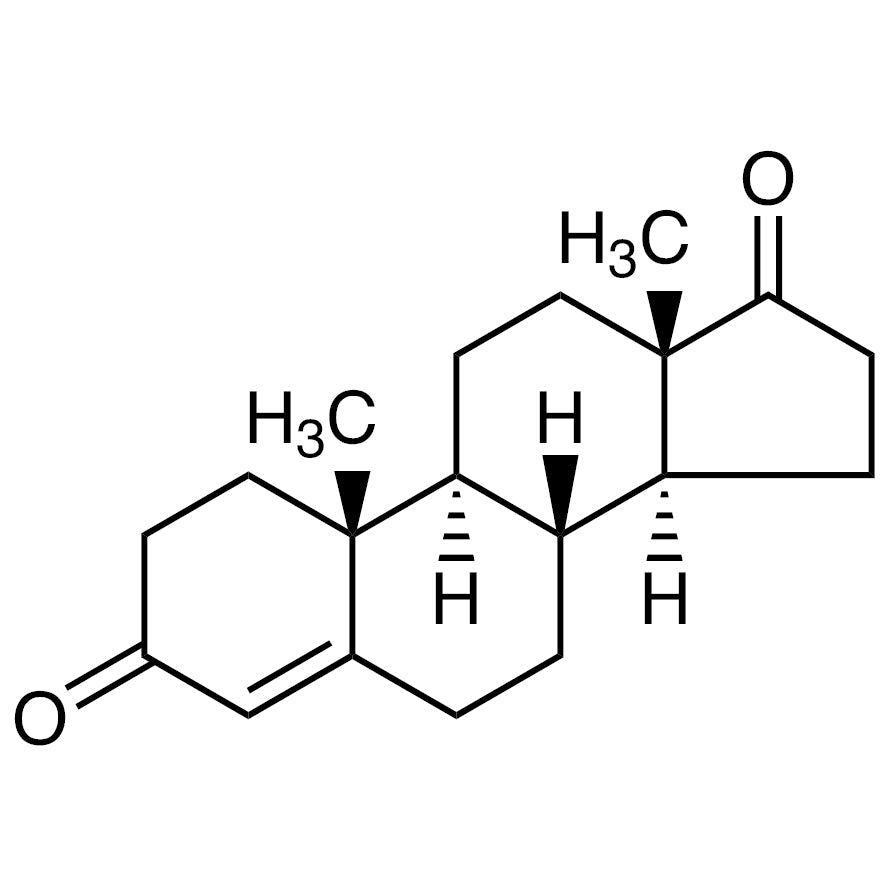
Delta-4-Androstene-3,17-dione is a steroid compound widely used in scientific research, particularly in life sciences and biochemical studies. As a fundamental building block in steroid chemistry, it plays a crucial role in the synthesis of various hormones and pharmaceutical compounds. Its presence in laboratory settings is essential for understanding metabolic pathways and hormonal interactions. This compound is commonly employed in research aimed at developing new therapeutic agents and studying the biochemical mechanisms of steroid-related diseases. Its versatility makes it an indispensable tool for researchers in multiple disciplines.
The compound is valued for its chemical stability and reactivity under various experimental conditions. Its molecular structure, which includes both polar and non-polar characteristics, allows it to dissolve in organic solvents such as ethyl acetate and acetone. This solubility profile makes it suitable for chromatographic techniques and analytical methods. Additionally, its ability to undergo chemical transformations makes it ideal for synthetic applications. These properties ensure its reliability and effectiveness in a wide range of laboratory procedures.
In Indonesian laboratories, Delta-4-Androstene-3,17-dione is frequently used in pharmacological, endocrinological, and biochemical research. Its role in studying hormone function and metabolic processes is well established. Researchers in Indonesia rely on this compound for its consistent performance and compatibility with standard laboratory protocols. Its application in both academic and industrial research settings underscores its importance in advancing scientific knowledge.
TCI brochures (PDF)
- Steroids 2026-07-28 · p. 3
Related TCI products
- Used in pharmacological research to study hormone synthesis and receptor interactions due to its structural similarity to key steroid hormones.
- Applied in endocrinological studies to investigate the metabolic pathways of steroid compounds and their physiological effects.
- Utilized in biochemical experiments for the synthesis of other steroid derivatives, such as testosterone and progesterone.
- Employed in analytical chemistry for chromatographic separation and purification of steroid compounds.
- Integrated into drug development programs to test the efficacy and safety of steroid-based pharmaceuticals.
| Brand | TCI |
|---|---|
| CAS number | 63-05-8 |
| Molecular formula | — |
| Purity | — |
| Category | Life Science > Biochemicals and Reagents > Steroids |
| Pack sizes | Available in various quantities as per standard laboratory supply requirements |
| Physical form | Solid powder |
| Storage | Store in a cool, dry place away from direct light and moisture |
Delta-4-Androstene-3,17-dione should be stored in a cool, dry environment, away from direct sunlight and moisture. It is recommended to keep the compound in a sealed container to prevent contamination and maintain its chemical integrity. Proper ventilation should be ensured when handling the material to minimize exposure. Laboratory personnel should wear appropriate personal protective equipment, such as gloves and safety goggles, to ensure safe handling. The compound is generally stable under standard laboratory conditions, but it should be handled with care to avoid any potential chemical reactions. Regular monitoring of storage conditions is advised to maintain its quality and effectiveness for research purposes.
—
Produk Terkait
-
Methylandrostenediol TCI M0146
Regular price From Rp 1.326.150,00Regular priceRp 942.900,00Sale price From Rp 1.326.150,00 -
6-Methyleneandrost-4-ene-3,17-dione TCI M3121
Regular price From Rp 1.087.800,00Regular priceRp 775.950,00Sale price From Rp 1.087.800,00 -
9-Hydroxyandrost-4-ene-3,17-dione TCI H1815
Regular price Rp 4.479.300,00Regular priceRp 3.132.150,00Sale price Rp 4.479.300,00 -
3beta-Hydroxy-DELTA5-cholenicAcid TCI H0521
Regular price Rp 8.877.750,00Regular priceRp 6.223.350,00Sale price Rp 8.877.750,00 -
Epiandrosterone TCI E0374
Regular price Rp 1.431.150,00Regular priceRp 1.016.400,00Sale price Rp 1.431.150,00 -
DehydroepiandrosteroneAcetate TCI D0045
Regular price From Rp 1.696.800,00Regular priceRp 1.202.250,00Sale price From Rp 1.696.800,00 -
Dehydroepiandrosterone TCI D0044
Regular price From Rp 742.350,00Regular priceRp 534.450,00Sale price From Rp 742.350,00 -
21-(Acetyloxy)-17-hydroxypregn-4-ene-3,20-dione TCI A3212
Regular price Rp 557.550,00Regular priceRp 405.300,00Sale price Rp 557.550,00