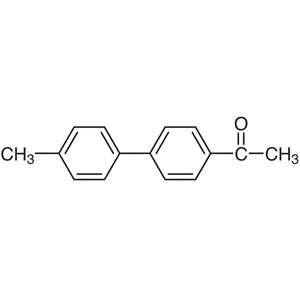
4-Acetylbiphenyl is a chemical compound widely used as a foundational material in various chemical reactions, particularly in the synthesis of complex compounds. It serves as a key building block in organic chemistry, offering versatility in both synthetic and analytical applications. This compound is commonly utilized in laboratory settings to facilitate reactions such as substitution and oxidation, depending on the specific conditions applied. Its role is critical in the development of new chemical structures, making it an essential component in research and development processes.
The preferred choice of 4-Acetylbiphenyl stems from its stable molecular structure and predictable reactivity. It exhibits high melting and boiling points, which make it suitable for thermal processes in chemical synthesis. Its chemical stability ensures that it remains effective under a variety of experimental conditions, while its molecular arrangement allows for consistent performance in different reaction environments. These properties make it a reliable and efficient material for both academic and industrial research.
In Indonesian laboratories, 4-Acetylbiphenyl is frequently used in pure and applied chemical research, especially within higher education institutions and research organizations. It plays a vital role in the synthesis of new compounds with potential applications in various fields. Its availability and reliability make it a standard component in the chemical supply chain supporting scientific innovation in Indonesia.
- Organic synthesis applications benefit from 4-Acetylbiphenyl due to its stable molecular structure and predictable reactivity, allowing for the creation of complex chemical compounds.
- It is ideal for substitution reactions in laboratory settings, where its chemical stability ensures consistent results across multiple experimental trials.
- Oxidation reactions often use 4-Acetylbiphenyl as a starting material because of its ability to participate in controlled chemical transformations under varying conditions.
- In research and development, this compound supports the synthesis of heterocyclic and aromatic compounds, which are essential in pharmaceutical and material sciences.
- It is commonly used in analytical chemistry for standardization and as a reference material due to its consistent properties and well-defined chemical behavior.
| Brand | TCI |
|---|---|
| CAS number | 92-91-1 |
| Molecular formula | — |
| Purity | — |
| Category | Chemistry > Building Blocks > Non-Heterocyclic Building Blocks |
| Pack sizes | Available in various quantities as per standard laboratory supply specifications |
| Physical form | Solid |
| Storage | Store in a cool, dry place away from direct sunlight and incompatible materials |
4-Acetylbiphenyl should be stored in a cool, dry environment to maintain its chemical stability and prevent degradation. It is recommended to use airtight containers to minimize exposure to moisture and air, which can affect its performance. Due to its solid form, it should be kept in a secure location away from heat sources and direct sunlight. In laboratory settings, it is important to handle this compound with care, using appropriate personal protective equipment when necessary. Proper labeling of storage containers ensures safe handling and easy identification. Regular inspection of storage conditions is advised to maintain the integrity of the material for long-term use.
—
Produk Terkait
-
3-Acetylbiphenyl TCI B6396
Regular price Rp 2.254.350,00Regular priceRp 1.576.050,00Sale price Rp 2.254.350,00 -
4,4'-Diacetylbiphenyl TCI D1902
Regular price Rp 1.644.300,00Regular priceRp 1.149.750,00Sale price Rp 1.644.300,00 -
4-Butyrylbiphenyl TCI B1956
Regular price From Rp 477.750,00Regular priceRp 333.900,00Sale price From Rp 477.750,00 -
4-Acetyl-4'-methylbiphenyl TCI A1322
Regular price From Rp 1.035.300,00Regular priceRp 723.450,00Sale price From Rp 1.035.300,00 -
4-Butylbiphenyl TCI B3888
Regular price From Rp 980.700,00Regular priceRp 685.650,00Sale price From Rp 980.700,00 -
4-tert-Butylbiphenyl TCI B1811
Regular price From Rp 2.889.600,00Regular priceRp 2.020.200,00Sale price From Rp 2.889.600,00 -
4,4'-Di-tert-butylbiphenyl TCI D2450
Regular price From Rp 1.538.250,00Regular priceRp 1.075.200,00Sale price From Rp 1.538.250,00 -
4-Pentylbiphenyl TCI P1133
Regular price From Rp 1.565.550,00Regular priceRp 1.094.100,00Sale price From Rp 1.565.550,00