


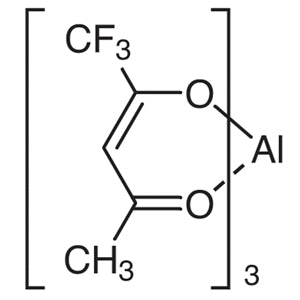
Tris(trifluoro-2,4-pentanedionato)aluminum(III) is an organometallic compound widely used in laboratory settings for its reactivity and versatility in chemical reactions. This reagent plays a crucial role in synthetic chemistry, particularly in the preparation of organic and inorganic compounds. Its ability to act as a catalyst or reagent in substitution, hydrolysis, and redox reactions makes it an essential tool for researchers. Due to its high reactivity and capacity to form complexes with various ligands, it is frequently utilized in advanced chemical studies.
The compound is known for its stability in complex structures and high reactivity, which are key factors in its preference among chemists. It dissolves well in organic solvents such as ethyl acetate and acetone, making it convenient for mixing and separation processes in chemical reactions. These properties allow for precise control over reaction conditions, which is vital in achieving desired outcomes in synthetic processes. Its solubility and reactivity also contribute to its effectiveness in a wide range of chemical applications.
In Indonesian laboratories, this compound is commonly used in advanced chemical research, especially in the field of synthesis of organic and inorganic compounds. It is a preferred choice for researchers working on complex reactions that require high reactivity and precision. Its application is widespread in both academic and industrial research settings, supporting the development of new chemical compounds and processes. The compound's reliability and performance make it a standard in many laboratory protocols across Indonesia.
Related TCI products
- TCI A0241 13963-57-0 Tris(2,4-pentanedionato)aluminum(III)
- TCI A0244 2269-22-9 Aluminum sec-Butoxide
- TCI A0804 556-91-2 Aluminum tert-Butoxide
- TCI A0245-250G 555-75-9 Aluminum Ethoxide
- TCI T0932 14592-89-3 Tris(trifluoro-2,4-pentanedionato)chromium(III)
- TCI T0746 16092-38-9 Bis(trifluoro-2,4-pentanedionato)cobalt(II)
- Used in organic synthesis for creating complex molecular structures due to its ability to form stable complexes with various ligands.
- Applied in redox reactions as a catalyst to facilitate electron transfer processes efficiently in solution.
- Employed in hydrolysis reactions to break down organic compounds under controlled conditions.
- Utilized in substitution reactions to replace functional groups in organic molecules with high selectivity.
- Integrated into catalytic systems for enhancing reaction rates and improving yield in industrial chemical processes.
| Brand | TCI |
|---|---|
| CAS number | 14354-59-7 |
| Molecular formula | — |
| Purity | — |
| Category | Chemistry > Organometallic Reagents > Organoaluminum |
| Pack sizes | Available in various quantities as per standard laboratory requirements |
| Physical form | Solid powder |
| Storage | Should be stored in a cool, dry place away from moisture and direct sunlight |
This compound should be stored in a cool, dry environment to maintain its stability and prevent degradation. It is recommended to use airtight containers to protect it from moisture and air exposure. Due to its high reactivity, it should be handled with care using appropriate personal protective equipment such as gloves and safety goggles. It is important to ensure that it is stored away from incompatible substances to avoid any potential chemical reactions. Regular monitoring of storage conditions is advised to maintain the integrity of the compound throughout its shelf life. Proper labeling and storage practices help in ensuring the safety of laboratory personnel and the effectiveness of the reagent in chemical processes.
—
Produk Terkait
-
Tris(2,4-pentanedionato)aluminum(III) TCI A0241
Regular price From Rp 689.850,00Regular priceRp 481.950,00Sale price From Rp 689.850,00 -
Aluminumsec-Butoxide TCI A0244
Regular price From Rp 584.850,00Regular priceRp 408.450,00Sale price From Rp 584.850,00 -
Aluminumtert-Butoxide TCI A0804
Regular price Rp 1.353.450,00Regular priceRp 946.050,00Sale price Rp 1.353.450,00 -
AluminumEthoxide TCI A0245-250G
Regular price Rp 3.180.450,00Regular priceRp 2.239.650,00Sale price Rp 3.180.450,00 -
Tris(trifluoro-2,4-pentanedionato)chromium(III) TCI T0932
Regular price Rp 2.013.900,00Regular priceRp 1.423.800,00Sale price Rp 2.013.900,00 -
Bis(trifluoro-2,4-pentanedionato)cobalt(II) TCI T0746
Regular price From Rp 2.597.700,00Regular priceRp 1.832.250,00Sale price From Rp 2.597.700,00 -
Tetrakis(2,4-pentanedionato)zirconium(IV) TCI Z0006
Regular price From Rp 1.353.450,00Regular priceRp 946.050,00Sale price From Rp 1.353.450,00 -
Bis(2,4-pentanedionato)titanium(IV)Oxide TCI T0249
Regular price From Rp 2.942.100,00Regular priceRp 2.056.950,00Sale price From Rp 2.942.100,00


