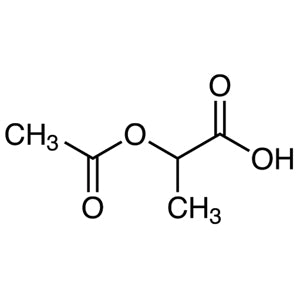
(S)-(-)-2-Acetoxypropionic Acid is a chiral building block widely used in asymmetric synthesis to construct molecules with specific stereochemical configurations. This compound plays a crucial role in organic chemistry laboratories, particularly in the development of pharmaceuticals and industrial chemicals. Its chiral nature allows for the creation of enantiomerically pure compounds, which are essential in drug development and other applications requiring precise molecular structures. As a key component in synthetic pathways, it enables researchers to achieve high levels of stereocontrol, which is vital for producing compounds with desired biological activities.
The compound is known for its high purity and stability under controlled laboratory conditions, making it a reliable choice for synthetic processes. Its chemical properties, including solubility and reactivity, are well-suited for various synthetic transformations. The ability to maintain its chiral integrity throughout synthesis ensures that the final products meet the required specifications for pharmaceutical and chemical applications. These characteristics make it a preferred material for researchers aiming at reproducibility and accuracy in their experiments.
In Indonesian laboratories, (S)-(-)-2-Acetoxypropionic Acid is commonly used in pharmaceutical research, organic synthesis, and material science. Its availability in high-quality form supports local scientific initiatives, contributing to the development of new drugs and advanced chemical materials. Its role in creating chiral compounds with specific biological activities makes it an essential reagent for scientific innovation in the region.
TCI brochures (PDF)
- Chiral Building Blocks 2025-04-14 · p. 12
Related TCI products
- Asymmetric synthesis of pharmaceutical compounds requiring specific stereochemistry for biological activity
- Development of new drugs with precise molecular structures and enantiomeric purity
- Organic chemistry research focused on chiral molecule construction and functional group transformations
- Creation of chiral intermediates for use in complex synthetic pathways and drug production
- Investigation of stereochemical effects in chemical reactions and material synthesis processes
| Brand | TCI |
|---|---|
| CAS number | 6034-46-4 |
| Molecular formula | — |
| Purity | — |
| Category | Chemistry > Asymmetric Synthesis > Chiral Building Blocks |
| Pack sizes | Available in standard laboratory quantities |
| Physical form | Solid or liquid, depending on supplier packaging |
| Storage | Store in a cool, dry place away from light and moisture |
This compound should be stored in a cool, dry environment, away from direct sunlight and sources of heat. It is recommended to use airtight containers to prevent moisture absorption and maintain its chemical integrity. Due to its chiral nature, it is important to handle the compound with care to avoid contamination or degradation. Proper labeling of containers is essential to ensure safe handling and accurate identification. In laboratory settings, it should be stored separately from incompatible substances to prevent any potential chemical interactions. Always follow standard safety protocols when working with this material to ensure a safe and controlled environment.
—
Produk Terkait
-
(R)-(+)-2-AcetoxypropionicAcid TCI A3084
Regular price Rp 1.803.900,00Regular priceRp 1.261.050,00Sale price Rp 1.803.900,00 -
(R)-(+)-2-AcetoxypropionylChloride TCI A3085
Regular price From Rp 2.332.050,00Regular priceRp 1.646.400,00Sale price From Rp 2.332.050,00 -
(S)-(-)-2-AcetoxypropionylChloride TCI A1297
Regular price From Rp 1.458.450,00Regular priceRp 1.035.300,00Sale price From Rp 1.458.450,00 -
2-AcetoxypropionicAcid TCI A2931
Regular price From Rp 1.272.600,00Regular priceRp 905.100,00Sale price From Rp 1.272.600,00 -
2-AcetoxypropionylChloride TCI A2932
Regular price From Rp 2.730.000,00Regular priceRp 1.924.650,00Sale price From Rp 2.730.000,00 -
(-)-Verbenone TCI V0072
Regular price Rp 1.405.950,00Regular priceRp 998.550,00Sale price Rp 1.405.950,00 -
(R)-1-[4-(Trifluoromethyl)phenyl]ethan-1-ol TCI T4357
Regular price Rp 2.889.600,00Regular priceRp 2.020.200,00Sale price Rp 2.889.600,00 -
(S)-TrichostaticAcid TCI T3402
Regular price Rp 7.712.250,00Regular priceRp 5.408.550,00Sale price Rp 7.712.250,00