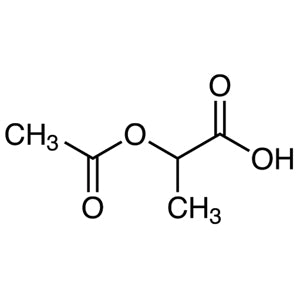
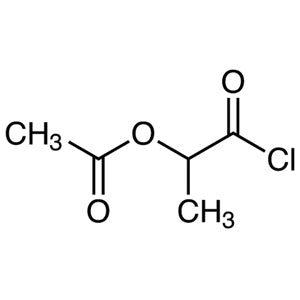
(R)-(+)-2-Acetoxypropionic Acid is a chiral building block essential in asymmetric synthesis, playing a critical role in the development of optically active compounds. This compound is widely used in organic chemistry to create molecules with specific stereochemistry, which is vital for pharmaceutical and biochemical applications. Its importance lies in its ability to influence the spatial arrangement of atoms during chemical reactions, enabling the synthesis of complex structures with precise biological activity.
The compound’s chiral nature and high reactivity make it a preferred choice for researchers requiring controlled stereoselectivity. Its stability under various reaction conditions allows it to participate in multiple chemical transformations, including esterification, hydrolysis, and substitution reactions. The ability to maintain its stereochemical integrity throughout these processes ensures reliable results in synthetic pathways. Additionally, its availability in pure form simplifies isolation and use in experimental settings, making it a valuable tool in laboratory research.
In Indonesian laboratories, (R)-(+)-2-Acetoxypropionic Acid is commonly used in organic chemistry research, particularly in pharmacology and the synthesis of bioactive compounds. It is a key component in experiments that require precise control over molecular structure and stereochemistry. Researchers in both academic and industrial settings rely on this compound for its versatility and effectiveness in creating compounds with specific biological functions.
TCI brochures (PDF)
- Chiral Building Blocks 2025-04-14 · p. 12
Related TCI products
- Asymmetric synthesis in pharmaceutical research due to its chiral structure and ability to control stereochemistry.
- Organic chemistry experiments requiring precise stereochemical control for the synthesis of optically active compounds.
- Development of bioactive molecules in medicinal chemistry applications where stereochemistry is critical.
- Research in synthetic organic chemistry for the preparation of complex molecular frameworks.
- Applications in biochemical studies where the spatial arrangement of atoms affects biological activity.
| Brand | TCI |
|---|---|
| CAS number | 18668-00-3 |
| Molecular formula | — |
| Purity | — |
| Category | Chemistry > Asymmetric Synthesis > Chiral Building Blocks |
| Pack sizes | Available in various quantities as per supplier specifications |
| Physical form | Solid or crystalline, depending on purity and storage conditions |
| Storage | Store in a cool, dry place away from light and moisture |
This compound should be stored in a cool, dry environment, away from direct light and moisture to maintain its stability and purity. It is recommended to use airtight containers to prevent exposure to air and humidity, which may affect its chemical integrity. Due to its chiral nature, proper handling is essential to avoid contamination or degradation during storage and use. Laboratory personnel should wear appropriate personal protective equipment, such as gloves and safety goggles, when handling the compound. It is important to ensure that the compound is kept in a well-ventilated area to minimize any potential risks associated with its chemical properties. Regular monitoring of storage conditions will help maintain the quality and effectiveness of the material for research purposes.
—
Produk Terkait
-
(S)-(-)-2-AcetoxypropionicAcid TCI A1299
Regular price From Rp 4.133.850,00Regular priceRp 2.906.400,00Sale price From Rp 4.133.850,00 -
(R)-(+)-2-AcetoxypropionylChloride TCI A3085
Regular price From Rp 2.332.050,00Regular priceRp 1.646.400,00Sale price From Rp 2.332.050,00 -
(S)-(-)-2-AcetoxypropionylChloride TCI A1297
Regular price From Rp 1.458.450,00Regular priceRp 1.035.300,00Sale price From Rp 1.458.450,00 -
2-AcetoxypropionicAcid TCI A2931
Regular price From Rp 1.272.600,00Regular priceRp 905.100,00Sale price From Rp 1.272.600,00 -
2-AcetoxypropionylChloride TCI A2932
Regular price From Rp 2.730.000,00Regular priceRp 1.924.650,00Sale price From Rp 2.730.000,00 -
(-)-Verbenone TCI V0072
Regular price Rp 1.405.950,00Regular priceRp 998.550,00Sale price Rp 1.405.950,00 -
(R)-1-[4-(Trifluoromethyl)phenyl]ethan-1-ol TCI T4357
Regular price Rp 2.889.600,00Regular priceRp 2.020.200,00Sale price Rp 2.889.600,00 -
(S)-TrichostaticAcid TCI T3402
Regular price Rp 7.712.250,00Regular priceRp 5.408.550,00Sale price Rp 7.712.250,00