


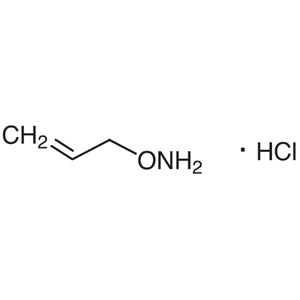
O-Allylhydroxylamine Hydrochloride is a chemical compound widely used as a building block in organic synthesis. It serves as a key reagent in laboratory settings, particularly in reactions that require high reactivity and nucleophilic participation. This compound is essential for the development of complex organic molecules, including heterocyclic compounds, pharmaceuticals, and specialty chemicals. Its unique chemical structure, featuring an allyl group attached to a hydroxylamine moiety, makes it a versatile tool in synthetic chemistry.
The compound is valued for its chemical stability under controlled conditions and its ability to act as an electron donor. These properties allow it to participate in various reaction types, such as nucleophilic substitution, hydrolysis, and other synthetic transformations. Its reactivity and functional versatility make it a preferred choice for researchers aiming to achieve high-efficiency synthesis of complex molecules. The compound's effectiveness in promoting specific chemical reactions contributes to its widespread use in both academic and industrial research environments.
In Indonesian laboratories, O-Allylhydroxylamine Hydrochloride is commonly utilized in organic chemistry research, especially in pharmaceutical and material science applications. It plays a crucial role in the development of new drugs and advanced materials. Its availability through suppliers like AMI Scientific ensures that researchers in Indonesia have access to this essential reagent for their experimental needs.
Related TCI products
- TCI B4780 85006-25-3 N,O-Bis(tert-butoxycarbonyl)hydroxylamine
- TCI B4589 39684-28-1 O-(tert-Butyl)hydroxylamine Hydrochloride
- TCI B1700 57497-39-9 N-(tert-Butyl)hydroxylamine Hydrochloride
- TCI H1581 5470-11-1 Hydroxylamine Hydrochloride
- TCI H0196 10039-54-0 Hydroxylamine Sulfate
- TCI N1013 35657-36-4 O-(4-Nitrobenzoyl)hydroxylamine
- Organic synthesis is a key application where O-Allylhydroxylamine Hydrochloride is used to create complex molecules due to its reactivity and nucleophilic properties.
- Pharmaceutical research benefits from this compound as it is involved in the synthesis of drug candidates requiring specific functional groups.
- Material science applications utilize this reagent for the development of specialty chemicals and polymers with unique properties.
- Heterocyclic compound synthesis relies on this compound to introduce nitrogen-containing rings in synthetic pathways.
- Analytical chemistry uses it as a reagent in various derivatization processes to enhance detection and identification of compounds.
| Brand | TCI |
|---|---|
| CAS number | 38945-21-0 |
| Molecular formula | — |
| Purity | — |
| Category | Chemistry > Building Blocks > Non-Heterocyclic Building Blocks |
| Pack sizes | Available in various quantities as per supplier specifications |
| Physical form | Solid or crystalline powder, depending on the batch |
| Storage | Store in a cool, dry place away from moisture and direct light |
O-Allylhydroxylamine Hydrochloride should be stored in a cool, dry environment, away from moisture and direct sunlight. It is recommended to keep the compound in a sealed container to prevent exposure to air and humidity. Due to its reactivity, it should be handled in a well-ventilated area and with appropriate personal protective equipment. Avoid contact with incompatible materials such as strong oxidizers. The compound should not be stored near heat sources or in areas with high temperature fluctuations. Proper labeling and storage conditions are essential to maintain its chemical integrity and ensure safe handling in the laboratory.
—
Produk Terkait
-
N,O-Bis(tert-butoxycarbonyl)hydroxylamine TCI B4780
Regular price From Rp 1.431.150,00Regular priceRp 1.016.400,00Sale price From Rp 1.431.150,00 -
O-(tert-Butyl)hydroxylamineHydrochloride TCI B4589
Regular price From Rp 2.650.200,00Regular priceRp 1.869.000,00Sale price From Rp 2.650.200,00 -
N-(tert-Butyl)hydroxylamineHydrochloride TCI B1700
Regular price From Rp 1.378.650,00Regular priceRp 979.650,00Sale price From Rp 1.378.650,00 -
HydroxylamineHydrochloride TCI H1581
Regular price From Rp 477.750,00Regular priceRp 333.900,00Sale price From Rp 477.750,00 -
HydroxylamineSulfate TCI H0196
Regular price From Rp 477.750,00Regular priceRp 333.900,00Sale price From Rp 477.750,00 -
O-(4-Nitrobenzoyl)hydroxylamine TCI N1013
Regular price From Rp 1.272.600,00Regular priceRp 905.100,00Sale price From Rp 1.272.600,00 -
O-(2,4-Dinitrophenyl)hydroxylamine TCI D5103
Regular price From Rp 1.458.450,00Regular priceRp 1.035.300,00Sale price From Rp 1.458.450,00 -
N-IsopropylhydroxylamineHydrochloride TCI I0877
Regular price From Rp 1.618.050,00Regular priceRp 1.146.600,00Sale price From Rp 1.618.050,00


