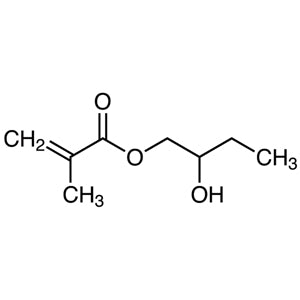
1-(Acryloyloxy)-3-(methacryloyloxy)-2-propanol (mixture of isomers) is a monomer-based chemical compound widely used in polymerization reactions to produce complex polymer structures. This material plays a crucial role in materials science laboratories, where it serves as a building block for creating polymers with tailored mechanical and chemical properties. Its versatility makes it a key component in the development of advanced materials, including thermoplastics and elastomers. Due to its reactivity and functional group compatibility, it is essential for synthesizing polymers with unique performance characteristics.
This compound is preferred for its ability to form stable cross-linked networks and its compatibility with a wide range of functional groups. The presence of both acryloyloxy and methacryloyloxy groups allows for multiple reaction sites, enhancing the material’s adaptability in polymer synthesis. Additionally, its stabilization with MEHQ ensures chemical stability under appropriate conditions, making it reliable for long-term storage and use. These properties make it a valuable reagent for researchers aiming to develop high-performance polymers.
In Indonesian laboratories, this compound is commonly used in scientific research, particularly in the development of new polymers and the modification of existing ones. Its relevance spans across disciplines such as chemistry, engineering, and materials science. It is especially useful for projects involving polymer synthesis, functionalization, and material characterization. Its application is widespread in both academic and industrial research settings in Indonesia.
TCI brochures (PDF)
- Biomaterials Research Reagents 2025-02-19 · p. 8
- Monomers 2025-05-28 · p. 3
Related TCI products
- TCI H1714 13159-51-8 2-Hydroxybutyl Methacrylate (mixture of isomers) (stabilized with MEHQ)
- TCI B2936 13048-33-4 1,6-Bis(acryloyloxy)hexane (stabilized with MEHQ)
- TCI B2935 1070-70-8 1,4-Bis(acryloyloxy)butane (stabilized with MEHQ)
- TCI M3411 126449-41-0 2-Methacryloyloxyethyl Thioctate (stabilized with MEHQ)
- TCI M3295 6613-65-6 4-[[2-(Methacryloyloxy)ethyl]dimethylammonio]butane-1-sulfonate
- TCI M3185 62723-61-9 2-[[2-(Methacryloyloxy)ethyl]dimethylammonio]acetate
- Polymer synthesis and functionalization in materials science research due to its reactivity and multiple functional groups.
- Development of thermoplastic and elastomeric materials for industrial and academic applications.
- Cross-linking agents in the creation of complex polymer networks with tailored mechanical properties.
- Modification of existing polymers to enhance their chemical and physical characteristics.
- Use in polymer characterization studies to analyze structural and functional properties of synthesized materials.
| Brand | TCI |
|---|---|
| CAS number | 1709-71-3 |
| Molecular formula | — |
| Purity | — |
| Category | Materials Science > Polymer/Macromolecule Reagents > Monomers |
| Pack sizes | Available in various quantities as per standard laboratory reagent packaging |
| Physical form | Liquid |
| Storage | Store in a cool, dark place away from light and heat |
This material should be stored in a cool, dark place, away from light and heat, to maintain its stability. It is recommended to use airtight containers made of glass or high-density polyethylene to prevent contamination and evaporation. Due to its chemical reactivity, it should be handled with appropriate personal protective equipment, including gloves and safety goggles. Avoid exposure to moisture and ensure proper ventilation in the workspace. The material should not be stored near incompatible substances such as strong oxidizers or acids. Regular inspection of storage conditions is advised to ensure the integrity of the compound.
—
Product Categories
Produk Terkait
-
2-HydroxybutylMethacrylate(mixtureofisomers)(stabilizedwithMEHQ) TCI H1714
Regular price From Rp 743.400,00Regular priceRp 519.750,00Sale price From Rp 743.400,00 -
1,6-Bis(acryloyloxy)hexane(stabilizedwithMEHQ) TCI B2936
Regular price From Rp 557.550,00Regular priceRp 405.300,00Sale price From Rp 557.550,00 -
1,4-Bis(acryloyloxy)butane(stabilizedwithMEHQ) TCI B2935
Regular price Rp 637.350,00Regular priceRp 445.200,00Sale price Rp 637.350,00 -
2-MethacryloyloxyethylThioctate(stabilizedwithMEHQ) TCI M3411
Regular price From Rp 4.373.250,00Regular priceRp 3.073.350,00Sale price From Rp 4.373.250,00 -
4-[[2-(Methacryloyloxy)ethyl]dimethylammonio]butane-1-sulfonate TCI M3295
Regular price Rp 4.108.650,00Regular priceRp 2.888.550,00Sale price Rp 4.108.650,00 -
2-[[2-(Methacryloyloxy)ethyl]dimethylammonio]acetate TCI M3185
Regular price From Rp 2.702.700,00Regular priceRp 1.905.750,00Sale price From Rp 2.702.700,00 -
3-[[2-(Methacryloyloxy)ethyl]dimethylammonio]propionate TCI M2359
Regular price From Rp 2.969.400,00Regular priceRp 2.091.600,00Sale price From Rp 2.969.400,00 -
3-[[2-(Methacryloyloxy)ethyl]dimethylammonio]propane-1-sulfonate TCI M1971
Regular price From Rp 900.900,00Regular priceRp 645.750,00Sale price From Rp 900.900,00