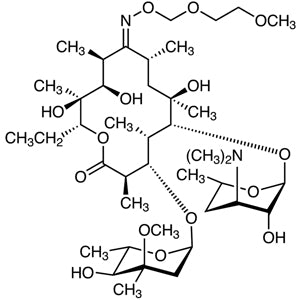
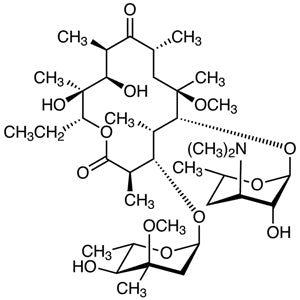
Azithromycin Dihydrate is a chemical compound classified under the category of macrolide antibiotics. It plays a crucial role in laboratory settings, particularly in microbiology and pharmacology research. This compound is widely used for testing the effectiveness of antibiotics against various bacterial strains and for determining bacterial sensitivity to different drugs. Its importance lies in its ability to inhibit bacterial growth, making it an essential tool for researchers studying antimicrobial resistance and infection control.
Azithromycin Dihydrate is chemically stable and soluble in organic solvents such as ethanol and acetone, which makes it highly versatile for use in chemical and biochemical analyses. These properties contribute to its reliability in laboratory procedures, ensuring consistent results across different experiments. Additionally, its resistance to extreme environmental conditions allows for long-term storage and use without significant degradation, enhancing its practicality in research environments.
In Indonesian laboratories, Azithromycin Dihydrate is commonly utilized in public health-related research, such as evaluating the efficacy of antibiotics against pathogens causing infectious diseases. It is also a preferred choice for studying antibiotic resistance patterns and developing new treatment strategies. Its availability and reliability make it a staple in both academic and industrial research settings across the country.
TCI brochures (PDF)
- Antimicrobials and Antitumor Agents for Research and Experimental Use 2025-04-24 · p. 4
- Pharmaceutical Ingredients for Research and Experimental Use 2026-03-09 · p. 4
- Microbial Sensitivity Testing: This compound is ideal for assessing how effectively antibiotics inhibit bacterial growth, aiding in the identification of resistant strains.
- Antibiotic Efficacy Evaluation: It is used to test the potency of antibiotics against specific bacterial infections, supporting drug development and clinical research.
- Infection Control Research: Azithromycin Dihydrate helps in studying the impact of antibiotics on infectious disease pathogens, contributing to public health strategies.
- Pharmacological Studies: It is employed in experiments to understand the mechanism of action and therapeutic potential of macrolide antibiotics.
- Environmental Microbiology: It assists in analyzing bacterial populations in various environmental samples, supporting ecological and bioremediation research.
| Brand | TCI |
|---|---|
| CAS number | 117772-70-0 |
| Molecular formula | — |
| Purity | — |
| Category | Life Science > Biochemicals and Reagents > Antibiotics |
| Pack sizes | Available in various quantities as per supplier specifications |
| Physical form | Powder |
| Storage | Store in a cool, dry place away from moisture and direct sunlight |
Azithromycin Dihydrate should be stored in a cool, dry place, away from moisture and direct sunlight to maintain its chemical stability. It is recommended to use airtight containers to prevent exposure to humidity and contaminants. Since it is a powder, it should be handled with care to avoid inhalation or contact with skin. Proper labeling of containers is essential for safe handling and to prevent cross-contamination. In laboratory settings, it is important to follow standard safety protocols, including the use of personal protective equipment when handling and storing this compound. Regular monitoring of storage conditions ensures the compound remains effective for research purposes.
—
Product Categories
- Biochemicals and ReagentsAntibioticsAntibiotics (Chemical Structure Class)
- Biochemicals and ReagentsPharmaceutical Research Reagents (for Experimental Use)Antimicrobial Ingredients (for Research and Experimental Use)
- MicrobiologyAntibioticsAntibiotics (Chemical Structure Class)
- Pharmaceutical Development and Drug Discovery ResearchPharmaceutical Research Reagents (for Experimental Use)Antimicrobial Ingredients (for Research and Experimental Use)
- Pharmaceutical Development and Drug Discovery ResearchAntibioticsAntibiotics (Chemical Structure Class)
Produk Terkait
-
Roxithromycin TCI R0164
Regular price From Rp 1.776.600,00Regular priceRp 1.257.900,00Sale price From Rp 1.776.600,00 -
Dirithromycin TCI D5495
Regular price Rp 5.352.900,00Regular priceRp 3.759.000,00Sale price Rp 5.352.900,00 -
Clarithromycin TCI C2220
Regular price From Rp 1.563.450,00Regular priceRp 1.108.800,00Sale price From Rp 1.563.450,00 -
Erythromycin TCI E0751
Regular price From Rp 1.696.800,00Regular priceRp 1.202.250,00Sale price From Rp 1.696.800,00 -
4-AminosalicylicAcid TCI A0420
Regular price From Rp 822.150,00Regular priceRp 590.100,00Sale price From Rp 822.150,00 -
Sodium4-AminosalicylateDihydrate TCI A0423
Regular price From Rp 928.200,00Regular priceRp 664.650,00Sale price From Rp 928.200,00 -
Wortmannin TCI W0007
Regular price Rp 11.632.950,00Regular priceRp 8.150.100,00Sale price Rp 11.632.950,00 -
ValganciclovirHydrochloride TCI V0158
Regular price From Rp 1.618.050,00Regular priceRp 1.146.600,00Sale price From Rp 1.618.050,00