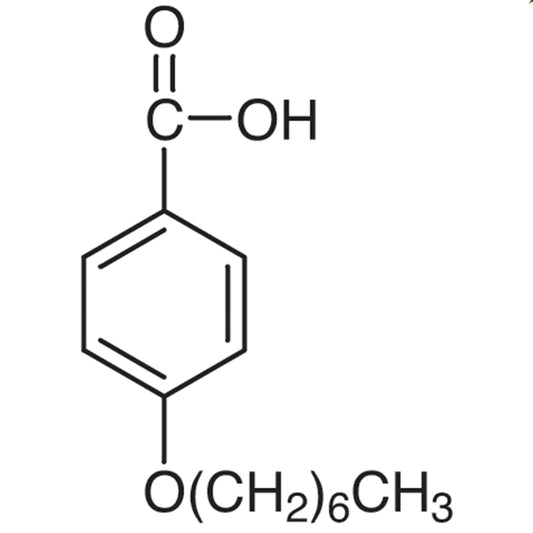
4-(trans-4-Amylcyclohexyl)benzoic Acid is a specialized chemical compound used in materials science research, particularly in the development of materials with unique properties such as liquid crystals. This compound plays a key role in the study of molecular structures and the physical properties of complex substances. In the laboratory, it serves as a building block for creating materials with specific orientations, which is essential for advanced technological applications. Its presence enables researchers to manipulate molecular alignment, making it a critical component in the design of functional materials.
The compound's complex molecular structure, featuring a long hydrocarbon chain and a cyclic system, contributes to its unique chemical behavior. These properties allow it to interact effectively with various chemical environments, making it a preferred choice for precise molecular control. Its stability and predictable performance under different experimental conditions further enhance its utility in research settings. These characteristics make it an ideal material for studies requiring controlled molecular orientation and structural integrity.
In Indonesian laboratories, this compound is widely used by researchers in universities and research institutions. It supports investigations in materials science, particularly in the development of liquid crystal-based technologies. Its relevance extends to projects involving display technologies, optical sensors, and other advanced material applications. The compound's versatility and reliability make it an essential tool for scientific innovation in the region.
Related TCI products
- TCI B5318 83626-35-1 4-(trans-4-Butylcyclohexyl)benzoic Acid
- TCI E1253 87592-41-4 4-(trans-4-Ethylcyclohexyl)benzoic Acid
- TCI A1827 82575-69-7 4-(trans-4-Amylcyclohexyl)phenol
- TCI B1585 115595-27-2 4-(3-Butenyloxy)benzoic Acid
- TCI A3322 83883-26-5 4-[[6-(Acryloyloxy)hexyl]oxy]benzoic Acid
- TCI H1629 83883-25-4 4-(6-Hydroxyhexyloxy)benzoic Acid
- Liquid Crystal Research – This compound is ideal for studying molecular orientation and phase behavior in liquid crystal systems due to its complex structure and predictable properties.
- Material Development – It serves as a building block for creating advanced materials with specific structural and functional characteristics, supporting innovation in nanotechnology and polymer science.
- Optical Sensor Design – Its unique molecular interactions make it suitable for developing sensors that respond to environmental changes with high sensitivity and accuracy.
- Structural Chemistry Studies – Researchers use it to investigate the physical and chemical properties of complex molecules, aiding in the understanding of molecular behavior under various conditions.
- Display Technology Research – It plays a key role in the development of next-generation display technologies, where precise molecular alignment is essential for optimal performance.
| Brand | TCI |
|---|---|
| CAS number | 65355-30-8 |
| Molecular formula | — |
| Purity | — |
| Category | Materials Science > Material Building Blocks > Liquid Crystal (LC) Building Blocks |
| Pack sizes | Available in various quantities as per standard laboratory supply |
| Physical form | Liquid |
| Storage | Store in a cool, dry place away from direct sunlight |
This compound should be stored in a cool, dry environment, away from direct sunlight and sources of heat. It is recommended to use sealed containers made of glass or high-density polyethylene to prevent contamination and maintain purity. Due to its chemical nature, it should be handled with appropriate personal protective equipment, including gloves and safety goggles. Storage conditions should ensure that the compound remains stable and retains its intended properties for use in research applications. Proper labeling and safe storage practices are essential to prevent accidental exposure and ensure laboratory safety.
—
Produk Terkait
-
4-(trans-4-Butylcyclohexyl)benzoicAcid TCI B5318
Regular price Rp 1.298.850,00Regular priceRp 924.000,00Sale price Rp 1.298.850,00 -
4-(trans-4-Ethylcyclohexyl)benzoicAcid TCI E1253
Regular price Rp 1.378.650,00Regular priceRp 979.650,00Sale price Rp 1.378.650,00 -
4-(trans-4-Amylcyclohexyl)phenol TCI A1827
Regular price Rp 1.087.800,00Regular priceRp 775.950,00Sale price Rp 1.087.800,00 -
4-(3-Butenyloxy)benzoicAcid TCI B1585
Regular price Rp 5.750.850,00Regular priceRp 4.037.250,00Sale price Rp 5.750.850,00 -
4-[[6-(Acryloyloxy)hexyl]oxy]benzoicAcid TCI A3322
Regular price From Rp 928.200,00Regular priceRp 664.650,00Sale price From Rp 928.200,00 -
4-(6-Hydroxyhexyloxy)benzoicAcid TCI H1629
Regular price From Rp 1.590.750,00Regular priceRp 1.127.700,00Sale price From Rp 1.590.750,00 -
4-(4-Hydroxyphenoxy)benzoicAcid TCI H0642
Regular price From Rp 3.763.200,00Regular priceRp 2.647.050,00Sale price From Rp 3.763.200,00 -
4-(Heptyloxy)benzoicAcid TCI H0248
Regular price From Rp 2.068.500,00Regular priceRp 1.461.600,00Sale price From Rp 2.068.500,00