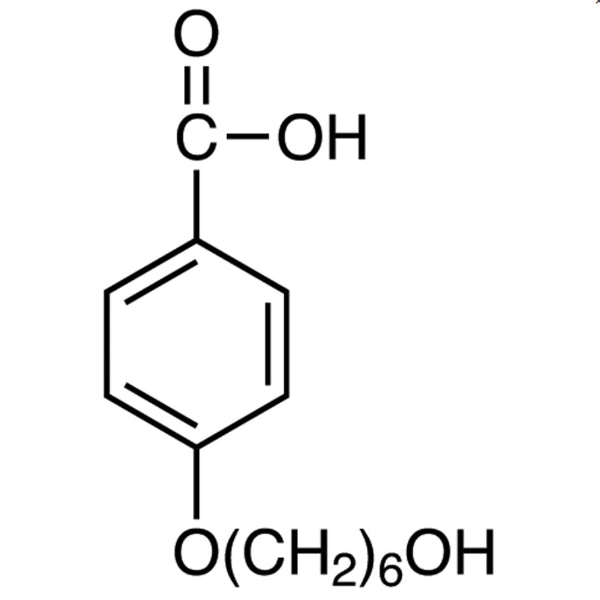
4-(6-Hydroxyhexyloxy)benzoic Acid is a chemical compound widely used in scientific material research, particularly in the development of liquid crystal-based materials. This compound plays a crucial role in laboratories where researchers are focused on creating advanced materials with specific optical and thermal properties. Its unique molecular structure allows it to act as a building block for synthesizing complex compounds, making it an essential tool for material scientists. Due to its versatility, it is frequently utilized in both academic and industrial research settings to explore new material properties and applications.
The compound is favored for its high reactivity and ability to form stable chemical bonds, which are critical in the synthesis of functional materials. Its solubility in organic solvents further enhances its usability in laboratory processes, enabling efficient manipulation and integration into various material systems. These properties make it a preferred choice for researchers aiming to achieve precise molecular structures and functional performance in their experiments. Additionally, its chemical stability under controlled conditions supports consistent results in repeated experiments.
In Indonesian laboratories, 4-(6-Hydroxyhexyloxy)benzoic Acid is commonly used in applied research within the field of material technology. It supports the development of materials for liquid crystal displays and optical applications, contributing to advancements in display technology and optical devices. It is also utilized in academic research at universities and research institutions to drive innovation in material science and related disciplines.
Related TCI products
- TCI B5318 83626-35-1 4-(trans-4-Butylcyclohexyl)benzoic Acid
- TCI B1585 115595-27-2 4-(3-Butenyloxy)benzoic Acid
- TCI A3322 83883-26-5 4-[[6-(Acryloyloxy)hexyl]oxy]benzoic Acid
- TCI A2593 65355-30-8 4-(trans-4-Amylcyclohexyl)benzoic Acid
- TCI H0642 500-76-5 4-(4-Hydroxyphenoxy)benzoic Acid
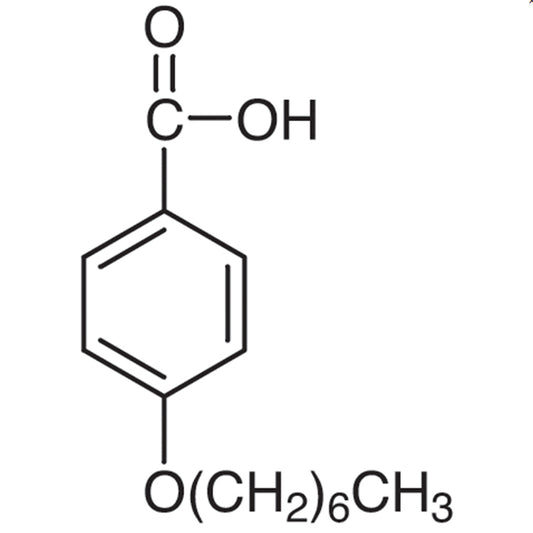
- TCI H0248 15872-42-1 4-(Heptyloxy)benzoic Acid
- Liquid Crystal Display (LCD) Development: This compound is ideal for creating materials with specific optical and thermal properties required for advanced LCD technologies.
- Optical Material Synthesis: Its reactivity and solubility make it suitable for synthesizing compounds used in optical applications such as lenses and filters.
- Molecular Structure Research: The compound's complex structure is valuable for studying molecular interactions and material behavior in controlled environments.
- Academic Research Projects: It supports in-depth studies on material properties and is frequently used in university laboratories for experimental research.
- Industrial Material Innovation: Its role as a building block enables the development of new materials with tailored properties for various industrial applications.
| Brand | TCI |
|---|---|
| CAS number | 83883-25-4 |
| Molecular formula | — |
| Purity | — |
| Category | Materials Science > Material Building Blocks > Liquid Crystal (LC) Building Blocks |
| Pack sizes | — |
| Physical form | — |
| Storage | Store in a cool, dry place away from direct sunlight |
This compound should be stored in a cool, dry environment, away from direct sunlight and sources of heat. It is recommended to use airtight containers to prevent exposure to moisture and air, which could affect its chemical stability. Due to its reactivity, it should be handled with appropriate personal protective equipment, such as gloves and safety goggles, to ensure laboratory safety. Proper ventilation is also essential when working with this compound to minimize inhalation risks. It should not be stored near incompatible materials, such as strong oxidizers or acids, to prevent unwanted chemical reactions. Regular monitoring of storage conditions is advised to maintain the compound's integrity and ensure safe usage in laboratory settings.
—
Produk Terkait
-
4-(trans-4-Butylcyclohexyl)benzoicAcid TCI B5318
Regular price Rp 1.246.350,00Regular price -
4-(3-Butenyloxy)benzoicAcid TCI B1585
Regular price Rp 5.698.350,00Regular price -
4-[[6-(Acryloyloxy)hexyl]oxy]benzoicAcid TCI A3322
Regular price From Rp 875.700,00Regular price -
4-(trans-4-Amylcyclohexyl)benzoicAcid TCI A2593
Regular price From Rp 1.035.300,00Regular price -
4-(4-Hydroxyphenoxy)benzoicAcid TCI H0642
Regular price From Rp 3.710.700,00Regular price -
4-(Heptyloxy)benzoicAcid TCI H0248
Regular price From Rp 2.016.000,00Regular price -
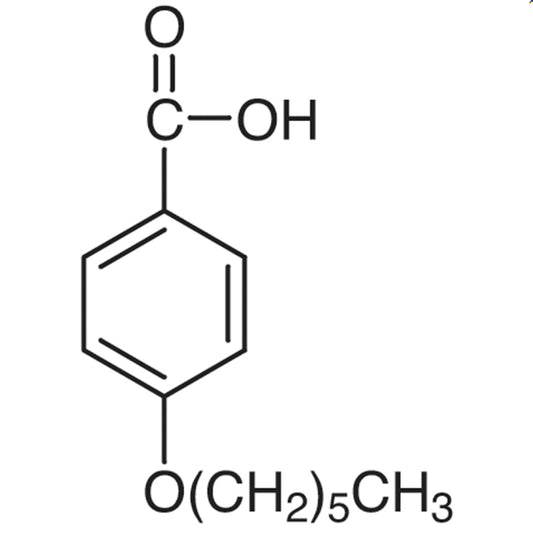
4-(Hexyloxy)benzoicAcid TCI H0247
Regular price From Rp 610.050,00Regular price -
4-(trans-4-Ethylcyclohexyl)benzoicAcid TCI E1253
Regular price Rp 1.326.150,00Regular price


![83883-26-5 4-[[6-(Acryloyloxy)hexyl]oxy]benzoic Acid - AMI Scientific](http://amiscientific.com/cdn/shop/files/TCI2510A3322.jpg?v=1768358883&width=533)