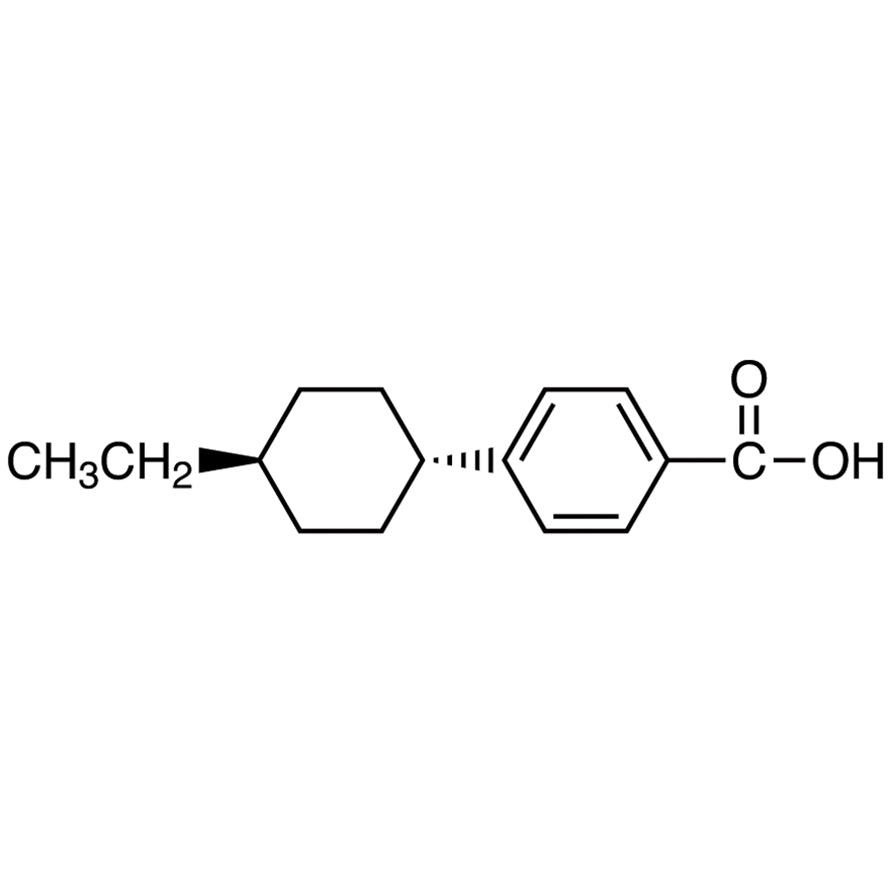
4-(trans-4-Ethylcyclohexyl)benzoic Acid is a chemical compound widely used in scientific research, particularly in the field of material science. This compound plays a crucial role in the development of advanced materials with specific optical and electronic properties. It is commonly found in studies related to liquid crystals, which are molecular structures that exhibit unique characteristics between solid and liquid states. In laboratory settings, this compound serves as a foundational element for creating materials with precise molecular structures and functional properties.
The compound is valued for its complex molecular structure and its ability to form stable crystalline structures. These properties make it an ideal choice for applications requiring precise molecular control. Its chemical stability allows it to be used in a variety of laboratory conditions, ensuring consistent results across different experiments. This reliability is essential for researchers aiming to develop new materials with specific performance criteria.
In Indonesian laboratories, 4-(trans-4-Ethylcyclohexyl)benzoic Acid is utilized in applied research across various disciplines, including organic chemistry, physics, and materials technology. It is a key component in the development of innovative materials with applications in modern industries. Many research institutions and universities in Indonesia rely on this compound to advance their studies and contribute to technological progress.
Related TCI products
- TCI B5318 83626-35-1 4-(trans-4-Butylcyclohexyl)benzoic Acid
- TCI A2593 65355-30-8 4-(trans-4-Amylcyclohexyl)benzoic Acid
- TCI E1252 89100-78-7 4-(trans-4-Ethylcyclohexyl)phenol
- TCI B1585 115595-27-2 4-(3-Butenyloxy)benzoic Acid
- TCI A3322 83883-26-5 4-[[6-(Acryloyloxy)hexyl]oxy]benzoic Acid
- TCI H1629 83883-25-4 4-(6-Hydroxyhexyloxy)benzoic Acid
- Liquid Crystal Research – This compound is ideal for studying liquid crystal phases due to its molecular structure that facilitates the formation of ordered, anisotropic materials.
- Organic Synthesis – Its complex structure makes it a valuable intermediate in the synthesis of other organic compounds with specific functional groups.
- Material Development – It is used to create materials with tailored optical and electronic properties, essential for advanced technological applications.
- Structural Analysis – Its stable crystalline form allows for detailed characterization using techniques such as X-ray diffraction and spectroscopy.
- Educational Research – It is commonly used in academic settings to teach and demonstrate molecular structure and material behavior.
| Brand | TCI |
|---|---|
| CAS number | 87592-41-4 |
| Molecular formula | — |
| Purity | — |
| Category | Materials Science > Material Building Blocks > Liquid Crystal (LC) Building Blocks |
| Pack sizes | — |
| Physical form | — |
| Storage | Store in a cool, dry place away from direct sunlight |
This compound should be stored in a cool, dry environment, away from direct sunlight and sources of heat. It is recommended to use airtight containers to prevent moisture absorption and contamination. Due to its chemical stability, it does not require refrigeration under normal laboratory conditions. However, it is important to ensure that the storage area is well-ventilated to avoid the accumulation of harmful vapors. Always handle the compound with appropriate personal protective equipment, such as gloves and safety goggles, to ensure laboratory safety. Proper labeling of containers is essential to prevent accidental exposure and ensure safe handling procedures are followed.
—
Produk Terkait
-
4-(trans-4-Butylcyclohexyl)benzoicAcid TCI B5318
Regular price Rp 1.246.350,00Regular price -
4-(trans-4-Amylcyclohexyl)benzoicAcid TCI A2593
Regular price From Rp 1.035.300,00Regular price -
4-(trans-4-Ethylcyclohexyl)phenol TCI E1252
Regular price Rp 1.961.400,00Regular price -
4-(3-Butenyloxy)benzoicAcid TCI B1585
Regular price Rp 5.698.350,00Regular price -
4-[[6-(Acryloyloxy)hexyl]oxy]benzoicAcid TCI A3322
Regular price From Rp 875.700,00Regular price -
4-(6-Hydroxyhexyloxy)benzoicAcid TCI H1629
Regular price From Rp 1.538.250,00Regular price -
4-(4-Hydroxyphenoxy)benzoicAcid TCI H0642
Regular price From Rp 3.710.700,00Regular price -
4-(Heptyloxy)benzoicAcid TCI H0248
Regular price From Rp 2.016.000,00Regular price


![83883-26-5 4-[[6-(Acryloyloxy)hexyl]oxy]benzoic Acid - AMI Scientific](http://amiscientific.com/cdn/shop/files/TCI2510A3322.jpg?v=1768358883&width=533)