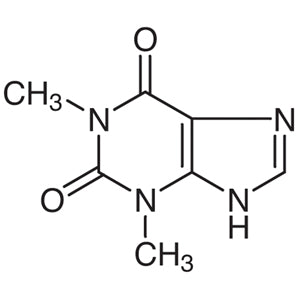
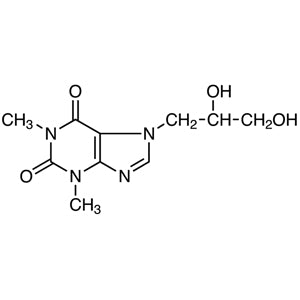
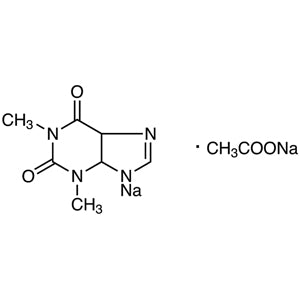
Aminophylline is a chemical compound widely used in various laboratory experiments, particularly in the fields of bio-pharmaceuticals and chemical analysis. As an alkaloid, it exhibits significant pharmacological activity, especially in respiratory system regulation. This compound is commonly used as a raw material for the synthesis of other compounds or as a reagent in qualitative and quantitative tests. In the laboratory, Aminophylline plays a crucial role in research related to pharmaceuticals and their pharmacological effects. Its chemical stability under certain conditions allows for relatively easy storage over a specific period, making it a reliable choice for many laboratory applications.
Aminophylline is known for its favorable chemical properties that make it a preferred choice in laboratory settings. It is soluble in organic solvents such as ethyl acetate and ethanol, but it is not soluble in water. This solubility profile facilitates separation and purification processes in chemical analysis. Additionally, Aminophylline demonstrates good reactivity with various chemical reagents, making it suitable for a wide range of chemical reactions and laboratory tests. These characteristics contribute to its versatility and effectiveness in different experimental setups.
In Indonesian laboratories, Aminophylline is used in various research areas related to pharmacology, pharmacokinetics, and chemical analysis. Its role in studying the effects of drugs and their interactions with biological systems is essential for advancing scientific understanding. The compound is also utilized in the development of new pharmaceutical products, supporting both academic and industrial research efforts in the country.
TCI brochures (PDF)
- Alkaloids 2025-10-10 · p. 7
- Nucleosides, Nucleotides, Nucleic Acids and Related Reagents 2026-03-23 · p. 10
- Pharmaceutical Ingredients for Research and Experimental Use 2026-03-09 · p. 42
- Pharmacological research involving respiratory system modulation benefits from Aminophylline’s known bronchodilatory effects.
- Pharmacokinetic studies often use Aminophylline to evaluate drug absorption, distribution, metabolism, and excretion.
- Chemical analysis applications rely on its solubility in organic solvents for chromatographic and spectroscopic techniques.
- Qualitative and quantitative assays benefit from its reactivity with various reagents, enabling accurate detection and measurement.
- Drug development projects utilize Aminophylline as a model compound for studying therapeutic effects and potential side effects.
| Brand | TCI |
|---|---|
| CAS number | 317-34-0 |
| Molecular formula | — |
| Purity | — |
| Category | Life Science > Biochemicals and Reagents > Alkaloids |
| Pack sizes | Available in standard laboratory quantities as per supplier specifications |
| Physical form | Solid powder |
| Storage | Store in a cool, dry place away from light and moisture |
Aminophylline should be stored in a cool, dry place, away from direct light and moisture to maintain its chemical stability. It is recommended to use airtight containers made of glass or high-density polyethylene to prevent contamination and degradation. Due to its solubility in organic solvents, it is important to handle the compound in a well-ventilated area to avoid inhalation of vapors. Laboratory personnel should wear appropriate personal protective equipment, such as gloves and safety goggles, when handling Aminophylline. Proper labeling of containers is essential to ensure safe handling and prevent accidental exposure. The compound should be kept out of reach of children and not stored near incompatible materials to ensure safety in the laboratory environment.
—
Product Categories
- Biochemicals and ReagentsAlkaloidsPurine Alkaloids
- Biochemicals and ReagentsNucleosides, Nucleotides, OligonucleotidesNucleobases and their Analogs
- Biochemicals and ReagentsPharmaceutical Research Reagents (for Experimental Use)Pharmaceutical Research Reagents (Others)
- Biochemicals and Reagents
- Pharmaceutical Development and Drug Discovery ResearchPharmaceutical Research Reagents (for Experimental Use)Pharmaceutical Research Reagents (Others)
Produk Terkait
-
Theophylline TCI T0179
Regular price From Rp 557.550,00Regular priceRp 405.300,00Sale price From Rp 557.550,00 -
7-(2,3-Dihydroxypropyl)theophylline TCI D3600
Regular price Rp 1.060.500,00Regular priceRp 757.050,00Sale price Rp 1.060.500,00 -
Theophyllol TCI T0180
Regular price Rp 2.147.250,00Regular priceRp 1.517.250,00Sale price Rp 2.147.250,00 -
Dimenhydrinate TCI D6336
Regular price From Rp 1.881.600,00Regular priceRp 1.331.400,00Sale price From Rp 1.881.600,00 -
Theophylline-7-aceticAcid TCI T2941
Regular price Rp 1.087.800,00Regular priceRp 775.950,00Sale price Rp 1.087.800,00 -
8-Bromotheophylline TCI B3456
Regular price From Rp 3.419.850,00Regular priceRp 2.406.600,00Sale price From Rp 3.419.850,00 -
8-Chlorotheophylline TCI C0293
Regular price From Rp 1.510.950,00Regular priceRp 1.072.050,00Sale price From Rp 1.510.950,00 -
L-Adrenaline TCI A0173
Regular price Rp 1.351.350,00Regular priceRp 960.750,00Sale price Rp 1.351.350,00