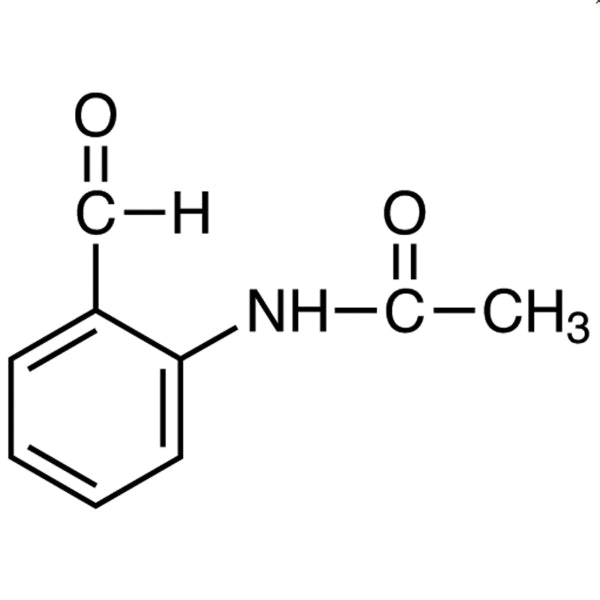
2-Acetamidobenzaldehyde is a chemical compound widely used in organic reactions for the synthesis of complex molecules. It serves as a fundamental building block in various laboratory processes, particularly in substitution and condensation reactions. This compound is commonly found in chemical laboratories as a key reagent for the development of new compounds and the modification of existing ones. Its versatility makes it an essential tool for researchers and students working in organic chemistry.
The compound’s structure consists of an aromatic ring with an amide group and an aldehyde group, which contribute to its high reactivity. These functional groups allow it to participate in a wide range of chemical reactions, including nucleophilic and condensation reactions. Its polar nature enables it to dissolve in organic solvents such as ethyl acetate and ethanol, making it suitable for various synthetic procedures. The presence of both amide and aldehyde functionalities provides flexibility in chemical transformations, enhancing its utility in laboratory settings.
In Indonesian laboratories, 2-Acetamidobenzaldehyde is frequently used by researchers and students for the synthesis of aromatic compounds and their derivatives. It is particularly relevant in academic programs related to chemistry, pharmacy, and food technology, where its applications span from drug development to the modification of chemical compounds. Its role in experimental synthesis makes it a valuable resource for both educational and research purposes.
- Organic Synthesis: 2-Acetamidobenzaldehyde is ideal for organic synthesis due to its reactive functional groups and ability to participate in condensation and substitution reactions.
- Drug Development: Its structural versatility makes it a valuable reagent in the synthesis of pharmaceutical compounds and drug derivatives.
- Chemical Modification: The compound’s amide and aldehyde groups allow for flexible chemical modifications, making it suitable for compound development.
- Educational Research: It is commonly used in academic settings for teaching and research in organic chemistry and related fields.
- Analytical Chemistry: Its reactivity and solubility properties make it useful in analytical procedures and compound characterization.
| Brand | TCI |
|---|---|
| CAS number | 13493-47-5 |
| Molecular formula | — |
| Purity | — |
| Category | Chemistry > Building Blocks > Non-Heterocyclic Building Blocks |
| Pack sizes | Available in various quantities as per standard laboratory requirements |
| Physical form | Solid |
| Storage | Store in a cool, dry place away from direct sunlight |
2-Acetamidobenzaldehyde should be stored in a cool, dry place, away from direct sunlight and sources of heat. It is recommended to keep the compound in a sealed container to prevent moisture absorption. Due to its polar nature, it is best stored in glass or polyethylene containers that are resistant to chemical reactions. Laboratory personnel should handle the compound with appropriate personal protective equipment, such as gloves and safety goggles, to ensure safety. It should not be exposed to strong oxidizing agents or incompatible materials. Proper ventilation is advised when handling the compound to minimize inhalation risks. Always follow standard laboratory safety protocols when working with reactive chemicals.
—
Produk Terkait
-
4-Acetamidobenzaldehyde TCI A0009
Regular price From Rp 637.350,00Regular price -
4-Acetamidobenzenesulfonamide TCI A0115
Regular price From Rp 1.273.650,00Regular price -
Methyl2-Acetamidobenzoate TCI M2087
Regular price Rp 1.829.100,00Regular price -
2-Hydroxy-5-iodobenzaldehyde TCI I1175
Regular price From Rp 903.000,00Regular price -
4-Iodobenzaldehyde TCI I0612
Regular price From Rp 1.431.150,00Regular price -
3-Iodobenzaldehyde TCI I0611
Regular price From Rp 3.419.850,00Regular price -
2-Iodobenzaldehyde TCI I0610
Regular price From Rp 2.491.650,00Regular price -
4-Hydroxy-3-iodobenzaldehyde TCI H1960
Regular price From Rp 1.087.800,00Regular price